If you’re wondering what you can put in a septic tank to break down solids, here’s the honest answer up front: the best thing is already in there. Your tank is full of anaerobic bacteria that arrived the natural way — through ordinary human waste — and they work around the clock breaking down the organic solids you send them. No packet, powder, or pantry ingredient replaces that living colony, and nothing you pour down the drain eliminates the need to pump the tank when sludge and scum build up.
That probably sounds anticlimactic if you’ve seen ads promising a miracle additive that “dissolves sludge” or a neighbor swearing by flushing yeast down the toilet. But understanding why the answer is boring is exactly what saves you money — and keeps your system healthy for decades. This guide covers where your tank’s bacteria come from, why the popular DIY remedies (yeast, baking soda, milk, and the rest) don’t do what people claim, what enzyme and bacterial products can and can’t do, the daily habits that genuinely speed up solids breakdown, and the moment when pumping is the only answer.
If you’re mostly curious about commercial treatments, we already covered the full landscape — claims, honest limits, and which product types are worth avoiding — in our article on whether septic tank additives really work. This article is about something more practical: the solids themselves, what breaks them down, and what you can actually do about it.
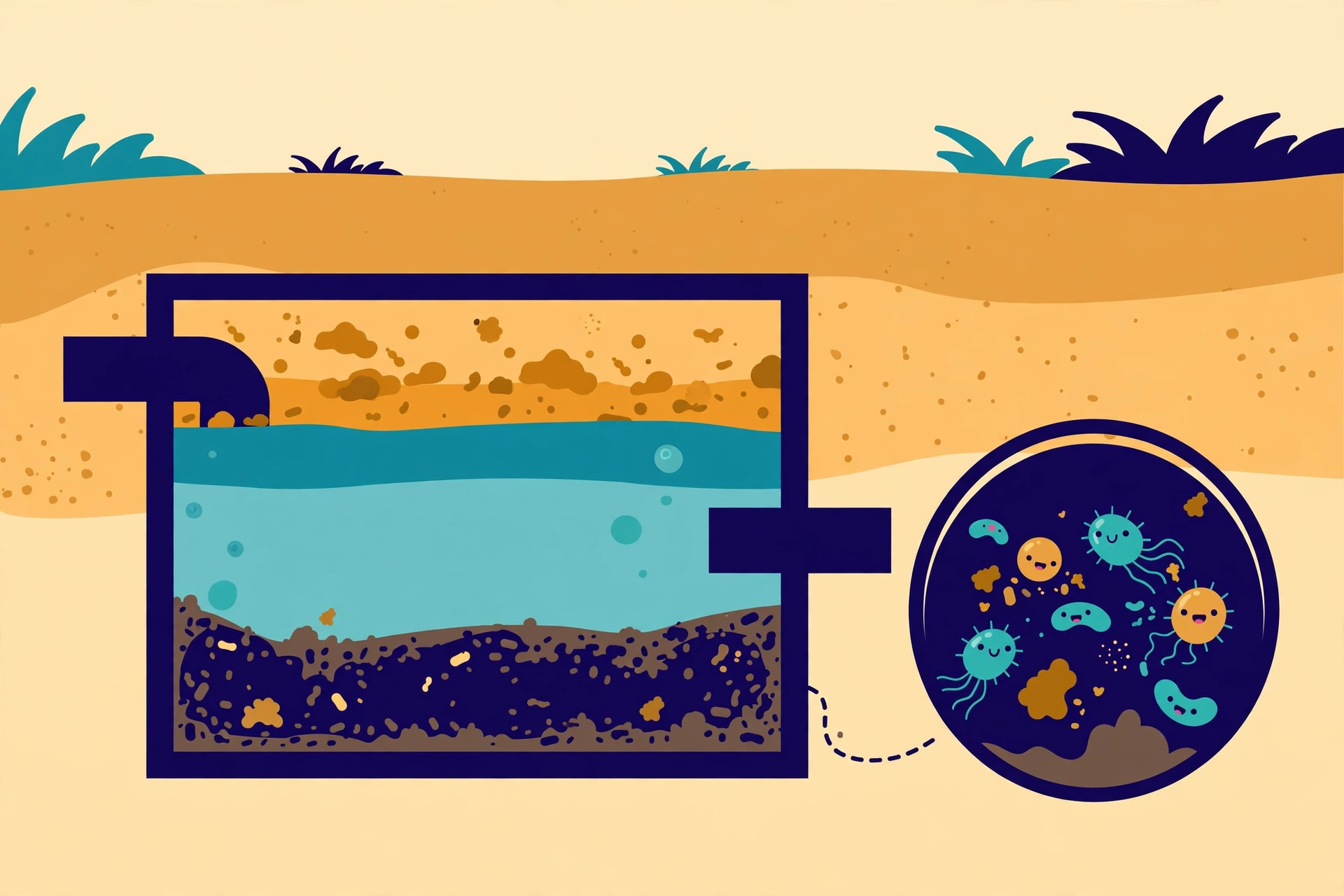
Why Solids Need Bacteria (And Where Your Bacteria Come From)
A septic tank does two jobs, and bacteria only handle one of them. The first job is physical: wastewater slows down inside the tank, heavy solids sink to the bottom and form the sludge layer, grease and oils float to the top and form the scum layer, and the clearer water in the middle — the effluent — flows out to the drain field. The second job is biological: anaerobic bacteria (the kind that thrive without oxygen) eat the organic matter in the sludge and scum layers, digesting it down over time. Bacteria reduce the volume of organic solids. They do not make solids vanish entirely.
Here’s the part most people miss: you don’t need to supply those bacteria. They come free with every flush. Human waste naturally contains the microorganisms a septic system needs — this is how the system was designed to work. As soon as regular toilet waste enters the tank, the bacterial colony establishes itself. A freshly pumped tank reseeds itself the same way; there’s no “starter” step required, despite what a lot of well-meaning advice suggests.
The colony is self-sustaining under normal household use. What it can’t do is digest everything. Two things accumulate no matter how healthy your bacteria are:
- Inorganic solids — anything that isn’t organic can’t be digested at all: plastics, synthetic fibers, wipes, feminine products, cigarette butts. Every one of these adds directly to the sludge or scum layer.
- The undigestible fraction of organic waste — bacteria are efficient, not magic. Some organic material digests very slowly, and a residue always remains. Over months and years, that residue builds up.
That slow accumulation is why pumping exists. The bacteria are doing their job — they just can’t outpace everything a household sends them. So when someone asks what to put in the tank to break down solids faster, the most honest framing is this: the bacteria are already there, the solids that can be digested already are being digested, and your real leverage is (a) what you send into the tank, (b) the conditions the bacteria work under, and (c) pumping on schedule.
Yeast, Baking Soda, and Other DIY Myths — Busted Honestly
The internet loves pantry remedies for septic tanks. Most of them fall apart on a single question: at what scale? Your tank holds a thousand gallons or more. A kitchen-shelf remedy is a drop in that ocean.
Flushing yeast
The most common tip: flush a packet (or a pound) of active dry yeast down the toilet to “boost” digestion. The problem is that yeast is a fungus, not a bacterium — it’s a fermentation organism, and it produces the wrong enzymes for septic digestion. The trillions of anaerobic bacteria already in your tank outnumber a yeast packet’s cells by orders of magnitude, and most yeast die off within a day or two in the tank’s oxygen-free environment. Worse, activating yeast produces a frothing action that can disturb the tank’s settling layers — the very separation process the system depends on. So yeast isn’t neutral; it can actively interfere while helping nothing.
Baking soda
The theory is that baking soda adjusts pH or helps solids clump and settle. In practice, a tablespoon or two flushed occasionally is chemically insignificant in a thousand-gallon tank — it does nothing harmful, but nothing helpful either. Large, repeated doses are the actual risk: baking soda is sodium bicarbonate, and enough of it shifts pH outside the range your bacteria prefer and adds sodium that can affect the soil structure around the drain field. The myth likely started because baking soda neutralizes odors in a drain pipe — which is real, but a drain pipe and a 1,000-gallon tank are completely different scales and chemistries.
Milk, buttermilk, and yogurt
These contain live cultures, which sounds promising — but again, scale defeats them. The amount of buttermilk or yogurt you’d need to meaningfully supplement a tank’s bacterial population is enormous (think jugs, not cups). And whole milk is actively harmful: its biochemical oxygen demand is hundreds of times higher than normal wastewater, so it can overwhelm the system and stress the drain field. Dairy products belong in the fridge, not the septic tank.
“Seeding” a new or freshly pumped tank
Related to all of the above: some advice says to dump yeast, manure, or other material into a new or recently pumped system to give bacteria a “head start.” Completely unnecessary. The first flushes of ordinary waste reintroduce everything the colony needs. University extension programs are blunt on this point: by design, an onsite wastewater system doesn’t need human assistance to start its biological process.
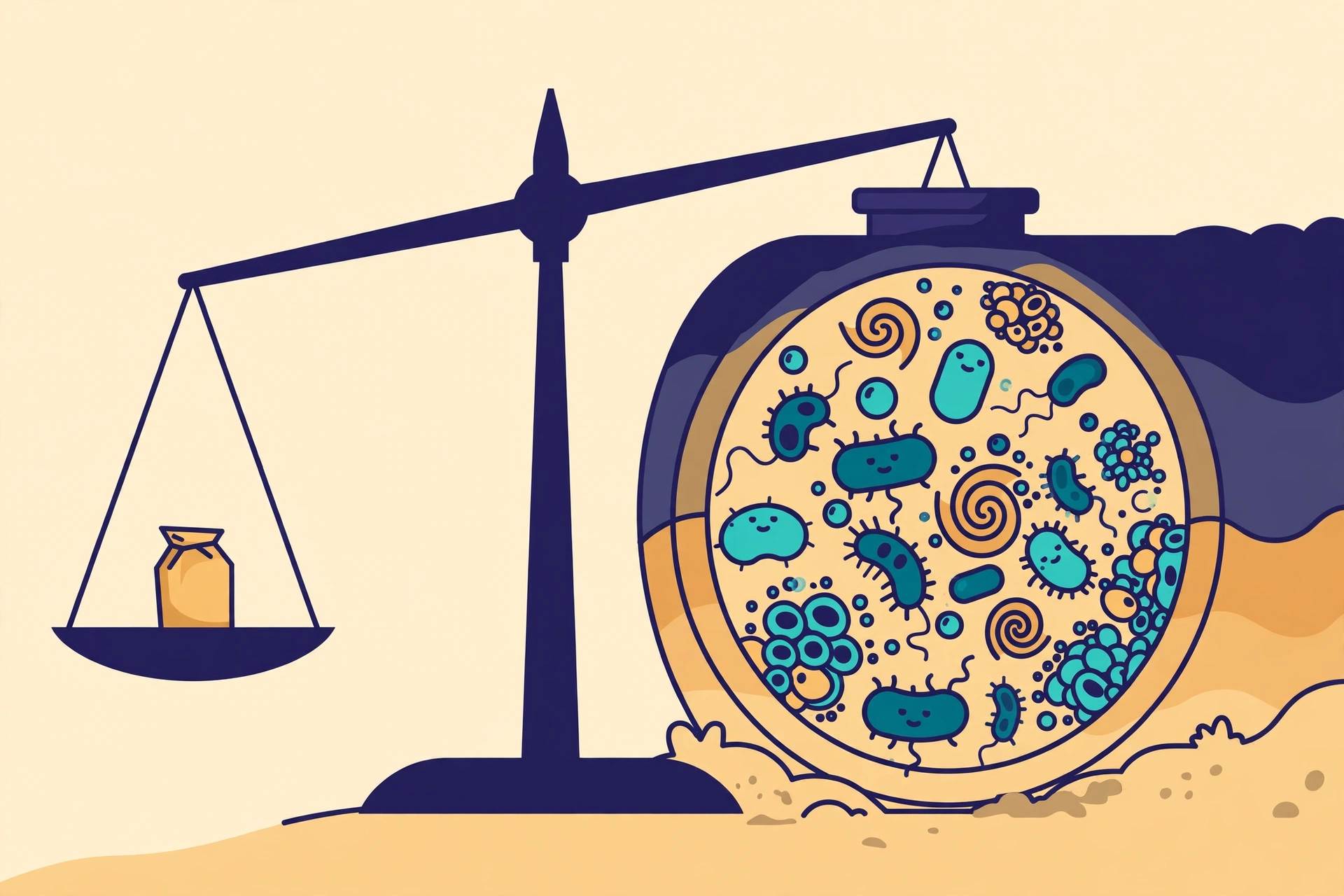
Enzyme vs Bacterial Products: What They Actually Do
Commercial septic treatments come in two types, and the difference matters:
- Enzyme products contain proteins that speed up specific chemical reactions — breaking fats, proteins, and starches into smaller pieces. They contain no living organisms. Think of them as digestive aids, not replacements for the digestive system.
- Bacterial products contain live (or dormant) bacterial cultures meant to supplement the tank’s existing colony, sometimes packaged with enzymes.
What can these actually do for solids? In a narrow, specific case — a system whose bacterial colony has been knocked down by something unusual, like heavy bleach use, a round of antibiotics in the household waste stream, or a home that sat vacant for months — a bacterial supplement can help re-establish the colony faster than nature alone. That’s a recovery aid, not a routine treatment.
What they cannot do:
- Replace pumping. No product removes inorganic solids, and no product digests the undigestible fraction. Sludge accumulation is a physical fact; only physical removal fixes it. This is the claim to watch for — any product promising “never pump again” is selling fiction.
- Liquefy everything into the drain field. Some aggressive chemical additives break solids into smaller suspended pieces that flow out of the tank into the drain field, where they clog soil pores. The tank looked cleaner; the drain field got the damage. Chemical additives containing acids, caustics, or solvents are the worst offenders — they can kill bacteria and corrode concrete tanks.
- Help a healthy system. The EPA does not recommend additives for a properly sized and maintained system, and university extension programs say the same: a working tank already contains everything it needs.
The full breakdown of product claims, honest math, and which types to avoid is in our dedicated article on whether septic tank additives really work — read that before you buy anything, especially anything promising to end pump-outs forever.
What Actually Speeds Up Solids Breakdown: Your Daily Habits
If products are mostly irrelevant, what moves the needle? Almost everything that matters happens at the source: what you put in, and how water flows through the house. These habits don’t make bacteria work faster — they make their job smaller, which is what actually extends the time between pump-outs.
Keep indigestible solids out of the tank
Every indigestible item becomes sludge or scum, permanently, until pumped. The usual suspects:
- “Flushable” wipes — the number one modern enemy of septic systems. They don’t disintegrate like toilet paper; they clog tanks, filters, and drain fields. Trash them.
- Feminine hygiene products, diapers, condoms, dental floss, cotton swabs — none break down. All go in the trash.
- Paper towels, napkins, tissues — far sturdier than toilet paper; they break down slowly and add to sludge.
- Grease, cooking oil, and fats — the quiet killer. Grease cools and hardens in the tank, forms thick scum, and is one of the top reasons tanks need pumping sooner. Wipe pans with a paper towel before washing and keep a grease jar under the sink.
- Coffee grounds and cat litter — settle straight to the sludge layer and never digest.
Moderate the garbage disposal
A garbage disposal dramatically increases the solids load — finely ground food particles that bacteria struggle to digest quickly. If you have one, use it sparingly: scrape plates into the trash or compost instead. Households with heavy disposal use typically need pumping sooner, which is why our pumping frequency chart treats disposal use as a schedule-shortening factor.
Spread out your water use
The tank needs quiet time for solids to settle and bacteria to work. Five loads of laundry back-to-back on Saturday sends a surge of water that stirs up settled solids and can push undigested matter toward the drain field. Spread laundry across the week, run the dishwasher and washing machine on different days when you can, and fix running toilets fast — a silently running toilet can waste hundreds of gallons a day, straight into your tank.
Protect the bacteria you already have
Harsh chemicals don’t add anything to the tank — they subtract. Concentrated bleach, antibacterial cleaners, chemical drain cleaners, paint, solvents, and pesticides can kill the bacterial colony or push it so far down that digestion stalls. Normal household cleaning in normal amounts is fine; it’s the heavy doses that cause trouble. If a drain clogs, reach for a plunger or a drain snake first — chemical drain openers rarely fix the real clog anyway, and they punish the tank.
Give the drain field a chance
This one is indirect but real: the drain field handles the effluent after the tank does its work. Keep cars and heavy equipment off it, don’t let gutters and sump pumps drain toward it, and plant only grass over it. A stressed, soggy drain field can’t absorb effluent properly — and when effluent can’t leave, the whole system backs up, solids and all.

When Pumping Is the Only Answer
Here’s the line no product crosses: once sludge and scum physically fill enough of the tank, nothing but a pump truck fixes it. The standard guidance is to pump when combined sludge and scum reach roughly one-third to one-half of the tank’s liquid depth — at that point the tank’s working volume is compromised and solids start escaping toward the drain field, where they do real, expensive damage.
In practice, that works out to the EPA’s general recommendation of every 3–5 years for a typical household, adjusted for your situation: more people, more water use, and a garbage disposal all shorten the interval. Our pumping frequency chart by household size walks through how to estimate your own schedule.
A few signs the clock has run out regardless of schedule:
- Sludge measured at the outlet baffle or effluent filter clogging repeatedly
- Slow drains throughout the whole house, gurgling fixtures, or sewage odors
- A previous pump-out where the pumper warned the tank was overdue — believe them
There is no additive, enzyme, bacterium, yeast packet, or pantry remedy that removes accumulated sludge. Pumping is not a failure of maintenance; it is the maintenance. Everything else on this page just stretches the time between pump-outs.
Do This, Not That: The Quick Reference
| Do this | Not that |
|---|---|
| Let human waste supply your bacteria naturally | Flush yeast to “seed” the tank |
| Keep wipes, grease, and non-biodegradables in the trash | Assume the tank can digest anything |
| Spread laundry loads and water use across the week | Run all the water on one marathon day |
| Scrape plates; use the garbage disposal sparingly | Grind every meal’s leftovers down the drain |
| Use normal cleaning products in normal amounts | Pour bleach, solvents, or drain cleaner down drains |
| Pump every 3–5 years (per your household’s schedule) | Buy an additive that promises “no more pumping” |
| Consider a bacterial supplement only after a real disruption (heavy chemicals, long vacancy) | Treat additives as routine maintenance for a healthy system |
The Bottom Line
The question “what can you put in a septic tank to break down solids” has a one-sentence honest answer: nothing you buy will outperform the bacteria already living in your tank. Yeast is the wrong organism, baking soda works at the wrong scale, and commercial additives can’t remove what only a pump truck removes. What genuinely helps is boring and free: keep indigestibles out, moderate the disposal, spread out water use, protect the bacteria from harsh chemicals, and pump on schedule.
If you’re new to septic ownership and want the full picture — records, baseline inspection, habits, and a maintenance calendar — our first time homeowner septic system guide walks through it as a first-year playbook. And if you want the whole SepticWise library in one place, the Start Here page maps out everything we cover.
Greetings Glows Team is dedicated to creating meaningful, helpful, and thoughtfully curated content for everyday inspiration and special moments.
What We Focus On:
Well-researched and reader-friendly articles.
Meaningful greetings, blessings, prayers, and inspirational messages.
Carefully curated ideas for everyday life and special occasions.
Clear, helpful, and engaging information.
Consistent quality and attention to detail in every publication.
Our goal is simple: to make every visit worthwhile with content that inspires, informs, and brings a little more positivity to your day.