Walk down the plumbing aisle of any hardware store and you’ll see them: bright packets and bottles promising to “supercharge” your septic tank, “eliminate pumping,” and “restore” your system — all for a few dollars a month. It’s an appealing pitch. Pumping a tank costs hundreds; a packet of powder costs pocket change.
Here’s the honest answer, the one backed by the EPA and state health departments: no, septic tank additives don’t do what their labels claim — and some can actively harm your system. A healthy septic tank already contains everything it needs to do its job. This article breaks down exactly why, claim by claim, so you can stop spending money on products your tank never needed.
The Short Answer
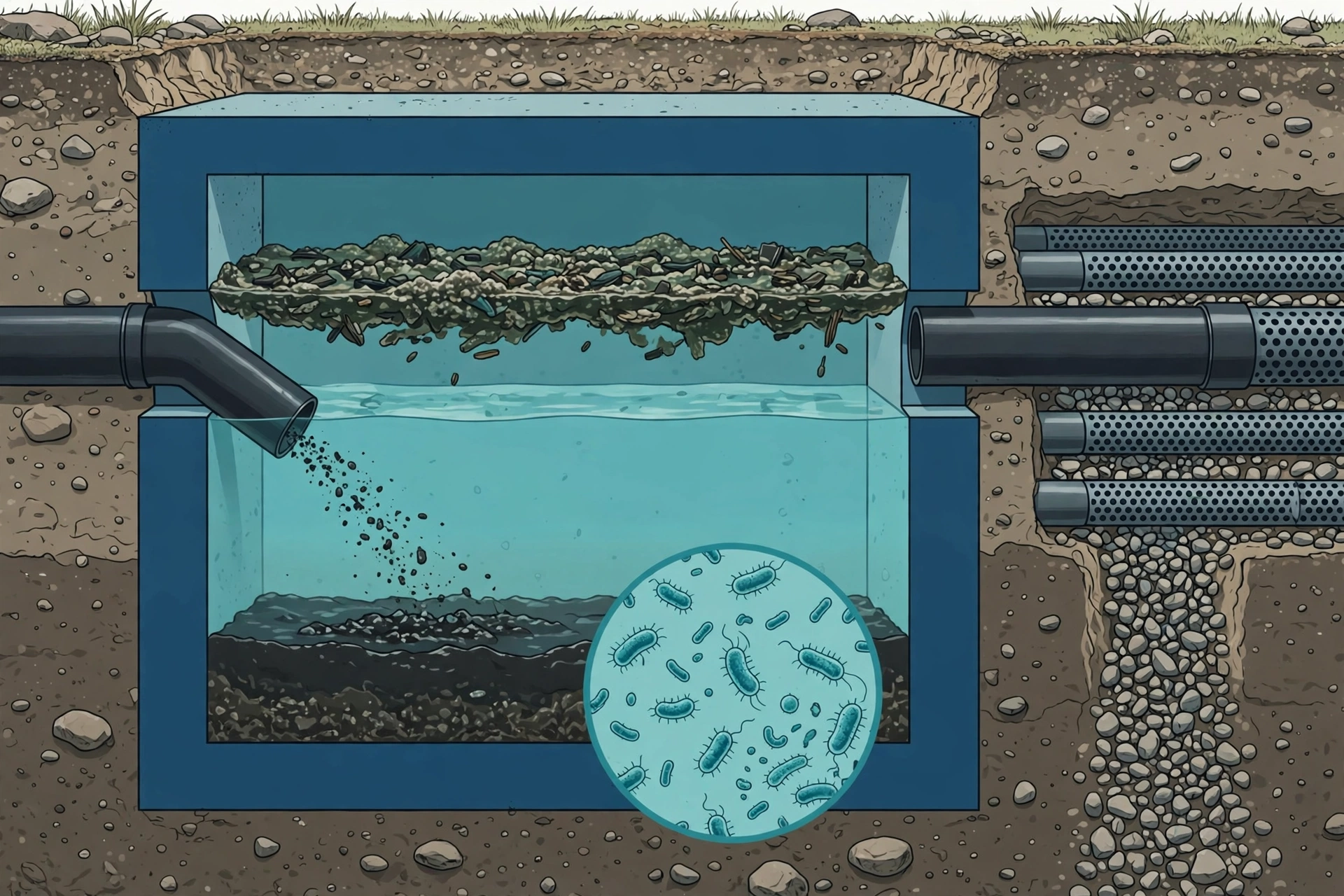
Your septic tank is a living ecosystem. Every time anyone in your household flushes, trillions of naturally occurring bacteria enter the tank and get to work breaking down organic waste. That biology is self-sustaining — it doesn’t need a boost, a starter, or a monthly supplement. The U.S. EPA does not recommend septic additives, and the Georgia Department of Public Health puts it even more bluntly: “Additives are not beneficial to on-site sewage management systems and, in fact, can be detrimental.”
The one thing additives universally promise — reducing or eliminating pumping — is the one thing no product can deliver. Sludge (the settled solids at the bottom of your tank) accumulates no matter what you pour in. Only a pump truck removes it.
What Additives Actually Are
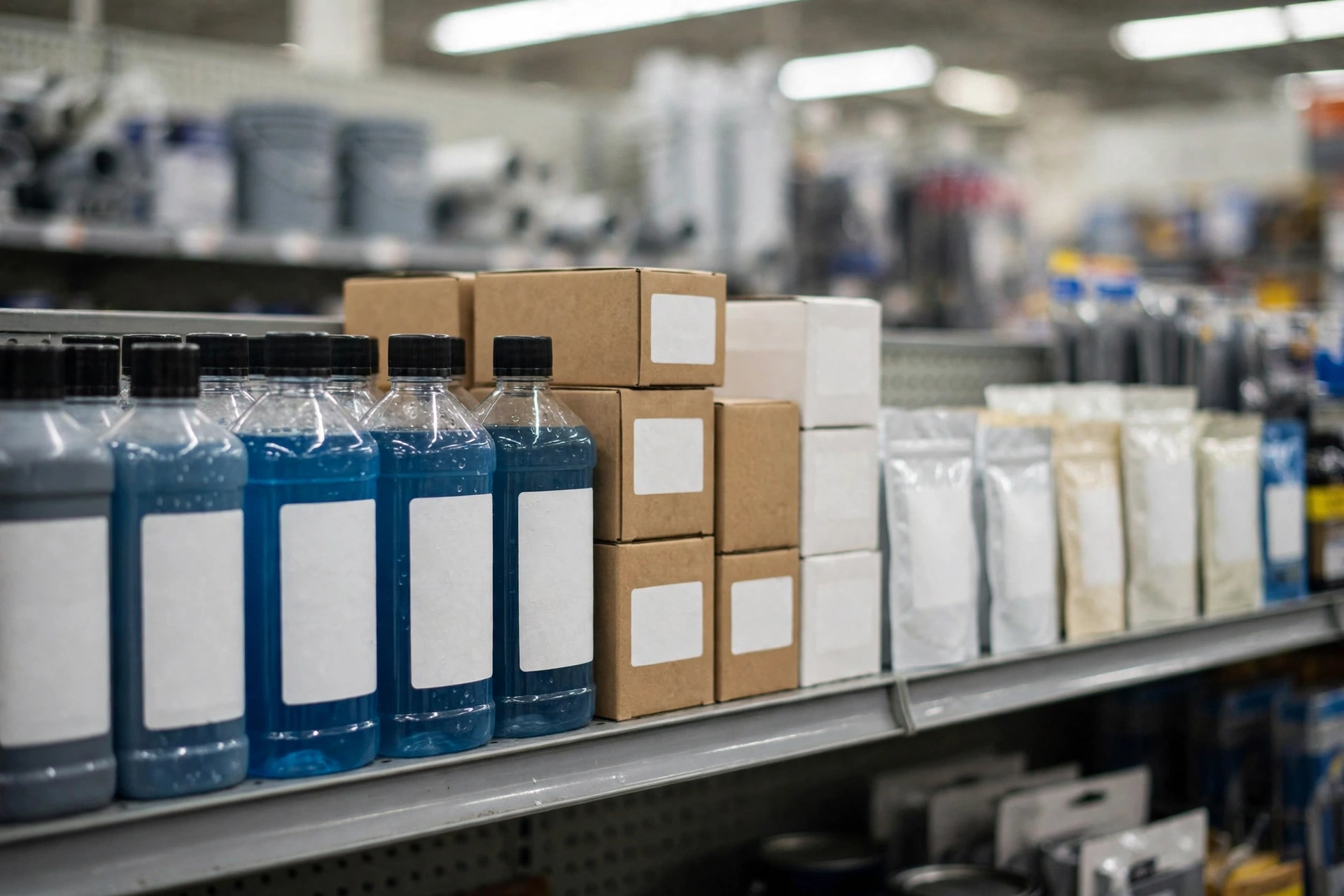
Every product on that shelf falls into one of two categories:
Biological additives
Packets, powders, or liquids containing bacteria, enzymes, or yeast. Marketed as “starter cultures” for new or recently pumped tanks, or as monthly maintenance boosters. Brands in this category are the most common — they’re the ones with the friendly “all-natural” labeling.
Chemical additives
Strong acids, alkalis (like lye), solvents, or hydrogen peroxide blends. Marketed to “shock” a sluggish system, dissolve clogs, or break up grease. These are the dangerous ones — some chemical additives are restricted or prohibited in certain states because of the damage they cause.
Claim by Claim: What They Promise vs. What’s True
| The claim | The reality |
|---|---|
| “Eliminates the need for pumping” | False. No additive removes accumulated sludge. Only physical pump-outs do. Skipping pumping because you use additives is the fastest route to a clogged drain field — a $10,000–$25,000 mistake. |
| “Adds beneficial bacteria your tank lacks” | Unnecessary. Human waste already seeds the tank with all the bacteria it needs, and they multiply on their own. Your tank is never short of bacteria under normal use. |
| “Breaks down grease, paper, and solids faster” | Mostly false, sometimes harmful. Some products break solids into smaller suspended particles — which then flow out into your drain field and clog it. The Georgia DPH specifically warns that this “liquefying” effect leads to drain-field clogging. |
| “Fixes slow drains and backups” | False. Backups come from full tanks, blocked pipes, or failing drain fields. No powder or liquid addresses any of those. It delays the real fix while the problem gets worse. |
| “Reduces odors” | Misleading. Odors have specific causes — dry traps, vent blockages, full tanks. Additives don’t fix any of them. (See our guide to tracking down sewage smells for what actually works.) |
| “All-natural, so it can’t hurt” | Wrong. Even biological additives can stir up settled solids and push them toward the drain field. “Natural” describes the ingredients, not the effect on your system. |
The Money Math: What Additives Really Cost You
Let’s run the numbers, because the “cheap alternative to pumping” framing falls apart fast:
- A typical monthly additive costs $10–$30 per dose — that’s $120–$360 per year.
- Premium “system restore” kits run $40–$60 per treatment.
- A routine professional pump-out in most of Georgia costs $275–$600 every 3–5 years — roughly $60–$200 per year amortized.
Read that again: many homeowners spend more per year on additives than pumping actually costs. And the additives don’t replace a single pump-out — so additive users pay for both. Over ten years, that’s potentially $1,200–$3,600 spent on products that did nothing, on top of the pumping they needed anyway.
Worse, if an additive contributes to a drain-field clog — the exact failure mode the Georgia DPH warns about — you’re looking at thousands in repairs. The “cheap” option becomes the most expensive one.
The “Starter Bacteria” Myth
The most persistent additive myth is that a new or recently pumped tank needs a bacterial “head start.” It sounds logical — like reseeding a lawn. The Georgia Department of Public Health addressed this directly in their official advisory:
“Is it true that some additives are necessary to give bacteria a ‘head start’ when the system is new or recently pumped? Absolutely not! By design, an on-site sewage management system does not need any help doing its job. The natural, biological process by which the system works requires only the bacteria that it receives from wastewater.”
Think about it: a pumped tank is never truly empty or sterile. Residual sludge coating the walls and baffles carries a thriving bacterial colony, and the very first flushes after service reseed it completely. Within days, the biology is back at full strength — no packet required. Pumping companies that sell you a “starter” dose at the end of a service visit are selling you something your next flush provides for free.
Why Chemical Additives Are Worse Than Useless
Biological additives are mostly a waste of money. Chemical additives can be genuinely destructive:
- They kill the bacteria your system depends on. Acids, caustics, and solvents don’t discriminate — they wipe out the beneficial microbes doing the actual treatment work. Without them, solids accumulate faster, not slower.
- They corrode concrete tanks and distribution boxes. The Georgia DPH notes that acids in some additives can eat through concrete components, causing leaks and structural failure.
- They contaminate soil and groundwater. Solvents that flush through into the drain field can poison the soil’s filtering ability and migrate toward wells — which is why some states restrict or ban them.
- They create a false sense of progress. A chemical “shock” may temporarily clear a sluggish drain by brute force while the underlying problem — a full tank, a clogged filter, a struggling field — keeps getting worse unseen.
If you have chemical additives sitting under your sink right now, the safest thing to do with them is to dispose of them through your local household hazardous waste program — not down the drain.
What the Authorities Actually Say
- U.S. EPA: Does not recommend septic system additives. Its septic care guidance focuses on inspection, pumping, water efficiency, and waste disposal — additives don’t appear in the formula.
- Georgia DPH: “Additives are not beneficial to on-site sewage management systems and, in fact, can be detrimental.” Their official advisory (PDF) answers the common marketing claims one by one.
- Multiple state and county health departments (including Florida’s and several in the Northeast) actively discourage additive use, and some states prohibit certain chemical formulations outright.
When every agency that regulates these systems agrees, it’s worth listening.
What to Do Instead (What Actually Works)
Everything your tank needs falls into five habits — none of which come in a bottle:
- Pump on schedule. Every 3–5 years for most households. This is the entire ballgame — see what pumping costs in Georgia and budget for it instead of additives.
- Protect the bacteria you already have. Keep paint, solvents, harsh drain cleaners, and excessive bleach out of your drains. Normal household cleaning in moderation is fine.
- Watch what goes down. No grease, no “flushable” wipes (they aren’t), no coffee grounds, no medications. Your tank digests human waste and toilet paper — that’s the menu.
- Use water efficiently. Stagger laundry loads, fix leaky fixtures, consider efficient appliances. Less hydraulic overload means better treatment.
- Maintain the drain field. Keep vehicles, livestock, and deep-rooted trees off it; divert roof runoff away; don’t pave over it.
If your system is genuinely struggling — persistent odors, slow drains throughout the house, wet spots over the field — that’s a diagnostic problem, not a product deficiency. Get a licensed professional to inspect it. No bottle fixes a full tank or a clogged field.
Frequently Asked Questions
Do septic tank additives really work?
No. The EPA does not recommend them, and state health departments including Georgia’s say they provide no benefit and can cause harm — particularly by pushing suspended solids into the drain field, where they cause expensive clogs.
Will yeast or baking soda help my septic tank?
They won’t hurt, but they won’t help either. Your tank already has all the bacteria and the right chemistry from normal household waste. Home-remedy doses are too small to change anything meaningful — and they don’t reduce the need for pumping.
Can additives replace septic tank pumping?
Absolutely not. Sludge accumulates regardless of additives and must be physically pumped out every 3–5 years. Relying on additives instead of pumping is one of the most common paths to drain-field failure.
Are there any situations where an additive helps?
The narrowest possible case: after a major chemical contamination (say, a large accidental bleach dump) killed tank bacteria, a basic bacterial product might marginally speed recolonization. Even then, normal wastewater reseeds the tank on its own within days. It’s a short-term comfort measure, not maintenance.
Why do stores sell them if they don’t work?
Because they’re profitable, lightly regulated as household products (not as septic treatments), and the claims are carefully worded to imply results without guaranteeing them. Shelf space reflects demand created by marketing — not endorsement by any septic authority.
My pumper recommended an additive. Should I listen?
Be skeptical of any product sold at the point of service. An honest operator makes money from pumping and inspections, not from monthly packets. If your pumper pushes additives hard, it’s worth getting a second opinion on their overall advice.
The Bottom Line
Your septic tank is a self-sustaining biological system that has worked the same way for over a century: bacteria from ordinary wastewater break down solids, sludge settles, liquid flows to the field, and a pump truck removes the rest every few years. Nothing in a bottle improves on that design. Save the $120–$360 a year, put it toward your actual pump-out, and spend the difference on something your system genuinely needs — like risers that make the next service cheaper.
New to septic systems entirely? Our Start Here guide covers the real maintenance schedule in plain language — no products required.
Greetings Glows Team is dedicated to creating meaningful, helpful, and thoughtfully curated content for everyday inspiration and special moments.
What We Focus On:
Well-researched and reader-friendly articles.
Meaningful greetings, blessings, prayers, and inspirational messages.
Carefully curated ideas for everyday life and special occasions.
Clear, helpful, and engaging information.
Consistent quality and attention to detail in every publication.
Our goal is simple: to make every visit worthwhile with content that inspires, informs, and brings a little more positivity to your day.
1 thought on “Do Septic Tank Additives Really Work? The Honest Answer”