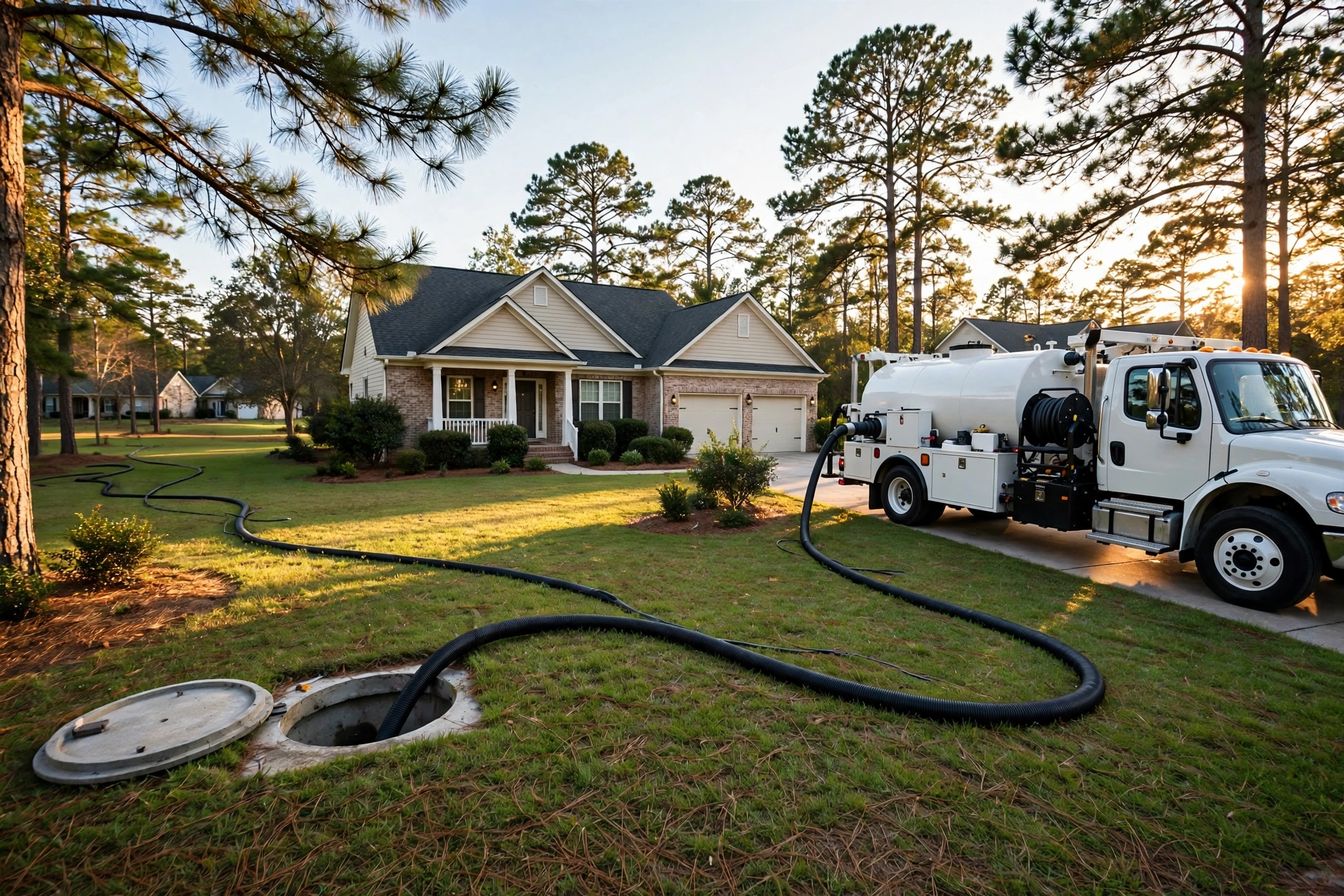
If you own a home with a septic system in Georgia, pumping the tank is the single most important maintenance bill you’ll pay — and the one most homeowners put off because they don’t know what it should cost. Here’s the straight answer: most Georgia homeowners pay between $275 and $600 for a standard septic tank pump-out, based on statewide estimator tools and published contractor pricing. In the Atlanta metro area, expect the higher end — roughly $500 to $900 — while rural parts of south and central Georgia often come in under $400.
That range is wide because “pumping a septic tank” isn’t one fixed service. Your tank size, how easy it is to access, where in Georgia you live, and what extras the job needs all move the price. This guide breaks down 2026 pricing region by region, shows you exactly what drives the cost up or down, and gives you a checklist for getting fair quotes — so you never overpay and never get talked into work you don’t need.
Georgia Septic Pumping Prices by Region

Georgia is a big state with very different local economies, and septic pricing follows that pattern. A pump-out in downtown Atlanta does not cost what a pump-out in Valdosta costs. Based on published contractor pricing and statewide cost estimators, here’s what homeowners are actually seeing:
Metro Atlanta and North Georgia: $500–$900
The Atlanta metro area — Fulton, Cobb, Gwinnett, DeKalb, Cherokee, and surrounding counties — has the highest pumping prices in the state. One established Atlanta-area contractor publishes a typical range of $650–$900 for a standard 1,000-gallon pump-out. Higher operating costs, longer drive times through traffic, and stricter county-level oversight all contribute. North Georgia mountain counties (think Blue Ridge, Ellijay, Dahlonega) land in a similar band, partly because steep or remote properties can complicate truck access.
Central Georgia: $350–$600
Macon, Warner Robins, Columbus, and Athens sit in the middle of the range. Competition among local haulers is decent, access is usually straightforward on flatter lots, and disposal facilities are reasonably close. Most homeowners here report quotes clustered around $350–$500 for a standard tank.
South Georgia and Rural Areas: $275–$500
Albany, Valdosta, Tifton, Waycross, and Georgia’s rural counties tend to have the lowest prices in the state. Statewide estimator tools put the typical range here at $275–$525. Lower overhead for local operators and simpler properties keep prices down. The trade-off: fewer competing companies, so always get at least two quotes.
Coastal Georgia: $400–$650
Savannah, Brunswick, and the Golden Isles run slightly above the state average. High water tables and flood-prone soils mean technicians often spend extra time checking that the system isn’t waterlogged, and some jobs get scheduled around tide and rainfall conditions.
What’s Included in a Standard Pump-Out (and What Costs Extra)

A standard pump-out should include: locating and opening the tank, pumping out all liquid, sludge, and scum, a basic visual inspection of the tank interior and baffles, and proper disposal of the waste at a licensed facility. But several common add-ons can appear on your invoice. Here’s what they typically run, based on published Georgia contractor pricing:
| Service | Typical range in Georgia |
|---|---|
| Standard pump-out (up to ~1,000 gallons) | $275–$600 |
| Large tank pump-out (1,500+ gallons) | $600–$1,000 |
| Tank locating (no riser, buried lids) | $100–$300 |
| Lid uncovering / digging | $50–$200 |
| Riser installation (so lids stay accessible) | $200–$600 |
| Effluent filter cleaning or replacement | $50–$150 |
| Full system inspection with written report | $150–$350 |
The biggest surprise charge for most homeowners is digging. If your tank lids are buried 12–18 inches underground with no risers, the crew has to find them and dig them up by hand — and you’ll pay for that labor. Installing risers once ($200–$600) eliminates this charge on every future visit. It usually pays for itself by the second pumping.
7 Factors That Determine Your Exact Price
1. Tank size
A 1,000-gallon tank is the most common residential size in Georgia and sets the baseline price. Larger tanks (1,250 or 1,500 gallons) hold more waste, take longer to pump, and cost more to dispose of — expect $100–$300 extra.
2. Accessibility
Can the pump truck park within hose reach of your tank? Long hose runs, steep slopes, fences, or soft ground after rain all add time and cost. Risers that bring lids to the surface are the single best investment for keeping access cheap.
3. How full (or neglected) the tank is
A tank pumped on schedule takes under an hour. A tank that hasn’t been touched in 10+ years may have compacted sludge that takes far longer to break up and remove — some companies charge extra for severely neglected tanks.
4. Your region
As shown above, metro Atlanta runs nearly double rural south Georgia. Always compare quotes from companies actually based near you, not statewide averages.
5. Add-on services
Filter cleaning, baffle inspection, riser installation, and written inspection reports are legitimate services — but confirm the price before the truck arrives, not after.
6. Time of year
Demand spikes after heavy rain periods, when saturated drain fields send homeowners calling. Georgia’s wet springs can mean longer wait times and less negotiating room. Scheduling in drier months sometimes gets you a better slot.
7. Disposal fees
Septage must go to an approved treatment facility, and tipping fees vary by county. Reputable haulers build this into the quote; be wary of any quote that seems far below market — the waste has to go somewhere legal.
Georgia Rules You Should Know Before You Hire
Georgia regulates septic systems through the Department of Public Health’s Rules and Regulations for On-Site Sewage Management Systems (Chapter 511-3-1), enforced by your county health department. Three things matter for your wallet:
- Pump every 3–5 years. That’s the DPH’s standard recommendation for a typical household. Larger families, homes with garbage disposals, or houses that host frequent guests should aim for the shorter end of that range.
- Hire a licensed septage hauler. Anyone pumping tanks in Georgia must hold a valid septage hauler license and dispose of waste at an approved facility. Ask for the license number — legitimate operators provide it without hesitation.
- Keep your records. Your county health department may have your system’s original installation records on file, which helps contractors locate the tank without expensive detective work.
For general septic upkeep beyond pumping, the EPA’s septic maintenance guidance is worth bookmarking — it covers the inspection intervals and water-use habits that keep systems healthy between pump-outs.
How to Get Fair Quotes: Your Phone Checklist
Call at least two or three local companies and ask every one of them the same questions:
- “What’s included in your standard pump-out price?” — Get the list: opening, pumping, basic inspection, disposal.
- “Is there a separate charge for locating or digging up the lids?” — This is the most common surprise fee.
- “Do you charge extra for the effluent filter?” — Cleaning it should be routine; replacement is a parts cost.
- “Are you a licensed Georgia septage hauler?” — Non-negotiable. Ask for the license number.
- “Where do you dispose of the waste?” — Must be an approved facility.
- “Can you give me the total in writing before you start?” — A reputable company will.
Red flags: quotes dramatically below everyone else (corners are being cut somewhere, often disposal), pressure to buy septic tank additives on the spot, or reluctance to show a license. A good operator welcomes informed questions.
How to Pay Less Over Time (Without Cutting Corners)
- Install risers. As noted above, this one-time cost removes digging fees forever.
- Pump on schedule. Emergency pump-outs and neglected-tank surcharges cost more than routine service. Set a calendar reminder based on your household size.
- Know where your tank is. If you can point the crew to the lids, you skip the locating fee. Your county health department often has the original site plan.
- Bundle the inspection. Some companies discount a full inspection when combined with a pump-out versus booking it separately later.
- Skip the additives. Monthly additive products cost $180–$600 a year and don’t reduce how often you need pumping — put that money toward the actual service instead.
Frequently Asked Questions
How much does it cost to pump a 1,000-gallon septic tank in Georgia?
Most Georgia homeowners pay $275–$600 for a standard 1,000-gallon pump-out. In metro Atlanta, expect $500–$900; in rural south Georgia, $275–$500 is typical. Access issues or add-on services can push the total higher.
How often should I pump my septic tank in Georgia?
The Georgia Department of Public Health recommends every 3–5 years for a typical household. Pump more often (every 2–3 years) if you have a large family, use a garbage disposal heavily, or host frequent guests.
Can I pump my own septic tank in Georgia to save money?
Practically speaking, no. You’d need a licensed pump truck, an approved disposal facility willing to accept your waste, and compliance with state septage handling rules. DIY pumping isn’t a realistic money-saver — the equipment and legal disposal requirements make professional service the only sensible option.
Why do quotes vary so much between companies?
Because “pump-out” isn’t a standardized package. One company’s $300 quote might exclude lid digging ($150 extra) and filter service ($75 extra), while another’s $500 quote includes everything. Always compare itemized, in-writing quotes — not headline numbers.
Is it cheaper to wait longer between pumpings?
Almost never. Stretching past the recommended interval risks solids escaping into your drain field, and a failed drain field costs $10,000–$25,000 to replace. Routine pumping is the cheapest insurance your septic system has.
Do I need a permit to have my tank pumped in Georgia?
No — routine pumping doesn’t require a homeowner permit. Your hauler handles all licensing and disposal compliance. Permits generally only come into play for repairs, replacements, or new installations through your county health department.
The Bottom Line
Budget $300–$600 for a routine septic pump-out in most of Georgia, more in metro Atlanta and less in rural counties. Get itemized quotes, verify the hauler’s license, install risers if you don’t have them, and pump on the 3–5 year schedule your system was designed for. It’s a few hundred dollars every few years that protects you from a five-figure drain field replacement.
New to septic ownership? Our Start Here guide walks you through everything a first-time homeowner needs to know. And if you’re noticing sewage smells or other warning signs, don’t wait for your next scheduled pumping — those symptoms deserve attention now.

Greetings Glows Team is dedicated to creating meaningful, helpful, and thoughtfully curated content for everyday inspiration and special moments.
What We Focus On:
Well-researched and reader-friendly articles.
Meaningful greetings, blessings, prayers, and inspirational messages.
Carefully curated ideas for everyday life and special occasions.
Clear, helpful, and engaging information.
Consistent quality and attention to detail in every publication.
Our goal is simple: to make every visit worthwhile with content that inspires, informs, and brings a little more positivity to your day.
5 thoughts on “How Much Does It Cost to Pump a Septic Tank in Georgia?”