Walk into any hardware store and you will find a shelf full of septic tank additives. Bottles and packets promise to boost bacteria, break down sludge, clean your drainfield, and save you from pumping. If you want to take good care of your septic system, it is natural to wonder whether you should be using one of them.
It is also natural to ask what the U.S. Environmental Protection Agency thinks about all of this. The EPA is the federal agency most homeowners turn to for guidance on septic systems, and its website answers the additive question directly. The short answer is that the EPA does not recommend additives for a septic system that treats ordinary household wastewater. Your tank already has the bacteria it needs, additives are not necessary, and some of them can actually cause harm.
That short answer is worth understanding in full. The EPA does not ban additives, does not test individual products, and does not endorse any brand. Some states go further than the federal guidance and restrict certain products on their own. This article walks through what the EPA actually says and how to use its guidance the next time a product label makes a big promise.

What the EPA Actually Says, in Plain English
The EPA publishes a page of frequent questions about septic systems, and two of those questions deal directly with additives. Taken together, they give a clear picture of the agency position, and it is simpler than most product marketing would have you believe.
First, the EPA says additives are not recommended for septic systems that handle domestic wastewater, meaning ordinary household wastewater. Additives that contain bacteria or chemicals are commonly marketed as a way to improve performance, but the agency says their use is not recommended, because a septic system already contains a significant population of bacteria, enzymes, yeasts, fungi, and other microorganisms. Those organisms arrive with the wastewater itself. Second, the EPA says these products can be ineffective, and in some cases they can harm the operation of the system and the environment around it. An additive that does nothing wastes money. One that harms the system can cost far more, because a damaged drainfield is one of the most expensive septic problems a homeowner can face.
The agency also says that if your system has an operational problem, the right step is to have it assessed by a septic professional or your local regulator, not to try to fix it with an additive. Problems have causes, and causes need a diagnosis. A bottle of bacteria does not diagnose anything.
The Two FAQ Answers, Explained
The first of the two EPA questions asks whether additives are recommended for septic systems. The answer is no, and the reasoning is straightforward. A working septic tank is already a living system. Every flush adds bacteria, and those organisms multiply on their own. The EPA points out that this natural population is already significant, which is why adding more of the same does not change much.
The second question asks what kind of additives are acceptable for a septic system. The answer starts with an important boundary. The EPA does not make recommendations on individual septic system products. There is no federal approval process for septic additives, and no EPA seal of approval to look for on a label. Within that answer, the EPA draws a line between different kinds of products. Microbiological and enzyme additives are promoted to reduce the buildup of sludge and scum, but the agency says they are not necessary for a system to function properly with domestic wastewater, and it warns that they may decrease the performance of the septic drainfield. The answer is firmer about another group of products. In general, the EPA says not to use additives made of organic solvents or strong alkali chemicals, because they pose a potential threat to soil structure and groundwater. Some states and localities have their own rules about additives, and homeowners should contact their local permitting authority for guidance.
What the EPA Does Not Do
Understanding what the EPA does not do is just as important as understanding what it says, because product marketing often implies a level of official backing that does not exist. The EPA does not test septic additives. It does not run trials on individual products, does not rank them, and does not publish a list of approved or recommended brands. If a product label or a sales page claims that a product is EPA approved, that claim should be treated with serious skepticism. There is no such approval to have. The EPA also does not endorse any additive product. An endorsement would be a recommendation, and the agency has said plainly that it does not make recommendations on individual products.
The EPA does not regulate additives as a category at the federal level either. It offers guidance and explains the risks, but it has not set a federal rule that bans or permits specific products. That job falls to the states and local governments. If you want to know whether a specific product is legal to use where you live, the EPA website is the starting point, but your state or county office is the authority. None of this means the EPA is silent on the subject. Additives are not recommended, they are not necessary for normal household wastewater, and some of them carry real risks. The absence of a federal ban is not an invitation to use them.
The Three Kinds of Additives and What the EPA Says About Each
Additives come in several forms, and it helps to sort them into groups, because the EPA treats them differently. The three main groups are biological additives, chemical additives, and the solvent and alkali products the agency specifically warns against.
Biological Additives: Bacteria and Enzymes
Biological additives are the most common products on the shelf. They contain bacteria, enzymes, or both. The pitch is simple. Your tank needs bacteria to break down waste, so adding more bacteria should help it work better. The EPA response is that the bacteria are already there, so adding more changes little. A septic tank that receives normal household wastewater already contains a large and varied population of microorganisms, and that population grows and maintains itself as long as waste keeps flowing in. Adding a packet of bacteria is like adding a bucket of water to a swimming pool. The amount is small compared with what is already present.
The agency also notes that these products may decrease the performance of the drainfield. When an additive breaks up solids too aggressively, solids that should have settled stay suspended and travel onward, where they can clog the soil and shorten the life of the field. Caution is still a long way from a recommendation. A product that is not necessary, that may not work, and that may harm the drainfield is not a good use of money.
Chemical Additives: The General Category
Chemical additives cover a broad range of products, from drain cleaners marketed for septic use to treatments that claim to unclog a sluggish system. The common thread is that they rely on chemistry rather than biology to change what happens in the tank. The EPA guidance on this group is general rather than product by product, because the agency does not evaluate individual products. The position is the same as for biological additives. They are not recommended for normal household wastewater, and the agency advises caution because they can be ineffective or can harm system operation and the environment. The key point is that a chemical additive cannot replace maintenance. It cannot pump a full tank, repair a failing drainfield, or fix a tank that is undersized for the household it serves.
Ordinary cleaning products are a separate question from additives. Our guide on whether you can use bleach with a septic system covers what normal cleaning products do to the bacteria in your tank. Normal household use of cleaners is very different from pouring a concentrated chemical treatment into the system.
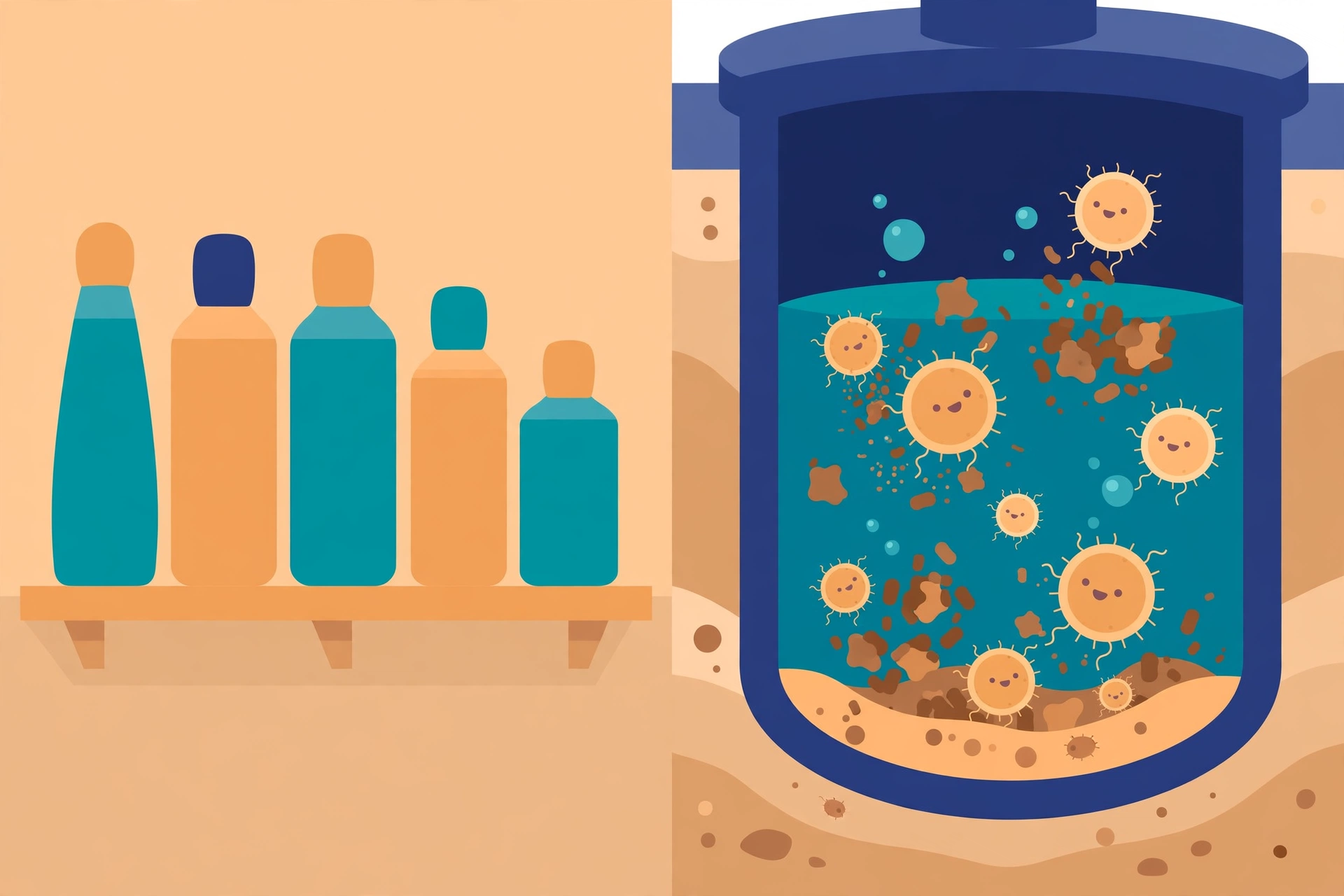
Solvent and Strong Alkali Additives: The Ones the EPA Warns Against
The third group is the one the EPA singles out most clearly. Additives made of organic solvents or strong alkali chemicals should generally not be used, because they pose a potential threat to soil structure and groundwater. Organic solvents are chemicals designed to dissolve grease and organic matter. In a septic system, they do not stop at the grease in the tank. They can break down the soil structure in the drainfield, reducing the ability of the soil to filter wastewater. They can also move through soil and reach groundwater, carrying contaminants with them. Groundwater is the source of drinking water for many rural homes, so a product that threatens it is a serious concern.
Strong alkali chemicals work by raising the pH in the tank dramatically. They can dissolve organic material quickly, which is why they are sometimes sold as a fast fix for a sluggish system. But a very high pH kills the bacteria that do the real work of treatment, and it can damage the soil in the drainfield in the same way solvents do. A struggling system needs a professional assessment, not a chemical shock. If you have a product on your shelf and you are not sure what it contains, check the label for solvent or strong alkali ingredients, and check with your local permitting authority before using it.
State and Local Rules That Go Further Than the EPA
The EPA guidance is federal guidance, and it leaves the detailed rules to the states. Some states have decided that federal guidance alone is not enough and have set their own restrictions. Several states regulate or ban certain septic additives, particularly those containing organic solvents. The exact rules vary, and they change over time, so this article does not list them state by state. The reliable step is to check with your own state or local permitting authority. In most places that is the county health department or the environmental health office.
When you call or check the website, ask whether any additives are restricted or banned in your state or county, and whether there is a list of products registered for use in your area. A product that is not registered may not be legal to sell or use there, even if it is sold online or in a neighboring state. A product being sold legally is not the same as a product being recommended. The shelf is not an endorsement.
When an Additive Might Still Come Up, and What the EPA Says to Do Instead
There are moments when even a homeowner who knows the EPA position might be tempted by an additive. The system is sluggish after a long vacation, a house has sat empty for months, or a large amount of antibacterial cleaner was accidentally used. In those moments the idea of a bacterial restart sounds appealing. The EPA answer is the same in these situations as it is in general. If your system has an operational issue, have it assessed by a septic professional or your local regulator. A professional can tell whether the system actually needs attention, and if it does, what kind. Sometimes the answer is pumping. Sometimes it is a repair. Sometimes it is simply waiting, because the bacterial population recovers on its own once normal use resumes.
That last point is worth emphasizing. As soon as people start using the plumbing normally, bacteria return with the wastewater, and the population rebuilds itself. It does not need a purchased starter culture. Our guide on what you can put in a septic tank to break down solids covers the related question of what helps solids break down. The answer is that normal household waste, water, and time do the job.
What the EPA Recommends Instead of Additives
The EPA guidance on septic care is built around maintenance, not products. The agency recommends inspecting a septic tank every one to three years and pumping it every three to five years. Those are general intervals, and the right schedule for a particular home depends on household size, tank size, and water use. Inspection and pumping are the two maintenance tasks that actually protect a system. An inspection finds problems early. Pumping removes the sludge and scum that bacteria cannot break down, and it keeps solids from flowing out to the drainfield and clogging the soil.
Our septic tank pumping frequency chart by household size gives a practical starting point for planning those intervals, so you can see how household size changes the timing. Your septic professional can adjust the timing for your tank size and water use. Beyond inspection and pumping, the EPA recommends habits that protect the system day to day. Use water efficiently, keep grease out of the drains, flush only toilet paper and human waste, and keep traffic and construction off the tank and drainfield. None of these habits requires a product purchase.

How to Check a Product Claim Against EPA Guidance
Product labels are written to sell, and they use language that can sound official even when it is not. A short checklist helps you read a claim the way the EPA guidance suggests you should. Start with the approval claim. If a label says the product is EPA approved, EPA endorsed, or EPA recommended, treat that as a red flag. The EPA does not approve, endorse, or recommend individual septic additives. Next, look at the promise. If a product claims you will never need to pump your tank, compare that with what the EPA says. The agency says additives are not necessary for normal operation and that operational issues should be assessed by a professional. A product that promises to replace pumping or professional assessment is promising something the EPA guidance says it cannot do.
Then check the ingredients and your local rules. If the label lists organic solvents or strong alkali chemicals, the EPA says in general not to use them. If the ingredient list is vague or missing, that is itself a reason for caution. Even a product that is legal to sell may be restricted in your state or county, so a quick call to your local permitting authority is worth making. If a product passes all of these checks, it still does not need to be used. The EPA position is that a system treating normal household wastewater does not need an additive at all.
Frequently Asked Questions
Does the EPA recommend septic tank additives?
No. The EPA says additives are not recommended for septic systems that treat domestic wastewater, because the system already contains a significant population of bacteria and other microorganisms. The agency also notes that additive products can be ineffective or can harm system operation and the environment.
Does the EPA approve any septic additive products?
No. The EPA does not make recommendations on individual septic system products, and it does not test, approve, or endorse any additive brand. There is no EPA approval to look for on a label.
Which additives does the EPA specifically warn against?
The EPA says in general not to use additives made of organic solvents or strong alkali chemicals, because they pose a potential threat to soil structure and groundwater. These products can damage the drainfield, harm the bacteria that treat wastewater, and carry contaminants toward groundwater.
Do I still need to pump my tank if I use an additive?
Yes. Additives do not eliminate sludge and scum entirely, and they do not replace pumping. The EPA recommends inspecting a septic tank every one to three years and pumping every three to five years, with the exact timing depending on household size, tank size, and water use. A product that claims you will never need to pump is making a promise the EPA guidance does not support.
What should I do if my septic system has a problem?
Have it assessed by a septic professional or your local regulator. That is the EPA advice for operational issues, and it applies whether the problem is slow drains, smells, wet spots in the yard, or a system that has been idle for a long time. A professional can find the cause and recommend the right fix, which an additive cannot do.
The Bottom Line
The EPA position on septic additives is clear, and it has not changed with the marketing. Additives are not recommended for a septic system that treats ordinary household wastewater. The bacteria your tank needs are already there, arriving with every flush and every load of laundry. Biological additives are not necessary and may harm the drainfield. Solvent and strong alkali additives should generally not be used at all, because they can damage soil and threaten groundwater. And no additive replaces inspection, pumping, or a professional assessment when something goes wrong.
That position is also an invitation to spend your money and attention where they actually help. An inspection every one to three years and pumping every three to five years, adjusted for your household, will do more for your system than any bottle on the shelf. If you want to read the source for yourself, the EPA frequent questions page is the place to start, and the agency’s septic homepage at epa.gov/septic gathers the rest of its homeowner guidance. For the broader question of whether additives work at all, our companion article on whether septic tank additives really work covers the evidence in more detail. Read both, check your local rules, and keep the money you would have spent on a bottle. Your tank already has what it needs.

Greetings Glows Team is dedicated to creating meaningful, helpful, and thoughtfully curated content for everyday inspiration and special moments.
What We Focus On:
Well-researched and reader-friendly articles.
Meaningful greetings, blessings, prayers, and inspirational messages.
Carefully curated ideas for everyday life and special occasions.
Clear, helpful, and engaging information.
Consistent quality and attention to detail in every publication.
Our goal is simple: to make every visit worthwhile with content that inspires, informs, and brings a little more positivity to your day.
3 thoughts on “What Does the EPA Say About Septic Additives?”