How often should you pump your septic tank? The honest answer is that it depends on two things: how big your tank is, and how many people live in your home. For the most common setup in the United States — a 1,000-gallon tank serving a family of four — EPA-based guidelines point to pumping roughly every 2 to 3 years. But a couple living with a 1,500-gallon tank might safely stretch to 5 or 6 years between pump-outs, while a family of six sharing an older 750-gallon tank could need service every single year.
That’s why the advice you’ll hear at every neighborhood barbecue — “just pump every 3 to 5 years” — is both right and wrong at the same time. It’s a fine starting point, but for your specific household it can be off by years in either direction. Pump too infrequently, and solids migrate into your drain field, which can ruin it. Pump too often, and you’re paying for service you didn’t need.
This guide gives you the full septic tank pumping frequency chart by household size: a tank-size × household-size table you can bookmark, the EPA data behind the numbers, the five factors that shift your personal schedule, how to find your tank size, and the warning signs that mean “stop reading the chart and call your pumper.”

Septic Tank Pumping Frequency Chart by Household Size
Find your tank size in the left column and read across to your household size. These bands are drawn from EPA and Penn State Extension pumping guidelines combined with the practical schedules recommended by licensed septic contractors.
| Tank size | 1–2 people | 3–4 people | 5+ people |
|---|---|---|---|
| 750 gallons | Every 2–4 years* | Every 1–3 years* | Every year* |
| 1,000 gallons | Every 3–5 years | Every 2–4 years | Every 1–3 years |
| 1,250 gallons | Every 4–6 years* | Every 3–4 years* | Every 1–2 years* |
| 1,500 gallons | Every 4–6 years | Every 3–5 years | Every 2–4 years |
| 2,000 gallons | Every 6–10 years* | Every 4–6 years* | Every 2–4 years* |
* Bands marked with an asterisk are estimates, interpolated between the published EPA and Penn State Extension figures. Treat them as starting points, not promises.
The EPA Numbers Behind the Chart
If you like your guidance precise, here is the pumping table behind most of the charts you’ll find online. It comes from the septic tank pumping guidelines published by the U.S. Environmental Protection Agency and Penn State Extension, based on conventional septic tanks with year-round occupancy and no garbage disposal:
| Tank size | 2 people | 3 people | 4 people | 5 people |
|---|---|---|---|---|
| 1,000 gallons | 5.9 years | 3.7 years | 2.6 years | 1.9 years |
| 1,500 gallons | 9.1 years | 5.9 years | 4.2 years | 3.3 years |
Notice how steep the drop-off is: adding a single person to a 1,000-gallon tank shaves more than a year off the interval. A family of five on a 1,000-gallon tank is looking at pumping roughly every two years — while two people on a 1,500-gallon tank could go nearly a decade. This is the math the “every 3–5 years” rule of thumb is trying to average out.
Why “Every 3–5 Years” Can Be Wrong for You
To be fair to the old rule of thumb, the EPA itself tells homeowners to have their system inspected every 1 to 3 years and pumped every 3 to 5 years as a general baseline. For a statistically average household — say, three to four people on a 1,000- to 1,250-gallon tank — that advice lands right in the middle of the chart. The problem is that fewer and fewer households are statistically average.
Consider two real-world scenarios. A retired couple in a three-bedroom home with a 1,500-gallon tank who travel half the year might pump every 7 or 8 years and never have a problem. Meanwhile, a family of six — plus teenagers who take marathon showers — on an original 750-gallon tank from the 1980s can fill the solids layer in under a year. Hand them both the same “every 3–5 years” advice, and one household wastes money on unnecessary pump-outs while the other slowly damages a drain field.
That’s the expensive part. A routine pump-out is a maintenance bill. A failed drain field is a construction project — often many times the cost of a decade of pump-outs. The chart above exists so you can stop guessing and start scheduling based on your household.
The Simple Math Behind Pumping Frequency
There’s no magic in the table — it’s arithmetic. Here’s how septic professionals think about it:
- Water in, water out. Each person in a home sends roughly 70 gallons of water down the drains every day (EPA estimate). A family of four pushes about 280 gallons a day through the tank, which is why the tank’s working volume matters so much.
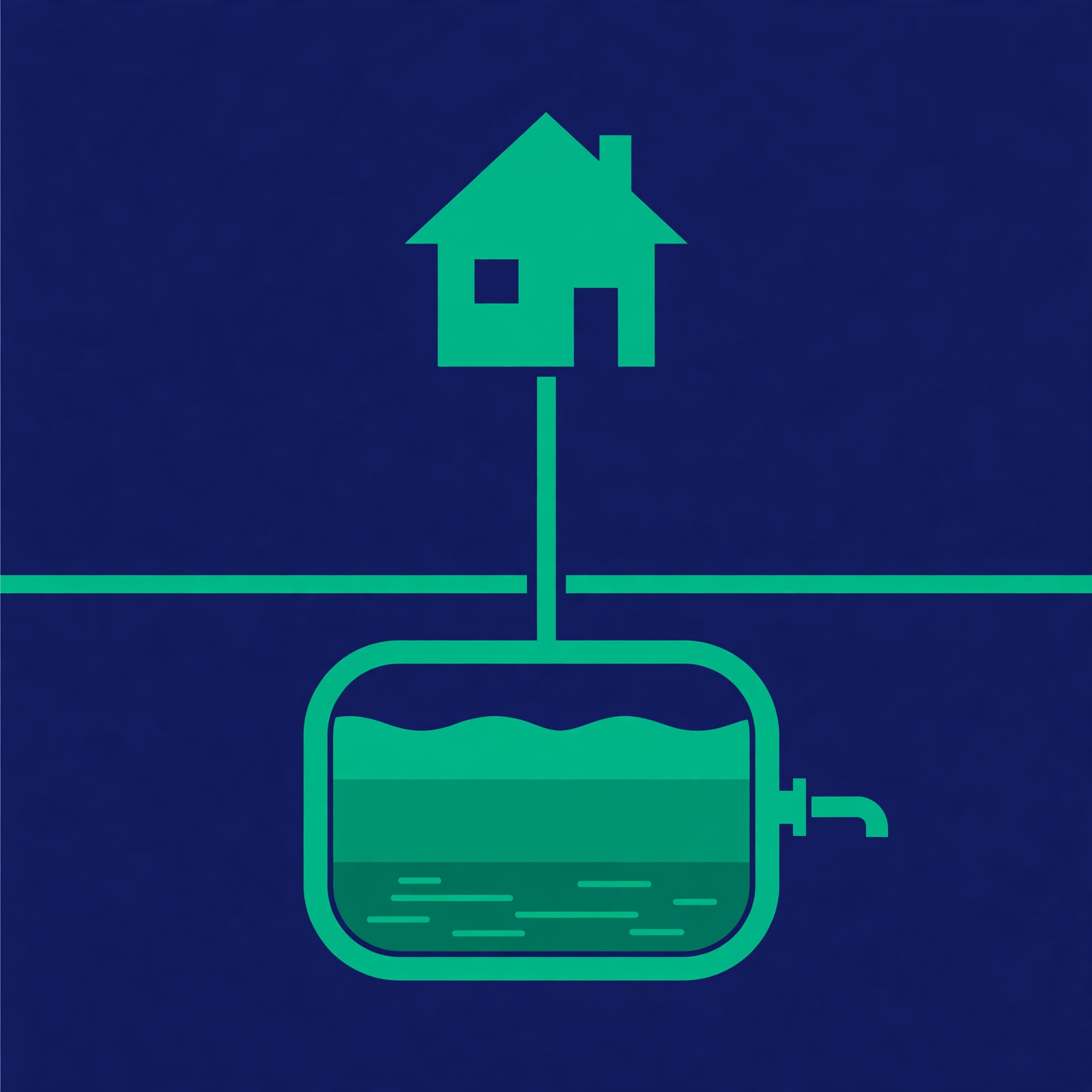
- Solids settle; scum floats. Your tank separates waste into three layers: sludge on the bottom, a clear zone in the middle, and a scum layer on top. Wastewater exits to the drain field from the clear middle zone — and only that zone.
- The one-third rule. The universal trigger for pumping: when the sludge and scum layers together take up about one-third of the tank’s depth, it’s time to pump. A bigger tank takes longer to reach that point; more people reach it faster.
- Garbage disposals change the equation. Grinding food waste into your drains sends roughly 50% more solids into the tank. If you use a garbage disposal regularly, move your interval toward the “more often” end — or have your sludge measured yearly until you know your real rate.
The chart is the calendar version of this math. But remember: the chart estimates — measurements decide. Which brings us to the inspection point the EPA keeps making.

5 Factors That Shift Your Pumping Schedule
The chart assumes an average household, average water use, and a tank in good condition. If any of these five factors describe your home, adjust accordingly.
1. Household size — including guests
The chart counts full-time residents, but part-time ones count too. Frequent overnight guests, a college kid home for the summer, or an in-law suite add up. Three months of extra occupants per year can shift your interval by half a year. When in doubt, round your household size up.
2. Your actual tank size
Many homeowners guess wrong here — and usually guess too big. If your house was built with a three-bedroom septic design but now sleeps six people, the math works against you. A smaller tank with more people is the fastest route to the short end of the chart. We show you how to find your real tank size below.
3. Garbage disposal use
As noted above, a garbage disposal can increase the solids load by roughly 50%. Heavy disposal users on small tanks sometimes need annual pump-outs. If you love your disposal, consider composting the bulk of your food scraps instead — your septic system will thank you.
4. Water use habits
Long showers, frequent laundry, and leaky fixtures push more water through the tank, which stirs up settled solids and carries them toward the drain field. A running toilet alone can waste hundreds of gallons a day — effectively adding an extra “person” or two to your household size. Fix leaks promptly; they’re septic saboteurs.
5. Tank age and condition
Older concrete tanks can develop cracks, and baffles can deteriorate — both of which let solids escape toward the drain field. If your system is more than 25 years old, shorten the chart’s interval and, more importantly, get professional inspections on the EPA’s 1-to-3-year schedule. An aging tank earns its maintenance.
How to Find Your Septic Tank Size
The chart is useless without your tank size, so let’s track it down. Start with the easy wins:
- Call your county health department or environmental health office. Most counties keep septic permits and “as-built” drawings on file, and these almost always list the tank size. This is the single most reliable source.
- Check your home inspection report. If you bought the home recently, the inspector often noted the tank size and type.
- Ask your septic pumper. If anyone has pumped the tank before, the invoice or service record usually lists the tank size. Your pumper may also know your system from neighborhood records.
- Look at the tank lid. Some tanks have the capacity stamped or stenciled on the lid or riser.
- Have it measured professionally. As a last resort, a septic professional can measure the tank’s dimensions through the access riser and calculate the volume. Never open or enter the tank yourself — septic gases are genuinely dangerous.
Once you know the size, drop it into the chart above and you’ve got your personalized interval.

When to Ignore the Chart and Call for an Inspection
Here is the most important sentence in this article: a chart estimates, but a sludge measurement decides. The EPA recommends a professional inspection every 1 to 3 years regardless of where you fall on the chart, because only an inspection measures your actual sludge and scum levels. Two identical households can accumulate solids at different rates depending on diet, cleaning products, medications, and plain luck.
Call for an inspection — don’t wait for your next scheduled pump-out — if you notice any of these warning signs like sewage smells in your home: slow drains throughout the house, gurgling toilets, unusually lush or soggy patches over the drain field, or any sewage backup. These symptoms mean the system is struggling now, and the calendar no longer matters.
One more honest note: if you’re hoping a bottle of bacteria or enzymes will stretch your interval, read our take on whether septic tank additives really work first. The short version: no additive replaces pumping. Schedule the pump-out; skip the magic bottle.
What Does Septic Pumping Cost?
Knowing when to pump naturally raises the question of how much. Pricing varies by region, tank size, and how accessible your tank is — if the crew has to dig to find the lid, expect to pay more. For a detailed breakdown with current regional numbers, see our guide on how much septic tank pumping costs. As a rule of thumb, one routine pump-out every few years is among the cheapest insurance policies a homeowner can buy.
The Bottom Line on Septic Tank Pumping Frequency
Forget “every 3–5 years” as a rule — use it as a starting point. Find your tank size, count your household honestly, and read your interval from the septic tank pumping frequency chart by household size above. Then put a professional inspection on your calendar every 1 to 3 years and let actual sludge measurements fine-tune the schedule. That’s the whole system: the chart for planning, inspections for truth.
New to septic ownership entirely? Our Start Here guide for new septic owners walks you through everything else your system needs — from what not to flush to how the drain field works. A well-maintained tank can serve your home for decades.
Greetings Glows Team is dedicated to creating meaningful, helpful, and thoughtfully curated content for everyday inspiration and special moments.
What We Focus On:
Well-researched and reader-friendly articles.
Meaningful greetings, blessings, prayers, and inspirational messages.
Carefully curated ideas for everyday life and special occasions.
Clear, helpful, and engaging information.
Consistent quality and attention to detail in every publication.
Our goal is simple: to make every visit worthwhile with content that inspires, informs, and brings a little more positivity to your day.
2 thoughts on “Septic Tank Pumping Frequency Chart by Household Size (2026)”