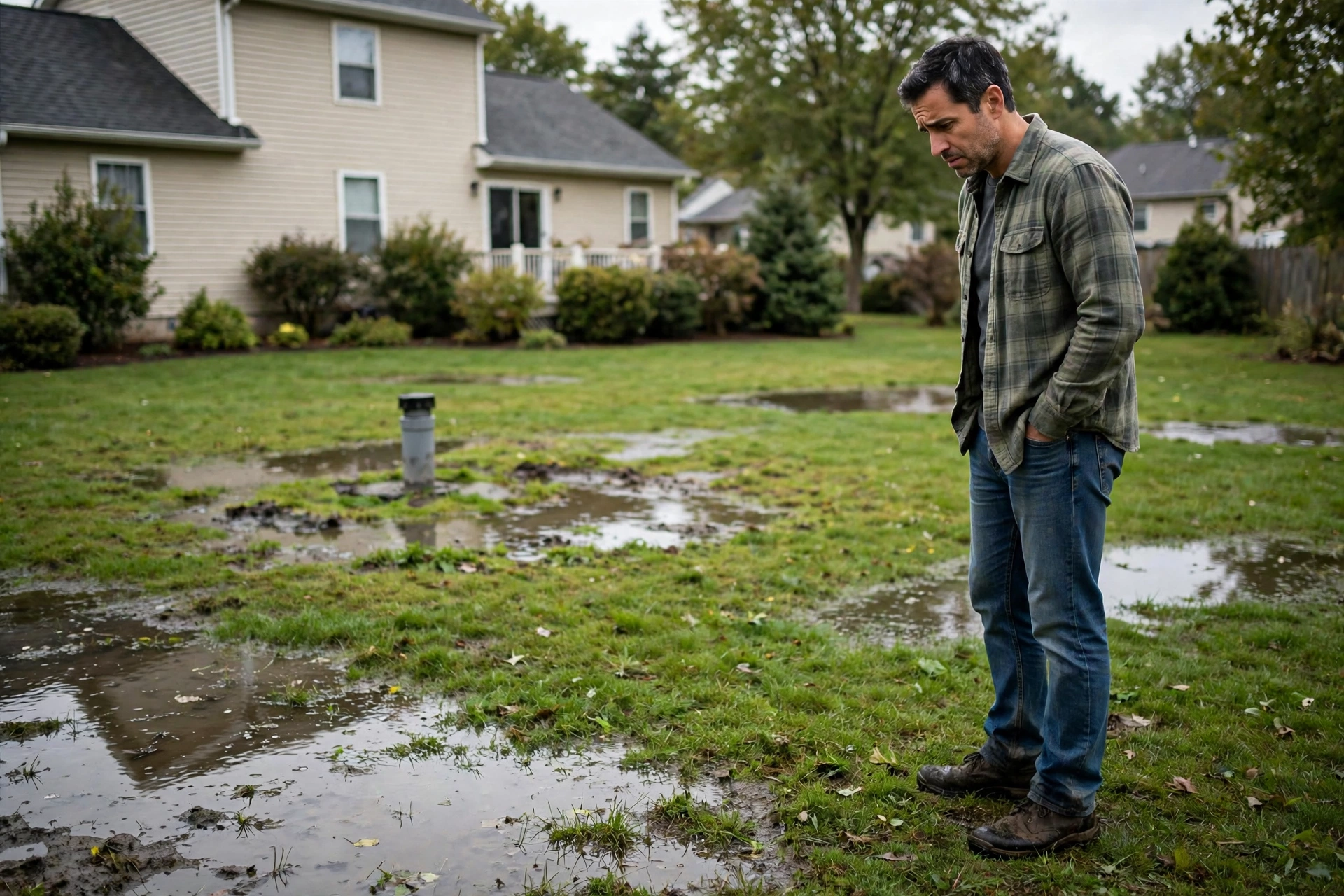
Finding a patch of standing water over your septic drain field is the kind of thing that stops you in your tracks. One day the yard looks normal, and the next there is a soggy, muddy area that was not there before, sitting right where your wastewater is supposed to be filtering safely underground. It is natural to wonder whether it is just rain, whether it will dry up on its own, and whether you need to worry at all.
The short answer is that standing water over a drain field deserves your attention. Sometimes the cause is simple, like a stretch of heavy rain or a downspout dumping water in the wrong place. But often it means the soil beneath your yard can no longer absorb wastewater the way it should, and that is a problem that tends to get worse if it is ignored. Catching it early gives you the best chance of a simple fix. This guide explains what standing water means, what usually causes it, how to tell it from an ordinary rain puddle, what to check first, what to avoid, and when to call a professional.
How a Drain Field Is Supposed to Work
To understand why water ends up pooling on the surface, it helps to know what is happening underground when everything works as it should. Your septic system has two main parts. The tank holds wastewater from your home long enough for solids to settle to the bottom and grease and scum to float to the top, and the liquid in the middle, called effluent, then flows out to the drain field.
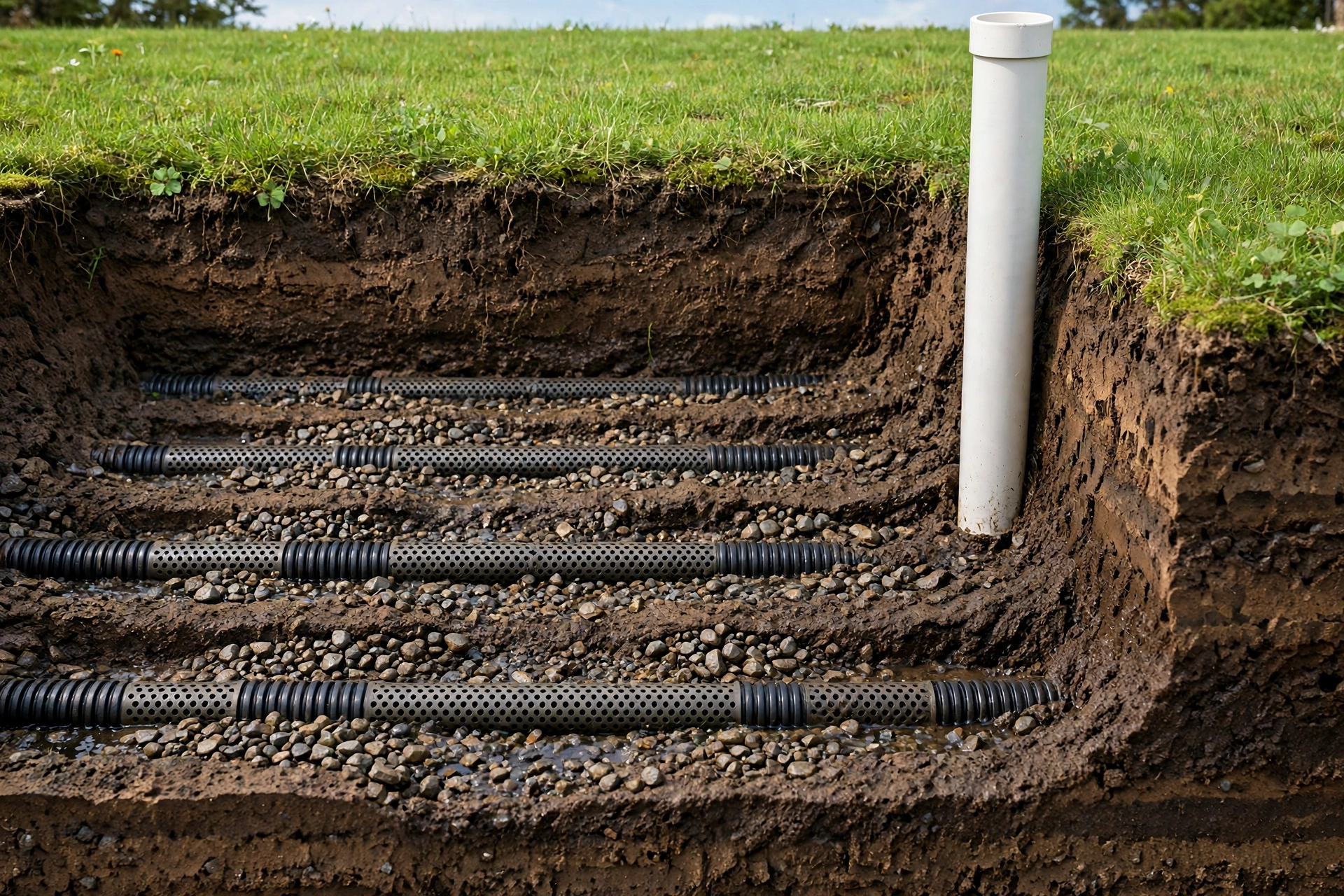
The drain field, also called a leach field, is a network of perforated pipes buried in gravel-filled trenches. Effluent trickles out of small holes in the pipes and seeps down through the gravel and into the soil below, where natural bacteria and soil microbes treat it as it moves slowly downward, removing harmful organisms and nutrients before the water rejoins the groundwater. A healthy drain field handles this quietly, day after day, with nothing visible on the surface at all.
The key point is balance. The field can only absorb so much liquid at a time, so as long as the amount of wastewater entering it stays within what the soil can take, the system works. Standing water appears when that balance breaks down: either too much liquid is arriving, or the soil has lost its ability to absorb it, and the excess has nowhere to go except up.
What Standing Water Over a Drain Field Means
When water pools above the drain field, it means effluent or groundwater is reaching the surface instead of filtering down through the soil. In plain terms, the final stage of your septic system is not doing its job, and the water you see may be partly treated wastewater, which is why this symptom should always be taken seriously.
Standing water does not automatically mean your whole system has failed. A field can be temporarily overwhelmed after days of heavy rain or unusually high water use, then recover once conditions return to normal. But water that lingers for days, appears during dry weather, or keeps coming back is a strong sign of a real problem underground. The longer it goes on, the more saturated the soil stays, and saturated soil treats wastewater poorly, so the wetter the field stays, the less it can absorb.
There is also a health side to this. Wastewater that reaches the surface can carry bacteria and other organisms that cause illness, and children, pets, and anyone tracking mud into the house can come into contact with it. Until you know what the water is, treat the area as contaminated, keep people and pets away, and avoid walking through it.
How to Tell Standing Water Apart From an Ordinary Rain Puddle
Not every puddle in a yard is a septic problem. Low spots collect rainwater, compacted ground drains slowly, and a clogged gutter can create a wet patch almost anywhere. Before you worry about the septic system, spend a little time figuring out what kind of water you are looking at.
| What to check | Ordinary rain puddle | Possible septic effluent |
|---|---|---|
| Timing | Appears with rain, then dries within a day or two | Stays for days after rain, or appears in dry weather |
| Location | Any low spot, near downspouts, or at the bottom of a slope | Directly over the drain field trenches, often in strips matching the trench layout |
| Smell | No smell, or a mild earthy smell | A sewage or rotten egg smell, especially on warm or humid days |
| Appearance | Clear or slightly muddy rainwater | Murky, grey, or dark water, sometimes with a greasy film |
| Grass around it | Grass looks the same as the rest of the yard | Grass over the field is unusually green, lush, or fast growing |
| What happens indoors | Drains and toilets work normally | Slow drains, gurgling toilets, or backups |
The single most useful clue is timing. A puddle that shows up after a storm and disappears as the yard dries is most likely rainwater, while a wet patch that stays soggy for several days without rain points toward the septic system. Smell is the second best clue: rainwater does not smell like sewage, so treat foul-smelling water as wastewater and keep everyone away from it.
Location matters too. If you know roughly where your drain field is, compare the wet area with that layout. Water that follows the lines of the buried trenches, in long strips or a rectangular pattern, is a classic sign of effluent surfacing, while a round puddle in the lowest corner of the yard is more likely a grading or drainage issue. Watch the grass as well: effluent carries nitrogen, which acts as fertilizer, so a strip of grass that is greener and faster growing than the rest of the lawn is another quiet warning sign. If you are not sure where your field is, your property records or a past service report may show it, and a professional can locate it for you.
Common Causes of Standing Water Over a Drain Field
Several different problems can produce the same wet patch, and the right fix depends on which one you are dealing with.
Saturated soil and a high water table
Soil can only hold so much water. After long periods of rain, snowmelt, or a seasonally high water table, the ground around the drain field may already be full before any wastewater arrives, leaving effluent nowhere to go except up. This is more likely in yards with heavy clay soil, which drains slowly, and in low-lying areas where groundwater sits close to the surface. If the problem appears mainly in wet seasons and clears up in dry weather, groundwater may be the main factor, though a professional still needs to confirm the system itself is healthy.
A full or overdue septic tank
When a tank is not pumped on schedule, solids build up until they reach the outlet and flow into the drain field, clogging pipes and coating the soil until the field slowly loses its ability to absorb liquid. Pumping the tank is the single most important maintenance task for protecting the field, and most households need it every three to five years. Our pumping frequency chart by household size can help you work out where your home falls in that range. If your tank has not been pumped in years and water is now surfacing, the tank is the first thing a professional will check.
Clogged or damaged pipes and a failing distribution box
Effluent leaves the tank through the outlet baffle and passes through a distribution box, which is supposed to send an even share of liquid to each trench in the field. If the outlet baffle is blocked, the distribution box is cracked or tilted, or a pipe is crushed or broken, liquid stops spreading evenly, and one trench gets overloaded while the others sit idle. Roots, shifting soil, and age can all damage these parts, and a camera inspection or a dye test can usually pinpoint the problem.
Biomat buildup in the trenches
A biomat is a thin, naturally occurring layer of bacteria and organic material that forms where effluent meets the soil in the trenches. A thin biomat is normal and even helpful, because it filters the effluent as it passes through. But when a tank is neglected or the field is overloaded for a long time, the biomat grows thick and slimy and seals off the soil beneath it, so effluent can no longer percolate downward as fast as it arrives and backs up toward the surface, which is why a field that worked fine for years can suddenly start ponding.
Too much water entering the system at once
Every drain field has a limit on how much water it can handle in a day. A house full of guests, several loads of laundry back to back, long showers, and a running toilet can push a large volume of water into the system in a short time, and a leaking toilet or dripping faucet adds to the load quietly, day after day. When the inflow exceeds what the soil can absorb, the field floods and water surfaces, so spread laundry loads across the week and fix leaks promptly.
Tree and shrub roots
Roots grow toward moisture, and a drain field is a reliable source of it. Trees and large shrubs planted over or near the field can send roots into pipe joints and cracks, where they grow into dense mats that block flow or break the pipe apart, often unnoticed until water starts surfacing or drains slow down. This is one reason planting deep-rooted trees near a drain field is discouraged, and why removing a problem tree sometimes becomes part of the repair.
Compacted soil and heavy traffic over the field
Soil needs open pore space for water to move through it. Driving cars over the field, parking on it, or running heavy equipment across it compresses the soil and crushes the shallow pipes underneath, and construction work, paving, or a new shed built over the field can do the same. Once soil is compacted, its ability to absorb effluent drops sharply, and the field may never fully recover without repair, so keeping vehicles and heavy equipment off the field is one of the easiest ways to protect it.
Heavy rain and poor surface drainage
Sometimes the water is coming from above rather than below. Roof runoff, gutters, and downspouts that discharge over or uphill of the field can dump large amounts of rainwater onto the same patch of ground, and poor grading or a driveway that drains onto it has the same effect. Redirecting gutters and regrading the surface can solve it, but do not assume this is the cause without checking, because a field that is already struggling will look the same way.
What to Check First
If you notice standing water over your drain field, a few calm, careful checks can help you understand what you are dealing with before you call anyone. None involve digging or opening the system, and none put you in contact with the water.
Start by looking at the weather and the calendar. Has it rained heavily in the last few days, and is the water getting bigger, staying the same, or slowly drying? A puddle that shrinks steadily after a storm is behaving like rainwater, while one that stays put or grows during dry weather is not. Next, check inside the house: run a tap, flush a toilet on the lowest floor, and listen for gurgling or slow draining, and check the lowest fixtures, such as a basement floor drain, for water backing up. If several fixtures are slow at the same time, the problem is in the shared system rather than a single drain, which points back to the tank or the field.
Walk the yard and look at the shape and spread of the wet area. Is it a strip or rectangle that could match buried trenches, or a round low spot? Is the grass over it greener or taller than the grass around it, and does the smell get stronger when you stand close? Take a photo and note the date, so you can show a professional exactly what you saw. Finally, check your records. When was the tank last pumped, and how old is the system? A tank that has not been pumped in five or more years is far more likely to have a field problem, and having these dates ready makes the professional visit faster.
What Not to Do
It is tempting to try to fix a wet yard quickly, but a few common reactions make the problem worse or create a health risk. The first is to keep using water as normal: every flush, shower, and laundry load sends more liquid into a field that already cannot cope. Cut back on nonessential water use right away by postponing laundry, taking shorter showers, and fixing any running toilet or leaking tap.
Do not walk through the standing water, and do not let children or pets play in or near it. If the water is effluent, it can carry organisms that cause stomach illness and skin infections, so wear boots and gloves if you must go near the area, and wash your hands and shoes afterward.
Do not try to drain the water elsewhere by digging a channel or a pit. Digging into a drain field can break pipes, and moving wastewater across the yard spreads contamination and can put you in conflict with local health rules. Do not open the tank or try to pump it yourself, and do not pour chemicals, additives, or drain cleaners into the system. These products do not restore a saturated field, and some can harm the bacteria the system depends on.
Do not drive over the wet area, park on it, or bring heavy equipment across it, since extra weight compacts the soil further and can crush pipes that are already under stress. Do not cover the area with soil or mulch to hide the water either, since that traps moisture against the field. And do not assume the problem will dry up if you wait: a rain puddle will dry, but a saturated field surfacing effluent usually will not, and the longer the soil stays waterlogged, the harder it becomes for the field to recover.
When Standing Water Is an Emergency
Some situations need a professional the same day, not next week. Call a licensed septic company right away if sewage is backing up into the house through a floor drain, a toilet, or a shower. That means the system has nowhere left to send wastewater, and the risk of damage and contamination inside the home is immediate.
Call the same day if the standing water smells strongly of sewage, looks dark or murky, or has a visible film or slimy growth on it. That is very likely effluent reaching the surface, and it is an active health hazard, so keep children and pets away and avoid contact with the water.
Also treat it as urgent if the wet area is spreading quickly, if you see water bubbling from the ground, or if the problem appeared suddenly along with slow drains throughout the house. A sudden change like that can mean a pipe has broken or the tank has backed up.
If you are unsure whether your situation counts as an emergency, it is always better to call and describe what you see than to wait. A reputable septic company can tell you over the phone whether you need a same-day visit. Our guide on when to call a septic professional immediately covers the warning signs that should never wait.
Repair Options and What the Process Looks Like
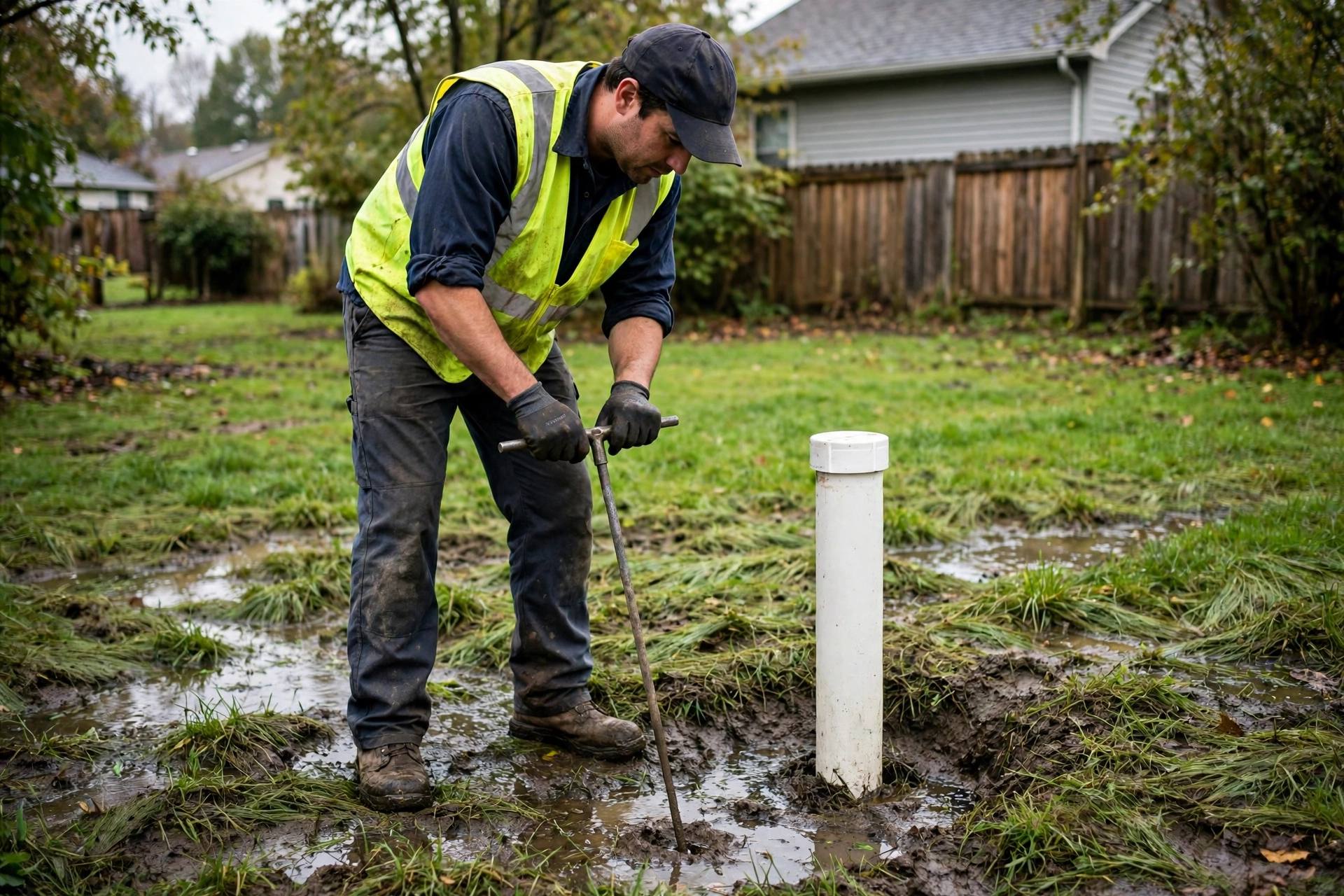
There is no single fix for standing water over a drain field, because the right repair depends on the cause. A professional inspection comes first: locating the tank and the field, checking the liquid level in the tank, and looking at the distribution box and pipes. Depending on what they find, they may run a camera through the lines, do a dye test to trace where water is going, or dig a small test pit to look at the soil and the biomat. Only then can they say which repair makes sense.
| Problem found | Typical repair | What it involves |
|---|---|---|
| Full or overdue tank | Pumping and inspection | The tank is pumped, the baffles and outlet are checked, and the field gets a chance to drain |
| Clogged or broken pipe | Jetting or pipe repair | High-pressure water clears blockages, or the damaged pipe section is replaced |
| Tilted or cracked distribution box | Leveling or replacing the box | The box is dug up, leveled again, or replaced |
| Root intrusion | Root removal and pipe repair | Roots are cut out, damaged pipe is replaced, and the offending tree may need removing |
| Surface water flooding the field | Redirecting runoff and regrading | Gutters and downspouts are moved, and the ground is regraded so rainwater drains away |
| Thick biomat or tired soil | Resting the field or soil treatment | Water use is reduced so the field can dry and recover |
| Failed or worn-out field | Partial or full replacement | New trenches are installed, sometimes in a reserve area, and the old field is retired |
Pumping the tank is usually the first step, and it is also a diagnostic tool. If the field starts working again after pumping, the problem may have been overload rather than failure. If water keeps surfacing, the trouble is in the field itself.
Resting a field is sometimes enough when the problem is caught early: cut household water use sharply for several weeks so the soil can dry out, the biomat can thin, and oxygen can return to the trenches. It is not a guaranteed fix, and it only works if the soil and pipes are still in reasonable shape, but it is the least disruptive option and is often tried before bigger repairs.
When a field is genuinely worn out, partial or full replacement is the honest answer. Drain fields do not last forever, and soil that has been saturated for years may not recover its ability to absorb effluent. Replacement usually involves installing new trenches, often in a reserve area set aside when the system was first built. It is the most disruptive and expensive option, which is why early inspection and regular maintenance matter so much. No one can give a useful price without seeing the property, so be cautious of any quote offered before an inspection.
Additives and treatments sold as field restorers do not replace any of these repairs. A thick biomat and compacted soil cannot be cleared by pouring a product down a drain, and some additives can make matters worse by disturbing the bacterial balance in the tank. Save your money for the inspection and the actual repair.
How to Prevent Standing Water Over Your Drain Field
Most drain field problems build up slowly over years, which means most of them can be prevented with steady, simple habits. The single most effective habit is pumping the tank on schedule, because regular pumping keeps solids out of the field, and solids in the field are what thicken the biomat and clog the soil. If you are not sure when your tank was last pumped, start there.
Watch your water use. Spread laundry across the week instead of doing it all in one day, run full loads rather than half loads, and fix running toilets and dripping taps promptly. A toilet that runs constantly wastes a large amount of water every day.
Keep the area above the field clear and protected. Do not drive or park on it, do not build sheds, patios, or paving over it, and do not plant trees or large shrubs nearby. Grass is the best cover for a drain field, because its roots are shallow and it helps take up moisture. Keep gutters and downspouts pointed away from the field, and make sure the ground slopes away so rainwater does not collect there. Be careful about what goes down your drains too: grease, coffee grounds, wipes, and harsh chemicals all make the system work harder and can contribute to the buildup that eventually chokes a field.
When to Call a Septic Professional
Call a licensed septic professional whenever standing water over your drain field lasts more than a day or two after rain, appears during dry weather, smells like sewage, or comes with slow drains or gurgling fixtures inside the house. These are all signs that the system needs a trained eye and proper equipment, not guesswork.
Call sooner rather than later even if the water seems minor. A field that is starting to struggle is much easier to help than one that has been surfacing effluent for months, and the inspection gives you a clear answer about whether you are looking at a full tank, a blocked pipe, saturated soil, or a field nearing the end of its life.
When you call, be ready to describe what you see: where the water is, how long it has been there, whether it smells, what the weather has been like, and when the tank was last pumped. Share any photos and notes from your own checks, so the company can judge how urgent the visit is. If the first company you call cannot come soon and your situation is urgent, call another one rather than waiting.
For general guidance on septic care, the EPA septic systems page at epa.gov/septic is a reliable place to start. It explains how septic systems work and what homeowners can do to keep them running.
Frequently Asked Questions
Does standing water over a drain field always mean the system has failed?
No. Heavy rain, a high water table, or a few days of very high water use can overwhelm a healthy field for a short time, and it may recover once things dry out. It becomes a sign of failure when it lingers for days without rain, keeps coming back, or appears alongside sewage odors, slow drains, or unusually lush grass over the field.
How long should I wait to see if the water dries up?
Give a rain puddle a day or two of dry weather. If the ground is still soggy after two or three dry days, or if the water has a smell, do not wait longer. Call a professional and cut back on water use in the meantime.
Will pumping the tank fix standing water over the drain field?
Sometimes. If the cause is a full tank pushing solids and excess liquid into the field, pumping can relieve the pressure and give the field a chance to recover, especially if water use is kept low afterward. But if the pipes are damaged, the biomat is thick, or the soil itself is worn out, pumping alone will not solve it.
Is standing water over a drain field dangerous?
It can be. If the water is effluent, it may carry bacteria and other organisms that cause illness, and it should be treated as contaminated until proven otherwise. Keep children and pets away, avoid walking through it, and wash up after any contact. If the water is simply rainwater, it is not a health risk, but you still need to confirm which one it is.
Standing water over your septic drain field is your system asking for attention, and the best response is a calm, prompt one. Work out whether the water is rain or effluent, cut back on water use, keep people and pets away, and get a professional inspection if the water lingers, smells, or comes with indoor symptoms. Regular pumping, sensible water use, and keeping traffic and trees off the field will do more to prevent the next wet patch than any product or quick fix.
Greetings Glows Team is dedicated to creating meaningful, helpful, and thoughtfully curated content for everyday inspiration and special moments.
What We Focus On:
Well-researched and reader-friendly articles.
Meaningful greetings, blessings, prayers, and inspirational messages.
Carefully curated ideas for everyday life and special occasions.
Clear, helpful, and engaging information.
Consistent quality and attention to detail in every publication.
Our goal is simple: to make every visit worthwhile with content that inspires, informs, and brings a little more positivity to your day.
3 thoughts on “Standing Water Over Your Septic Drain Field: What It Means and What to Do”