It rained hard all night, and now something is wrong with your septic system. The toilets flush slowly, the drains gurgle, and there is a damp patch in the yard that was not there yesterday. If this sounds familiar, you are dealing with one of the most common weather-related headaches for homeowners with a septic system. Septic problems after heavy rain are usually temporary, but they can turn serious fast if you respond the wrong way.
A septic system depends on the soil around it. The tank separates solids from liquids, and the drain field lets treated wastewater soak slowly into the ground, where soil microbes finish cleaning it. That process only works when the soil has room to take in more water. A long, heavy rain fills that space. When the ground is already full of rainwater, your wastewater has nowhere to go, so it moves slowly, backs up, or surfaces in the yard. Most systems recover on their own once the soil dries out. A few common mistakes, like pumping a flooded tank or running extra loads of laundry to catch up, can turn a short delay into expensive damage.
This guide explains why rain causes septic trouble, which warning signs matter most, what to do in the first hours after a storm, what to avoid, and how to protect your system before the next one. If sewage is backing up into your home right now, stop using water and call a septic professional immediately.
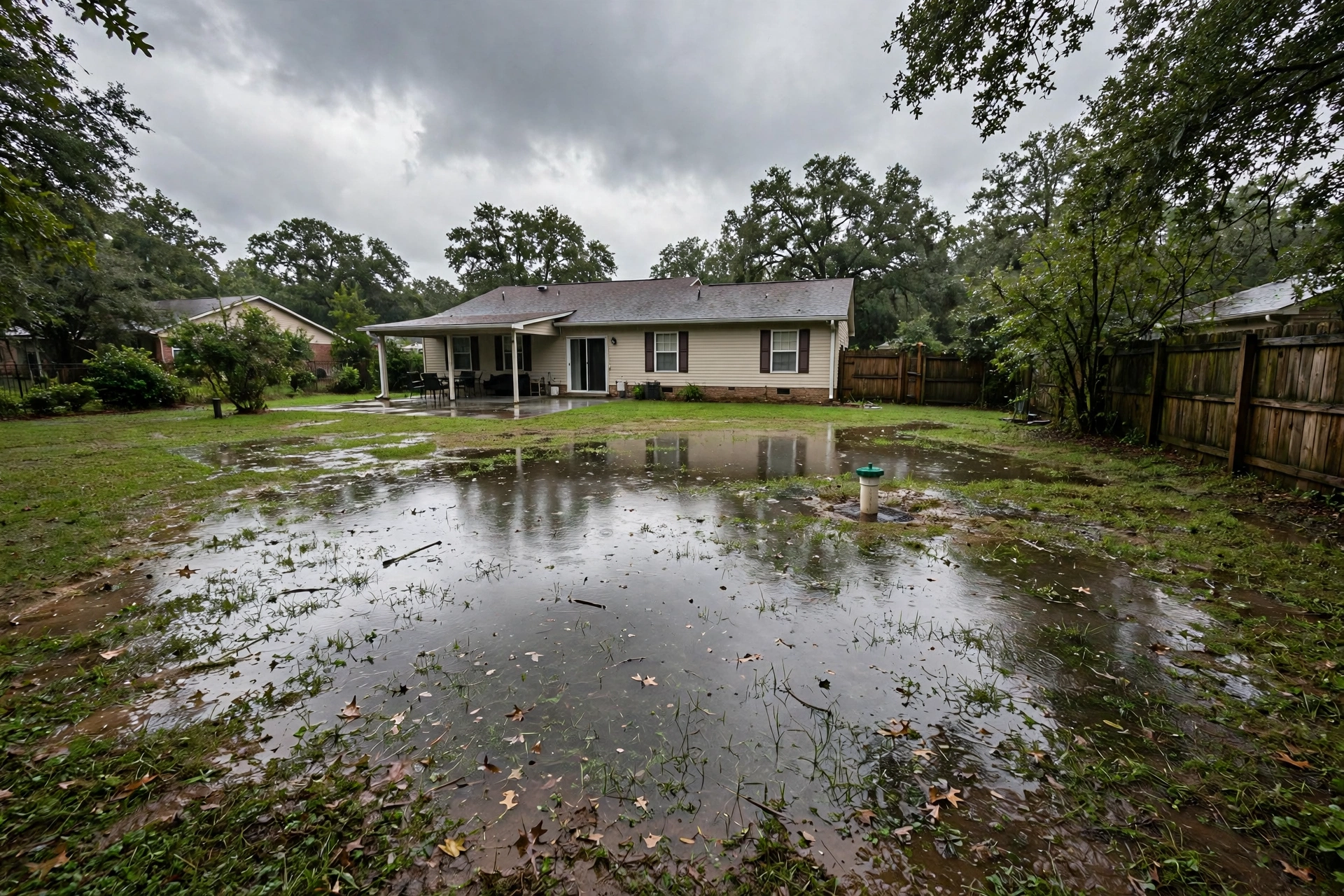
How Heavy Rain Causes Septic Problems
To understand why rain disrupts a septic system, it helps to picture how the system normally works. Wastewater from your home flows into the septic tank, where heavy solids sink to the bottom and lighter material floats to the top. The liquid in the middle flows out to the drain field, a network of perforated pipes buried in gravel trenches. That liquid seeps out of the pipes and into the soil, which filters it and lets naturally occurring microbes break down what remains. The whole design assumes the soil is dry enough to accept a steady flow of liquid, day after day.
Heavy rain changes that assumption. Soil can only hold so much water at a time. Once its pores are full, it cannot absorb more, no matter how well your system was designed. Effluent leaves the tank more slowly, the tank fills higher than usual, and the drains inside your house start to show it. This is why septic problems after heavy rain so often appear suddenly, even in a system that worked perfectly the week before. Nothing broke. The ground simply ran out of room.
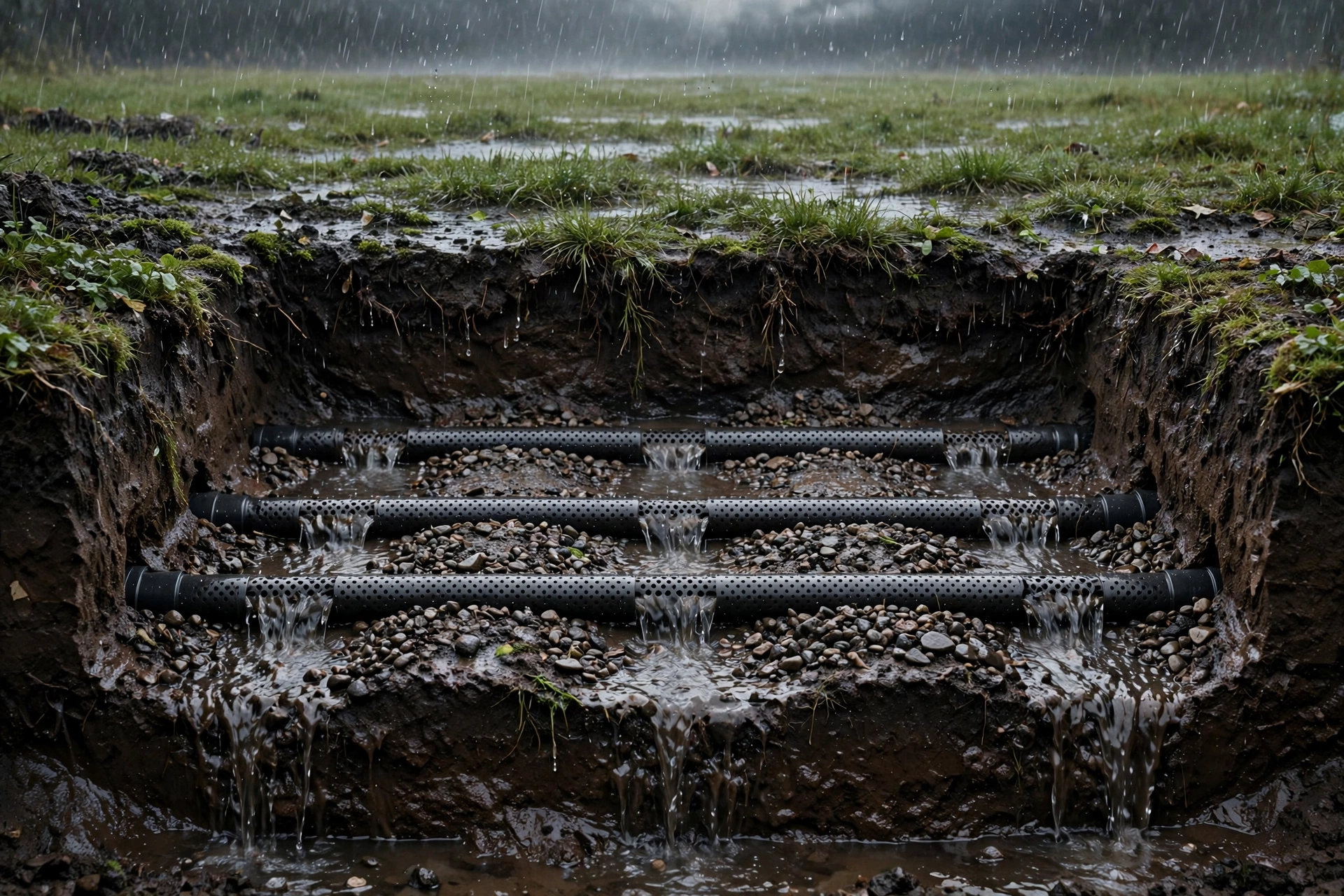
A Saturated Drain Field
The drain field is where rain causes the most trouble. In normal weather, the soil beneath and around the trenches absorbs effluent as fast as it arrives. After days of steady rain, or one very intense downpour, that soil becomes saturated. Think of a sponge that is already soaking wet. Pour more water on it and the water just sits on the surface. That is exactly what happens in a saturated drain field. Effluent cannot soak away, so it stays in the pipes and trenches, and the water level in the whole system rises.
Sandy soil usually recovers faster than clay, because sand drains more freely. Clay holds water for much longer, which is why homes on heavy clay soil often notice rain-related septic problems lasting several days after the storm has passed. A drain field at the bottom of a slope collects runoff from the whole yard, so it saturates faster and stays wet longer than one on level ground.
A Rising Water Table
Rain does more than wet the surface soil. A large storm also raises the water table, the level underground where the soil is permanently saturated. In areas where the water table is already close to the surface, a heavy rain can lift it up into the drain field itself. When that happens, the trenches are sitting in groundwater. Effluent has no dry soil to move into, and in the worst cases, groundwater can even flow backward into the system through the pipes.
A high water table is a seasonal problem in many parts of the country. Low-lying properties and homes near rivers, lakes, or wetlands are the most vulnerable. If your system struggles after every significant rain, not just the rare storm, a high water table may be part of the story.
A Flooded Septic Tank
In a severe storm, the tank itself can flood. Surface water running across the yard can enter through a loose or damaged lid, a cracked riser, or an inspection port that sits too low. Once rainwater gets in, it stirs up the contents of the tank and can push solids toward the outlet and into the drain field, where they can clog the pipes. A flooded tank also loses its ability to separate solids from liquids properly, which means partly treated wastewater may reach the drain field.
Rain can also enter the system from inside the house. In some older homes, the sump pump or the foundation drains are connected into the septic system, so every gallon of groundwater the pump moves during a storm goes straight into the tank. A sump pump can move hundreds of gallons in a single rainy day, far more than the system was designed to handle. If your septic system struggles after every heavy rain even though the yard looks fine, ask a professional to check whether any pumps or drains are tied into it. Those connections should be redirected to daylight or a storm drain, not into the septic tank.
Warning Signs of Septic Problems After Heavy Rain
The signs of a rain-stressed septic system usually show up in a clear pattern, starting inside the house and moving outside. Most of them appear during the storm or within a day after it. Taken one at a time, a single slow drain might mean nothing. Several of these signs together, all starting right after heavy rain, point strongly at a saturated system.
Slow drains are usually the first thing people notice. Sinks, tubs, and showers empty more slowly than usual, and the effect is spread across the house rather than limited to one fixture. When only one drain is slow, the problem is often a local clog. When several drains slow down at the same time, the problem is further downstream, which is exactly what a saturated drain field causes. Toilets are often the most obvious indicator. A toilet that flushes weakly or needs a second flush after a storm is telling you the system is backed up. If every toilet in the house is slow at once, the cause is almost always downstream of the fixtures, and our guide to toilets flushing slowly all at once explains how to tell a system-wide problem from a fixture problem.
Gurgling sounds are another early warning. If you hear bubbling from a toilet or a drain when another fixture is used, air is trapped in the pipes because wastewater cannot flow freely. The sound itself is not dangerous, but it means the system is under strain, and it is worth paying attention to before the strain becomes a backup.
Sewage smells are a sign to take seriously. A faint odor near the drain field after a storm can happen when the soil is saturated and gases escape more easily. A strong smell inside the house, or a smell that grows stronger over a day or two, suggests wastewater is not moving where it should. If the smell is strong, or if it is accompanied by slow drains, cut back on water use right away and keep an eye on the lowest drains in the house.
Standing water over the drain field is the most visible outdoor sign. After heavy rain, some puddling across the whole yard is normal. Water that lingers only over the drain field, stays for days after the rest of the yard has dried, or smells of sewage is different. It means effluent is surfacing because the soil cannot take it in. You can read more about standing water over a septic drain field and what it usually means. Spongy ground over the drain field is a related sign. If the grass feels soft and wet underfoot in that one area while the rest of the lawn is firm, the soil there is holding more water than it can handle.
The most urgent sign is a sewage backup into the home. Wastewater coming up through a floor drain, a shower, or a low toilet means the system has nowhere left to send it. This is a health hazard, not just an inconvenience. Stop using water, keep everyone away from the affected area, and call a professional. Do not try to fix a backup yourself by plunging repeatedly or pouring chemicals down the drain.
| Symptom | Likely cause after heavy rain | What to do |
|---|---|---|
| Several drains running slowly | Saturated drain field cannot absorb effluent | Cut water use and wait for the soil to dry |
| Toilets flushing weakly or gurgling | Wastewater backing up as the tank fills | Limit flushing and showers, watch for worsening |
| Gurgling when another fixture runs | Air trapped by slow-moving wastewater | Reduce water use and monitor the lowest drains |
| Sewage smell inside or outside | Effluent surfacing or gases escaping from saturated soil | Cut water use, ventilate, call a professional if strong |
| Standing water over the drain field | Soil fully saturated, effluent has nowhere to go | Keep people and pets away, do not drive over it |
| Spongy or extra green grass over the field | Excess moisture and nutrients near the surface | Note the area and check it again after dry weather |
| Sewage backing up into the home | System overwhelmed, wastewater has no outlet | Stop all water use and call a professional now |
What to Do Right Away After Heavy Rain
The first hours after a storm are when your choices matter most. A saturated system needs one thing above all else, which is less water coming in while the soil dries out. Everything you do in this period should serve that goal. The steps below are in the order that helps most, and none of them require special tools or knowledge.
Start by cutting back on water use. This is the single most helpful thing you can do. Postpone laundry, hold off on the dishwasher, and take short showers instead of baths. If you have a large family, spread the showers out across the day rather than running them back to back. Every gallon you keep out of the system is a gallon the soil does not have to absorb while it is already full.
Next, check the lowest drains in your home. The fixtures closest to the ground, usually a basement floor drain, a ground-floor shower, or a low toilet, will show a backup first. Look for water rising in them or any sign of sewage. If they are clear and dry, that is a good sign. If you see water, stop using water in the house until you have spoken to a professional. Catching a backup early, before it spreads across a floor, can save a great deal of cleaning and repair.
Walk the yard once the rain has eased and it is safe to go outside. Look at the drain field and the area over the tank. Note where water is standing, whether it smells, and whether the ground feels spongy. Take a photo or two with your phone, because the pattern of standing water is useful information for a septic professional if you end up calling one. While you are out there, check that your gutters and downspouts are still directing water away from the drain field.
Treat any standing water over the drain field as if it contains sewage, because it very well may. Keep children and pets away from it, do not walk through it, and do not let anyone play in it. If you step in it, wash your hands and boots thoroughly with soap and water afterward, and keep it away from vegetable gardens and wells. Standing water that smells of sewage or looks grey and murky should be reported to a septic professional right away rather than waited out.
Finally, give the system time. Most rain-related septic problems improve on their own as the soil dries. Resist the urge to fix the problem by flushing repeatedly to test the drains, because each test flush adds water to a system that is already overloaded. Check the drains once or twice a day instead. If they are gradually improving, the soil is recovering. If nothing changes after a few days of dry weather, or if things get worse, it is time to call a professional. Patience is not always easy when the toilets are slow, but with a saturated drain field, waiting is often the actual fix.
What Not to Do After Heavy Rain
Some of the most natural reactions to a struggling septic system are the ones that cause the most damage. When the drains are slow and the yard is wet, it is tempting to take action, any action, to get things moving again. Most of the time, the right action is to do less, not more. The mistakes below are common, and each one can turn a temporary problem into a lasting one.
Do not pump the tank while the ground is still saturated. This is the most important rule in this guide, and it surprises many homeowners, because pumping sounds like the obvious fix for a full system. The problem is that an empty tank in wet soil can float. A septic tank is heavy when it is full of wastewater, and that weight holds it in place against the pressure of groundwater in the surrounding soil. Pump it out while the soil is saturated, and the groundwater can lift the tank, shift it, crack the pipes, and break the seals. Repairing a floated tank is far more expensive than waiting a few days. Wait until the ground has dried before scheduling a pump-out.
Do not use extra water to catch up. After a storm, it is tempting to run several loads of laundry at once, take long showers, and run the dishwasher to get back to normal. Each of those loads sends water into a system that is already struggling. Space the work out. Do one load of laundry a day, keep showers short, and run the dishwasher only when it is full.
Do not drive or park over the drain field or the tank. Wet soil compacts easily, and the weight of a car or truck can crush drain field pipes or compact the soil so tightly that it absorbs water more slowly in the future. Keep vehicles, trailers, and heavy equipment off the whole septic area.
Do not pour additives, chemicals, or drain cleaners into the system hoping to clear it. Additives cannot dry out saturated soil, and they will not make effluent soak away faster. Harsh drain cleaners can kill the bacteria that your system depends on to break down waste, which makes recovery slower, not faster. A saturated drain field is a soil problem, not a chemical problem, and no product poured down a drain will change the condition of the soil. Save your money and let the ground dry.
Do not open the tank or try to inspect it yourself. Septic tanks contain gases that can be dangerous in an enclosed space, and an open tank is a serious fall hazard. If a lid has shifted or you suspect the tank has flooded, leave it alone and call a professional. The same applies to digging around the drain field to see what is happening underground. Observation from the surface is enough for a homeowner.
Do not ignore a backup. If sewage is coming into your home, it will not get better on its own while you keep using water. Stop using water, keep people away from the affected area, and call a septic professional.
When to Call a Septic Professional
Most septic problems after heavy rain clear up on their own, but some do not, and knowing the difference is what keeps a small problem small. The general rule is simple. If the ground has had a few days of dry weather and your symptoms are not improving, get the system checked. If symptoms are getting worse at any point, do not wait for dry weather. Call sooner.
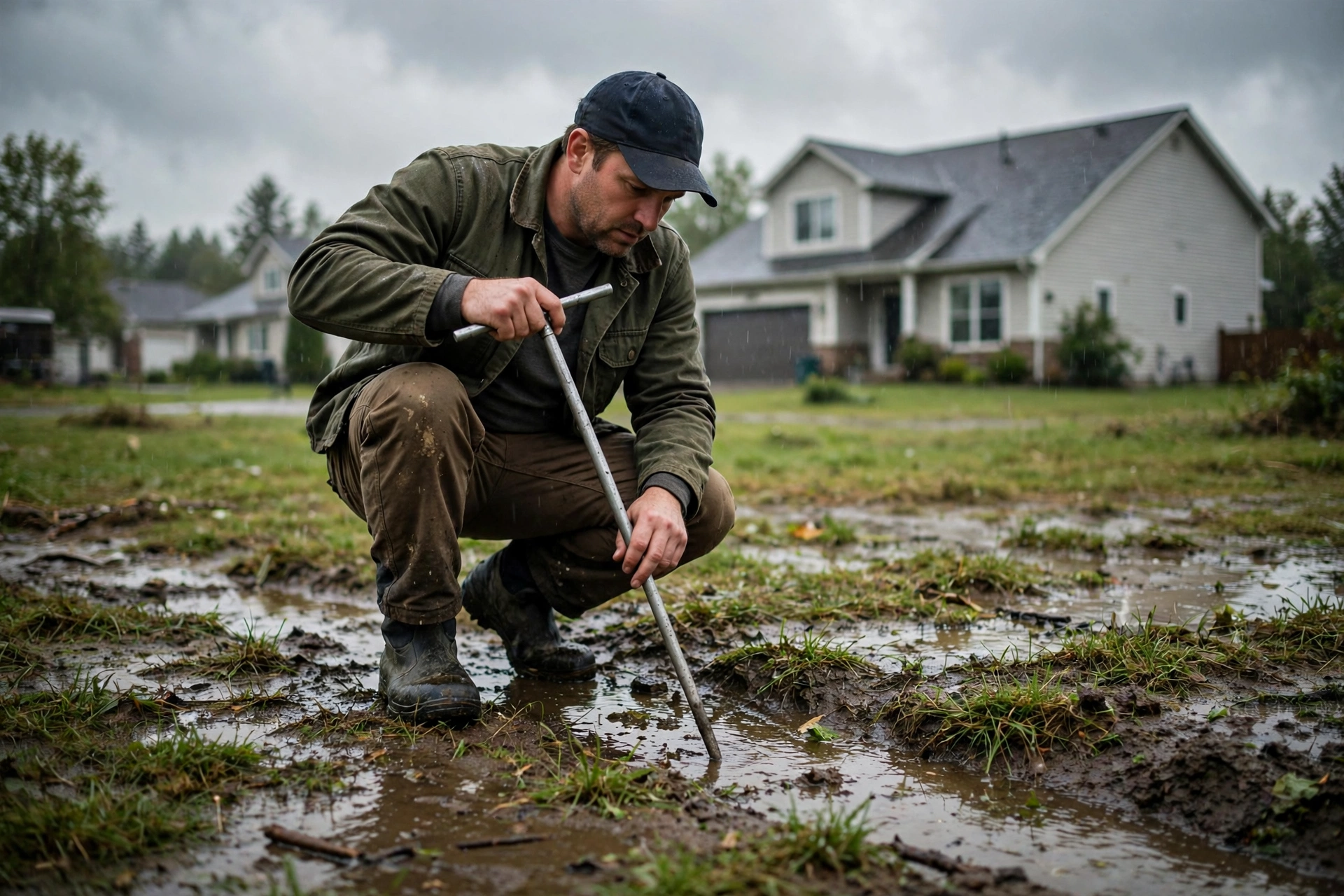
Call a professional right away if sewage is backing up into your home, if standing water over the drain field smells strongly of sewage, or if the ground over the field stays soggy long after the rest of the yard has dried. These are signs that the problem goes beyond temporary saturation. A professional can check the tank level, inspect the outlet baffle, test whether the drain field is accepting water, and look for damage to pipes or the tank itself. That inspection usually settles the question of whether the system just needs more drying time or whether something needs repair.
Repeated problems deserve attention even when each episode clears up on its own. If your system struggles after every moderate rain, not just the rare storm, something structural may be wrong. The drain field could be undersized for your household, the soil could be poor at absorbing water, the water table could be too high, or the tank could be overdue for pumping. A tank that is already full of solids has less room for liquid, so even a moderate rain can push it over the edge. Our guide on what happens if you never pump your septic tank explains how neglected maintenance slowly reduces the capacity a system has in reserve.
When you call, describe what you observed and when it started. Tell the company how much rain fell, which symptoms appeared, whether the problem is getting better or worse, and whether this has happened before. Photos of standing water will help them judge urgency. If they suggest pumping right away while the ground is still wet, that is a warning sign about the company, not about your system.
For authoritative guidance on septic care after flooding, the EPA septic systems page is a useful starting point, with homeowner guidance on maintenance and what to do when a system floods. Local health departments can also advise on rules in your area, since some counties require an inspection after a system has flooded or backed up.
How Long to Wait Before Normal Use
There is no single answer to how long a septic system takes to recover after heavy rain, because it depends on your soil, your yard, and how much rain fell. Sandy, well-drained soil can recover in a day or two. Heavy clay soil can take a week or longer. A system that was in good shape before the storm will usually bounce back faster than one that was already due for pumping. Rather than counting days, watch the signs.
Return to normal water use gradually, not all at once. When the drains are running at their usual speed, the gurgling has stopped, and the ground over the drain field is firm again, start adding back normal activities one at a time. Do a load of laundry, then wait and check the drains. If everything stays normal, resume your routine. If symptoms return, ease off again and give the soil another day or two.
If you need to pump the tank, wait until the ground is dry and the water table has dropped. A septic professional can judge this by checking the soil and the tank, and in most cases a few days of dry weather is enough. Rushing a pump-out into wet conditions risks the floating tank problem described above, which is a far bigger job than the pumping itself. Patience here is not wasted time. It protects the tank, the pipes, and the seals that hold the system together.
How to Prevent Septic Problems the Next Time It Rains
You cannot control the weather, but you can control how much of it reaches your septic system. Most prevention work is simple yard and household maintenance, and much of it costs little or nothing. The best time to do it is before the next storm, not during it.
Start with the water falling on your roof. Walk around the house and check where each downspout discharges. Every downspout should send water well away from the drain field and the tank, ideally to a part of the yard that slopes away from the system. A downspout extension is a cheap fix that makes a real difference. While you are there, make sure your gutters are clear. A clogged gutter overflows in exactly the wrong place, often right beside the foundation and over the septic area.
Next, look at the shape of the ground over your drain field. The soil there should be slightly mounded so that rainwater runs off it rather than pooling on top. If the area has settled and now collects water, adding a shallow layer of soil to restore the mound can help, but do this carefully. Deep soil over a drain field can smother it, and heavy equipment used to regrade can compact the soil or crush pipes.
Inside the house, spread water use out across the week. Doing all the laundry on one day sends a large surge into the system, and if that day happens to follow a storm, the surge lands on soil that is already saturated. Smaller, more frequent loads are easier on the system in all weather. Fix leaking fixtures and running toilets promptly, because a toilet that runs constantly sends a steady stream of extra water into the tank around the clock. That hidden flow leaves the system with less spare capacity when a storm arrives.
Finally, keep up with routine maintenance. A tank pumped on schedule has more room for liquid when a storm hits, and an inspection can catch cracked lids and damaged baffles before rainwater exploits them. Our septic system maintenance schedule by month breaks the year into small tasks so nothing gets forgotten. If your area gets heavy seasonal rain, have the system inspected before the wet season starts.
Frequently Asked Questions
Is it normal for a septic system to act up after heavy rain?
Yes, it is fairly common. A healthy system can slow down temporarily when the soil around the drain field becomes saturated. Slow drains, gurgling, and mild odors that clear up within a few days of dry weather are usually just a sign that the ground was full of rainwater. Problems that last longer, keep coming back after ordinary rain, or involve sewage backing up into the home should be checked by a professional.
Can heavy rain damage a septic system permanently?
Rain alone rarely causes permanent damage to a well-maintained system, but it can expose or worsen problems that were already there. Floodwater entering the tank can push solids into the drain field, and that can clog pipes over time. A tank pumped while the soil is saturated can float and shift, which is a serious and expensive repair.
How long should I wait before using water normally again?
Wait until the drains are running at their usual speed, the gurgling has stopped, and the ground over the drain field is firm again, then return to normal use gradually. In well-drained soil, that may take a day or two. In clay soil, it can take a week or longer. If you are unsure, add back one water-heavy activity at a time and watch the drains. If symptoms return, ease off and give the soil more time.
Should I pump my septic tank after a flood?
Not right away. Wait until the ground has dried and the water table has dropped, then have a professional check the tank before pumping. Pumping a tank while the surrounding soil is saturated can cause the tank to float or shift, which can crack pipes and break seals. A professional can tell you when conditions are safe and can check whether the tank actually needs pumping or whether the problem was only the saturated soil.
The Bottom Line
Septic problems after heavy rain are stressful, but they are usually a temporary problem with a simple cause. The soil filled up with rainwater, and your wastewater had nowhere to go. Cut back on water, keep vehicles away from the drain field, and give the ground time to dry. Do not pump a flooded tank, do not pour chemicals down the drain, and do not try to force the system back to normal with extra water. If sewage backs up into your home, or if problems last more than a few days after the weather clears, call a septic professional. And before the next storm, check the downspouts and make sure rainwater is running away from your system instead of toward it.
Greetings Glows Team is dedicated to creating meaningful, helpful, and thoughtfully curated content for everyday inspiration and special moments.
What We Focus On:
Well-researched and reader-friendly articles.
Meaningful greetings, blessings, prayers, and inspirational messages.
Carefully curated ideas for everyday life and special occasions.
Clear, helpful, and engaging information.
Consistent quality and attention to detail in every publication.
Our goal is simple: to make every visit worthwhile with content that inspires, informs, and brings a little more positivity to your day.
1 thought on “Septic Problems After Heavy Rain: What to Do and What to Avoid”