Spring is the season when your septic system wakes up from winter and tells you how it really did. The ground thaws, snowmelt soaks in, rain arrives in steady rounds, and the soil that treats your wastewater finally gets a real test. A system that seemed fine in January can show its first warning signs in March or April, and catching those signs early is almost always cheaper and simpler than dealing with a backup in the middle of summer.
This spring septic system maintenance checklist walks you through the whole job in a sensible order. You will start outside, where the ground itself gives you the clearest clues, then move to the tank area, then inside the house, and finally to the professional help worth booking before the busy season arrives. Nothing here requires special tools or experience. Most of it is looking, listening, and noting what you find.

Why Spring Is the Hardest Season for a Septic System
Winter is hard on a septic system in quiet ways. The ground freezes, water use shifts indoors, and small problems hide under snow and frozen soil. Spring removes the cover. As the frost leaves the ground, water that was locked up as snow and ice starts moving again, and much of it moves through the same soil your drain field depends on.
Your drain field works by letting treated wastewater soak slowly into the soil, where microbes and natural filtration finish cleaning it. That only works when the soil has room to take in more water. In spring, the soil is often already full from snowmelt and rain. When the ground is saturated, wastewater has nowhere to go, so it moves more slowly or starts to surface in a stressed system. That is why wet spots and slow drains so often appear in spring even when nothing about your household habits has changed.
Before You Start: Safety and a Quick Records Check
Before you walk the yard, take five minutes inside with your records. Find your last pumping receipt, your last inspection report, and any diagram that shows where the tank and drain field sit. If you do not have a diagram, your local health department or the company that installed the system may hold one. Knowing where things are buried saves you from digging in the wrong place and from driving over parts of the system you meant to protect.
A word on safety, because it matters more than any single checklist item. Never climb into a septic tank, and never lean over an open tank to look inside. The gases inside a tank can overcome a person quickly, and the walls can be slippery and unstable. Leave anything that involves opening the tank, measuring sludge, or working inside it to a licensed professional with the right equipment. Your job is the surface inspection, the indoor checks, and the decisions about who to call. Keep children and pets away from any open lids while work is happening, and make sure every lid is closed and secure before you finish for the day.
Walk the Yard and Inspect the Drain Field
The drain field walk is the single most useful thing you can do this spring, and it costs nothing but a slow walk after a dry stretch. Wait for a day or two without rain so you can tell the difference between ordinary wet ground and ground that stays wet for a reason. Walk the whole drain field area slowly, and then walk the ground between the house and the field, where the main line runs.
Look for standing water or soil that stays soft and spongy underfoot when the rest of the yard has dried out. A drain field that cannot absorb wastewater will often show itself as a soggy patch that never quite dries, even in fair weather. Look too for strips of grass that are noticeably greener, taller, or lusher than the grass around them. Extra nutrients from wastewater act like fertilizer, so a bright green stripe over a drain line is a classic early sign that effluent is reaching the surface.

While you are out there, check the ground over the tank itself. Frost heave over winter can lift or shift lids and risers slightly, and the thaw can leave the soil over the tank settled or eroded. The ground should sit fairly level over the tank, with no holes where surface water can collect and seep in. If the soil has sunk noticeably, do not just add fill and forget it. The lid or riser underneath may need attention, and a professional should check it.
Check the Tank Area for Winter Damage
Winter leaves its marks on the parts of the system you can see. Start with the access lids and risers. Check that each lid sits flat, closes securely, and shows no cracks. Concrete lids can crack from frost, and plastic risers can shift or warp after a hard freeze. A lid that rocks, a riser that has tilted, or a gap where soil meets the riser are all things to note. Surface water finds gaps easily in spring rain, and water leaking into the tank adds load the system does not need.
If your system was winterized or partly shut down over the colder months, spring is when you bring it back into full service carefully. That might mean reopening a valve, restarting a pump, or removing insulation that was placed over shallow components. Do it in the order your installer or service company recommended, and watch the system for a few days afterward for slow drains or alarms. Our guide on how to winterize a septic system covers the steps in reverse and is a useful refresher for what winter protection looked like on your setup.
Check Drains, Toilets, and Water Use Inside the House
The indoor check is the other half of the spring walk, and it takes about fifteen minutes. Start with the fixtures you use least in winter, such as a guest bathroom or a basement sink. Run each tap and flush each toilet, then listen. A drain that gurgles, a toilet that bubbles, or a sink that drains slowly can all point to a vent problem or a system that is struggling to move wastewater through to the tank.
Pay attention to how the whole house behaves at once. Flush a toilet upstairs while someone runs water downstairs, or run the washing machine while the shower is going. In a healthy system, fixtures work independently without affecting each other. If one fixture makes another gurgle or drain slowly, the main line or the tank may be under strain. That pattern matters more than a single slow sink, which is often just a local clog.
Look under sinks and around the base of toilets for dampness, staining, or a smell that was not there before. Small leaks add a steady trickle of water to the system around the clock, and a trickle adds up. A toilet that runs on and off by itself is a common culprit. Put a little food coloring in the tank and wait half an hour without flushing. If color shows up in the bowl, the flapper is leaking and the toilet is sending water to the tank all day and night. Replacing a flapper is a cheap fix that takes pressure off the whole system.
Divert Spring Rain and Runoff Away From the System
Rain is the one factor you cannot control, but you can control where it goes after it lands. Walk around the house during or just after a good rain and watch the water. Downspouts should carry roof water well away from the tank and drain field, not dump it beside the foundation where it can flow toward them. A downspout extension is a simple fix that makes a real difference, and spring is the time to fit one if it is missing.
Look at the grading around the house and over the system. The ground should slope gently away from the tank and the drain field so surface water runs off instead of pooling. Winter frost can shift soil and change a slope that was fine last year. If water stands over the field after rain, or if you can see a low spot where water collects, regrading that area or adding a shallow swale can keep surface water moving past the field instead of into it.
Book a Professional Inspection and Service the Filter
Spring is one of the best times of the year for a professional inspection, because a technician can see how the system handled winter while the ground is still soft enough to work with. An inspection is not the same as a pumping visit, though the two are often done together. The inspection is a health check. The technician measures sludge and scum levels, checks the baffles, looks at the condition of the tank, and checks the effluent filter and the distribution box if your system has them.
The effluent filter deserves a mention on its own, because it is one of the most useful and most neglected parts of a conventional system. It sits at the outlet of the tank and catches solids that would otherwise flow into the drain field. When it clogs, wastewater backs up toward the house. Many filters need cleaning every six months to a year, and spring is a natural time to have it done. Some homeowners clean their own filter with gloves and a hose, but if you are not sure where it is or how it comes out, let the technician handle it during the inspection visit.
For systems with mechanical parts, such as aerobic treatment units or systems with a pump, spring service is even more important. The guidance from the EPA on septic systems recommends inspecting conventional systems regularly and checking systems with mechanical components more often, since pumps, aerators, and alarms have more parts that can fail. When you book, tell the company what you noticed during your yard walk and indoor check. A note about a wet patch, a slow drain, or a smell gives the technician a place to start. Keep the inspection report when it comes back, and file it with your pumping receipts.
Pump the Tank and Schedule Spring Service
Pumping is the single most important maintenance job a septic system needs, and spring is a natural time to do it. Pumping removes the sludge and scum that build up in the tank. Left alone, those solids rise toward the outlet and start flowing into the drain field, where they clog the soil and shorten the life of the whole system. A pump-out resets that clock.
How often you need it depends on the size of your tank, the size of your household, and how much water you use. A common guideline is every three to five years for a typical household, but that range hides a lot of variation. A small tank with a large family fills faster than a large tank with two people in it. Our guide on whether pumping a septic tank every three years is enough walks through the factors that push a household toward the shorter or longer end of that range, and the pumping frequency chart by household size gives a clear starting point based on tank size and the number of people in the home.
Spring is a smart time to book because septic companies get busy as the weather warms and homeowners start finding winter problems. Booking early in the season, before the rush, usually means a shorter wait and a choice of dates that suits you. If your last pump-out was several years ago, or if you do not know when it was last done, spring is the right moment to get it handled rather than letting another summer of heavy water use pass on a full tank.
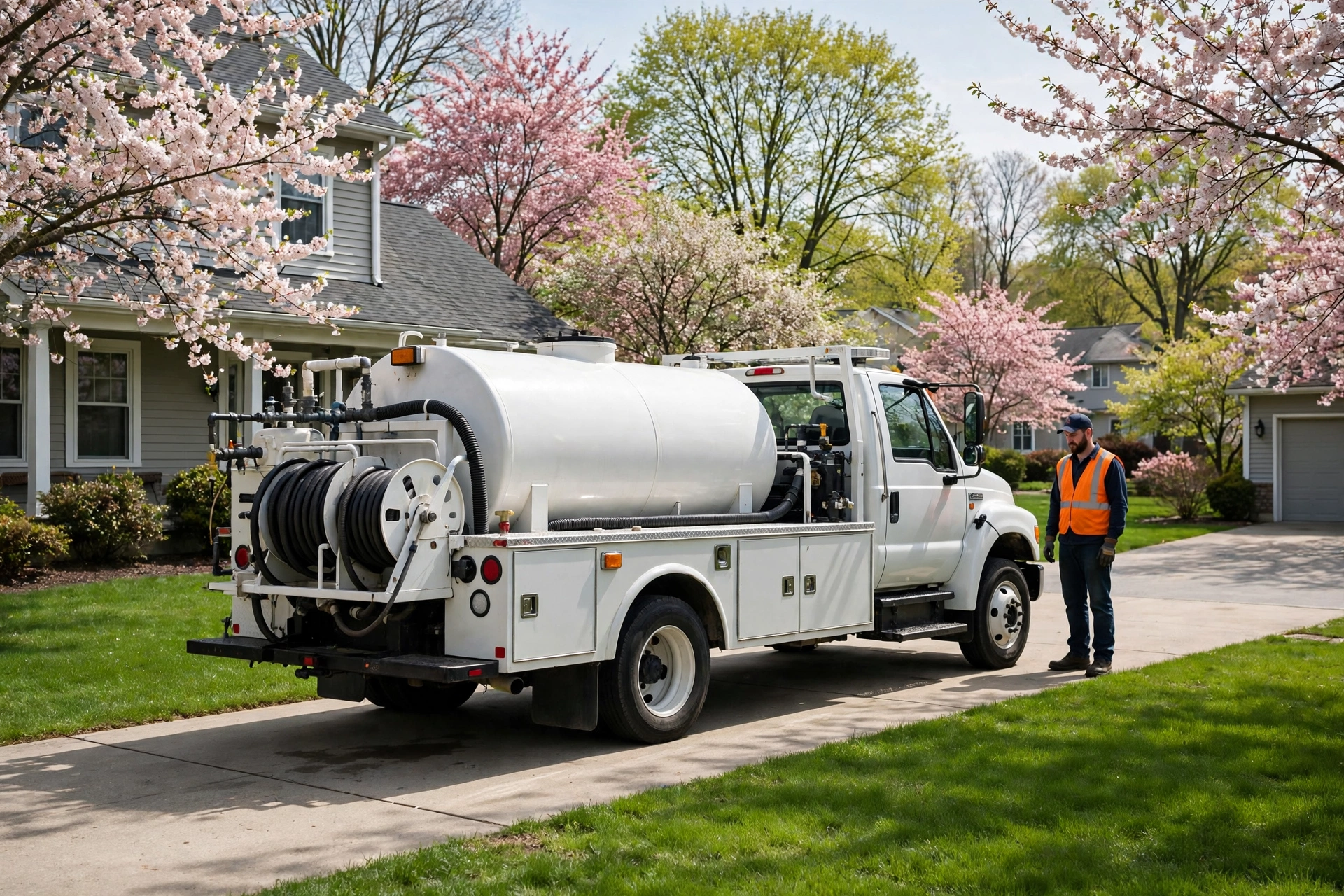
When the truck arrives, the technician will open the tank, pump out the contents, and usually take a look inside. That look is valuable. It is the one time every few years that someone with experience actually sees the inside of your tank, the condition of the baffles, and the level of solids that were in there. Ask what they found and whether the interval since the last pump-out looked about right. Their answer helps you set the next date with confidence instead of guessing. Bring your notes from the yard walk too. A wet patch over the field, a slow drain, or a smell that comes and goes are all easier to judge when the tank is open.
Check Pumps, Alarms, and Aerobic System Parts
If your system has a pump, an alarm, or an aerobic treatment unit, spring is the time to confirm every part still works after winter. Start with the alarm panel if you have one. Press the test button and make sure the alarm sounds and the light comes on. An alarm that has been silent all winter might be working fine, or it might have a dead bulb, a tripped breaker, or a float switch stuck in place. Testing it now means you will hear it when it matters.
Check the breaker or dedicated circuit for the pump and aerator. Winter power cuts and tripped breakers are easy to miss, especially if the system kept working on gravity alone for a while. Make sure the power is on, the panel shows normal operation, and nothing is flashing an error. Listen to the aerator or air pump if your system has one. It should hum steadily without rattling, grinding, or cutting in and out. A noisy aerator often means a worn diaphragm or a loose fitting, and both are cheaper to fix early.
Sort Out Landscaping, Roots, and the Grass Over the Field
Spring is when roots grow fastest, and that makes it the right time to think about what is planted near your system. Trees and large shrubs should not grow over or close to the tank, the pipes, or the drain field. Their roots seek moisture, and septic pipes are a reliable source of it. A root that finds a joint or a small crack will grow into the pipe, and once inside it will keep growing until the flow is blocked.
Grass is the best cover for a drain field, and spring is the time to help it along. Grass roots are shallow, so they do not threaten pipes, and they take up moisture and hold the soil in place. Mow regularly, keep the cover even, and overseed any thin patches. Avoid planting anything with deep roots over the field, and avoid vegetable gardens there too, since the soil is treating wastewater and is not a safe place to grow food.
Reset Your Water Habits for the Warm Months
Spring is a natural reset point for household water habits, because summer is coming and summer is the heaviest season for a septic system. Guests visit, children are home, laundry piles up, and outdoor water use climbs. A few habits set now will carry the system through the busy months.
Spread laundry through the week instead of saving it for one big day. A washing machine sends a large volume of water to the tank in a short time, and several loads back to back can overwhelm a drain field that is still dealing with spring rain. One or two loads a day, spaced out, gives the soil time to absorb each one. The same logic applies to dishwashers. Running full loads less often is better than running small loads constantly, and it saves water at the same time.
Refresh What Goes Down the Drain
Spring cleaning often means a round of harsh chemicals, and that is worth pausing over. A septic system depends on bacteria in the tank to break down waste, and strong disinfectants, bleach, and drain cleaners can knock those bacteria back. You do not need to ban every cleaning product, but it helps to use them in normal amounts, to avoid pouring large quantities down the drain at once, and to choose septic safe products where you can. A spring deep clean done one room at a time is easier on the system than a single day of heavy chemical use through every drain in the house.
The same spring clear out is a good time to remind the household what does not belong in the system. Only human waste and toilet paper should be flushed. Wipes, even those labeled flushable, do not break down the way toilet paper does and can clog pipes and the effluent filter. Grease, coffee grounds, and food scraps belong in the trash or compost, not down the kitchen drain. Medicines should go back to a pharmacy take back program rather than down the toilet, since they can harm the bacteria and the soil treatment that the system relies on.
Additives come up every spring, usually in the form of a product that promises to restart the bacteria after winter or to clean the tank without pumping. A healthy system that is pumped on schedule does not need additives to work. The bacteria it needs arrive with normal household waste, and they recover on their own as temperatures rise. Additives cannot replace pumping, and some can stir up solids or damage the soil in the drain field. If a product sounds like a shortcut around pumping, it almost certainly is not one. Spend the money on the pump-out instead.
Update Your Records and Plan the Rest of the Year
A checklist is only useful if the results are written down. When you finish the spring walk and the service visits, take ten minutes to update your records. Note the date of the inspection, the date of any pump-out, the condition the technician reported, and anything you saw during the yard walk. File the receipts and the inspection report together, and write the next pumping date on the front of the file so you can see it at a glance.
Use the spring check to plan the rest of the year too. A month by month septic maintenance schedule helps you see what comes next, from summer water care to autumn preparation and winter protection. Spring is the season for inspection and pumping. Summer is the season for watching water use. Autumn is the season for clearing leaves and preparing for cold. Winter is the season for protecting the system from frost. Knowing the shape of the year makes each season simpler, because you are never starting from scratch. Set a reminder for a short walk over the field after the first heavy summer rain, and another look before autumn. The spring checklist is the thorough one, but a quick seasonal look takes ten minutes and keeps you ahead of the system instead of behind it.
Warning Signs That Mean Call a Professional Now
Most of what you find in spring will be small and easy to handle. A few signs mean you should stop and call a professional rather than waiting to see if things improve. Sewage backing up into the house is the clearest of these. Even a small backup is a sign the system cannot move wastewater away from the house, and it will not fix itself. Cut back on water use, avoid flushing anything more than necessary, and call for help the same day.
Standing water over the drain field that does not drain after dry weather is another sign to act on quickly. It can mean the soil is saturated beyond recovery, a pipe has broken, or the field is clogged. The same applies to a strong and steady sewage smell in the yard or in the house. A smell that lingers on a dry day is not normal, and it usually means wastewater is reaching somewhere it should not.
Your Spring Checklist at a Glance
Here is the whole spring routine in one short list you can print or save. Work through it in order, and tick each item off as you go.
- Find your records and note the dates of the last pump-out and inspection.
- Walk the drain field after a dry stretch and look for standing water, soft ground, bright green stripes, smells, and settling.
- Check the ground over the tank for frost heave, erosion, and sinking.
- Check lids, risers, inspection pipes, and cleanout caps for cracks and damage.
- Run every tap and flush every toilet, and listen for gurgling or slow drains.
- Test toilets for silent leaks and fix any running flapper.
- Check gutters, downspouts, grading, and sump pump discharge, and direct water away from the system.
- Book a professional inspection and have the effluent filter cleaned.
- Pump the tank if it is due, and book early to beat the spring rush.
- Test pumps, alarms, aerators, and any disinfection stage on your system.
- Clear new seedlings and check for roots near pipes and the field.
- Refresh the grass cover over the field and keep structures and heavy items off it.
- Spread laundry through the week and fix household leaks.
- Remind the household what not to flush, and skip additives that promise to replace pumping.
- Update your records, note the next pumping date, and plan the rest of the year.
Frequently Asked Questions
When should I do the spring septic checklist?
Start once the ground has thawed and you have had a couple of dry days, usually in March or April depending on your climate. You want the soil dry enough to show wet patches clearly, and you want to finish before the heavy summer water use begins. Booking the professional visit early in that window also means a shorter wait.
Is spring a good time to pump a septic tank?
Yes, spring is one of the best times. Pumping before summer clears the solids out before the season of heaviest water use, and it lets the technician see how the system handled winter. If your pumping date falls anywhere near spring, bring it forward into the season rather than letting it slide into summer.
What if I find a wet patch over the drain field?
First, check whether it has rained recently. A patch that dries within a day or two of fair weather is often just spring saturation. A patch that stays wet and spongy in dry weather, especially with a smell or unusually green grass, needs a professional look. Cut back on water use in the meantime and avoid driving or parking over the area.
A Short Afternoon That Protects the Whole Summer
Spring maintenance is not glamorous, and it does not need to be. It is a walk around the yard, a few minutes at each fixture, a look at the gutters, and a phone call to book the professional help that is due. Done once a year, it catches the problems that are cheap to fix and prevents the ones that are not.
The real value of the checklist is the confidence it gives you. When summer arrives with guests, laundry, and long hot days, you will know the tank was pumped when it needed to be, the filter was cleaned, the field was checked, and the water around the house is running away from the system instead of into it. That is a good place to start the season, and it is the whole point of spending an afternoon on it now.
Greetings Glows Team is dedicated to creating meaningful, helpful, and thoughtfully curated content for everyday inspiration and special moments.
What We Focus On:
Well-researched and reader-friendly articles.
Meaningful greetings, blessings, prayers, and inspirational messages.
Carefully curated ideas for everyday life and special occasions.
Clear, helpful, and engaging information.
Consistent quality and attention to detail in every publication.
Our goal is simple: to make every visit worthwhile with content that inspires, informs, and brings a little more positivity to your day.