For many households, laundry day means one long Saturday morning at the washing machine. Towels, bedding, school clothes, and work uniforms all go in back to back until the pile is gone and the baskets are empty. It feels efficient. The problem is that your septic system does not see it the same way. It sees a sudden rush of water arriving far faster than it was built to handle, and over time that rush can cause real trouble underground.
Laundry is one of the largest sources of water your septic system receives, and it is also one of the easiest to control. You cannot stop flushing toilets or taking showers, but you can decide when the washing machine runs. That single choice makes a bigger difference than most homeowners realize. This guide explains how much water laundry really sends into your tank, whether a full laundry day can overload the system, what the warning signs look like, and how to set up a routine that keeps your clothes clean and your drain field healthy.
Does Laundry Day Overload Septic System Capacity?
The short answer is yes, it can. A single load of laundry is no threat at all. Five or six loads run one after another on the same morning is a different story. The issue is not the total amount of water your family uses over a whole week. It is how much water arrives in a short window, because your septic system works on a slow, steady rhythm and it needs time between surges to do its job. So does laundry day overload septic system capacity enough to cause real damage? It can, when the surge is large and the pattern repeats every week.
Inside your septic tank, wastewater separates into layers. Heavy solids sink to the bottom and form sludge. Grease and light material float to the top and form scum. The clearer liquid in the middle flows out to the drain field, where soil filters and treats it. That separation only works when the water inside the tank is calm. When load after load of wash water pours in, the tank gets stirred up. Solids that should have settled stay floating, and cloudy water can be pushed toward the drain field before it has been properly treated.
The drain field has its own limits too. Soil can only absorb so much water in a day. When it is soaked, it stops accepting more, and the water has nowhere useful to go. That is when you start seeing soggy spots in the yard, slow drains inside the house, and smells that were not there before. None of this happens because laundry is bad for a septic system. It happens because too much laundry at once overwhelms a system that was designed for steady, spread-out use. The EPA septic system guidance makes the same point in plain terms: a septic system works best when water use is spread out and the system is given time to treat wastewater between heavy uses.
How Much Water Does a Washing Machine Send to Your Septic Tank
The amount of water depends mostly on the age and type of your machine. An older standard top-loading washer typically uses 30 to 45 gallons of water per load. A newer high-efficiency top loader uses roughly 15 to 25 gallons. A front-loading high-efficiency machine is the most frugal, using about 12 to 17 gallons per load. That difference matters a great deal when you multiply it across a full laundry day.
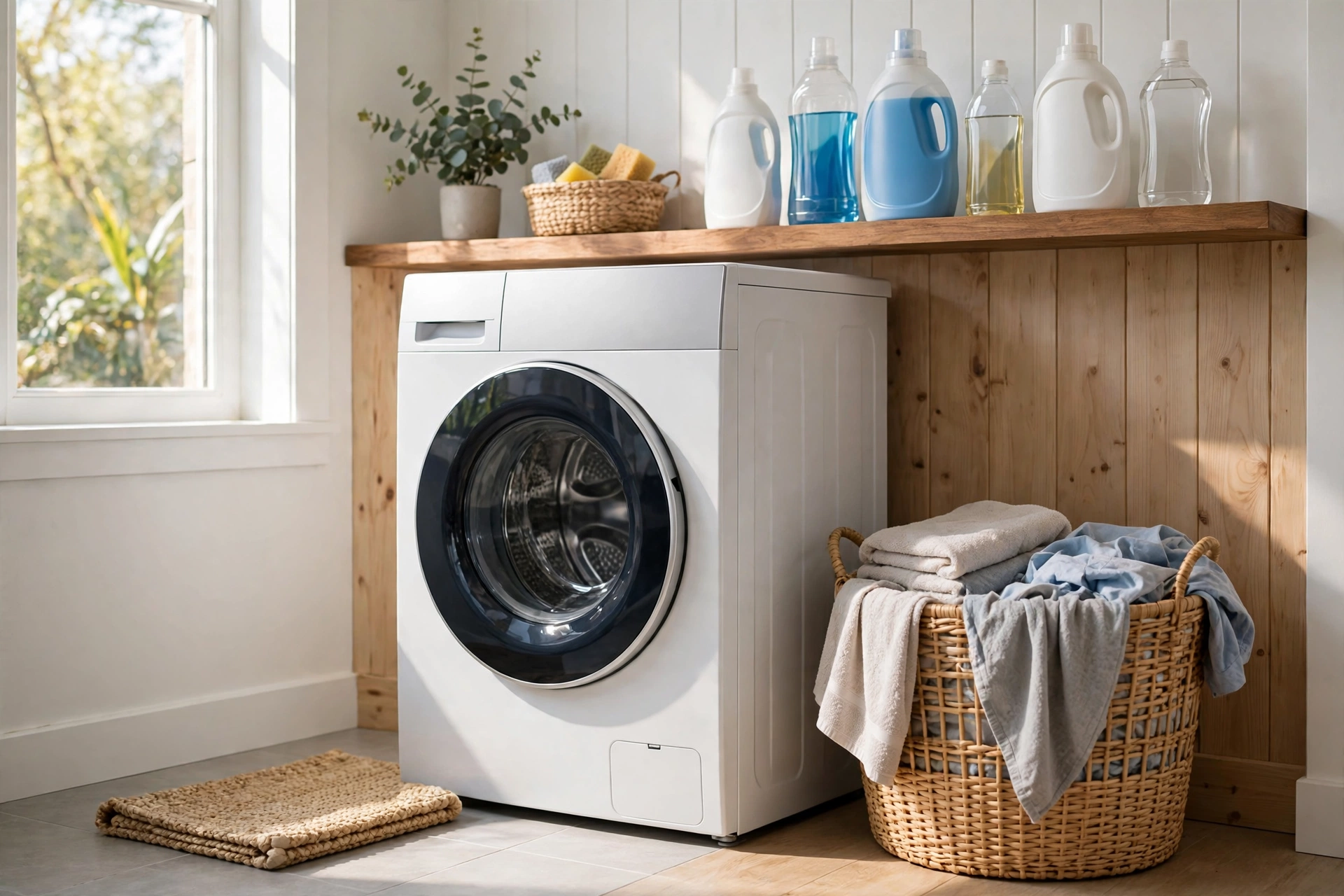
Run the numbers for a typical Saturday. Five loads in an older top loader send roughly 150 to 225 gallons of water into your septic tank in a few hours. That is laundry alone, before anyone showers, flushes a toilet, or runs the dishwasher. A three-bedroom home is commonly designed for around 360 gallons of total wastewater per day from all sources combined, based on a typical design figure of about 120 gallons per bedroom per day. Five loads of laundry can eat up more than half of that daily allowance before the rest of the household has even started its day.
The same five loads in a front-loading high-efficiency washer tell a very different story. At 12 to 17 gallons per load, five loads add up to roughly 60 to 85 gallons. That is a load your system can absorb far more easily, especially if the loads are spaced out. The machine you own shapes the risk more than almost any other single factor, which is why upgrading an old washer is one of the most effective septic-friendly improvements a homeowner can make.
It also helps to know where laundry fits in your overall water use. Laundry typically accounts for about a fifth to a quarter of indoor household water use. It is not the biggest category, but it is the most concentrated one, because a washing machine discharges its full load of water in a matter of minutes. Several loads in a row create a nearly continuous stream of water into the tank, and that is exactly the pattern a septic system handles worst.
What Happens Inside Your Tank When Too Much Water Arrives at Once
To understand why laundry day causes problems, it helps to picture what your septic system is doing on a normal day. Wastewater flows into the tank and then mostly sits still. That quiet time is called retention time, and it typically lasts a day or more. During that time, solids settle, grease rises, and bacteria begin breaking down waste. Only the clarified liquid in the middle layer moves on to the drain field. When a flood of wash water arrives quickly, every gallon that enters pushes a gallon out, and the churning mixes settled solids back into the middle layer before they have had time to separate.
Those solids are the real danger. The drain field is designed to receive liquid, not solid waste. When solids reach the soil, they clog the small spaces between soil particles and feed the growth of a thick biological layer called a biomat. A thin biomat is normal and even helpful, because it filters the water. A thick, overgrown biomat seals the soil shut, and the drain field absorbs water more and more slowly. That damage is difficult and expensive to reverse.
The other problem is simple saturation. Soil can only take in water at a certain rate, and that rate depends on your soil type. Sandy soil drains quickly. Clay soil drains slowly, and many homes sit on clay-heavy ground. When the soil is already wet from rain, or when it has been loaded with water all morning, it reaches a point where it simply cannot take more. The effluent then backs up toward the tank or rises toward the surface. A single heavy laundry day rarely destroys a healthy drain field on its own. The damage comes from repetition, week after week, year after year, with no recovery time in between.
How Many Loads of Laundry Per Day Are Safe
For most homes with a standard 1,000-gallon tank, one to two full loads of laundry per day is the practical safe limit. That is the figure most septic professionals and wastewater specialists settle on, and it lines up with the design capacity of a typical residential system. One or two loads spaced several hours apart give the tank time to settle and the drain field time to absorb the water before the next load arrives.
That guideline is not a hard rule for every home, because systems vary. A larger tank, a newer drain field, and sandy soil all raise the safe limit. A smaller tank, an aging drain field, and clay soil all lower it. Household size matters too. A family of five generates far more wastewater from showers and toilets than a retired couple, so there is less room in the daily budget for laundry.
The spacing between loads matters as much as the number. Two loads run three or four hours apart are far easier on your system than two loads run back to back. The gap lets the tank calm down and the drain field catch up. A useful habit is to run one load in the morning and one in the evening. If you have a high-efficiency washer, you have more room to work with, and three loads spread across the day may be perfectly fine.
It is worth checking how often your tank actually needs pumping, because a tank that is overdue for pumping has less room to handle surges. The more sludge has built up inside, the less effective volume remains, and the faster solids get pushed toward the drain field during a heavy laundry day. Our septic tank pumping frequency chart by household size can help you figure out where your home stands, so you are not guessing about a tank that may already be running low on capacity.
Signs Your Laundry Day Is Overloading the System
Your septic system usually gives you warning signs before a serious failure, and laundry day is often when they show up first. The most common early sign is slow drains. If the washing machine is running and the sinks or showers start draining slowly, or the toilet flushes weakly, the system is telling you it cannot keep up with the flow. The water has nowhere to go fast enough, so it backs up slightly through the lowest fixtures in the house.
Gurgling sounds are another early warning. When water drains from the washing machine and you hear gurgling from a nearby sink, tub, or toilet, air is getting trapped in pipes that are struggling to move water. That sound often appears during or right after a heavy laundry session, and it tends to disappear once the system catches up. If it happens every laundry day, the pattern is worth paying attention to rather than ignoring.
Smells are a stronger signal. A sewage odor in the house after running several loads, or a damp, unpleasant smell near the drain field, suggests that wastewater is not being treated and absorbed the way it should be. The smell may fade by the next day, but its return each laundry day means the system is being pushed past its comfortable limit.
Outside the house, look at the ground over your drain field. Soggy patches, standing water, or grass that is suddenly greener and faster growing than the rest of the lawn can all point to effluent reaching the surface. That extra green grass is easy to misread as a good thing, but over a drain field it usually means the soil is receiving more nutrient-rich wastewater than it can handle. If you notice wet ground that lines up with laundry day, take it seriously.
The most serious sign is sewage backing up into the house, usually through a basement floor drain or a ground-level toilet. That is not a laundry-day inconvenience. It is a system failure, and it needs professional help right away. Most homes never reach that point, because the earlier signs appear first. The key is to notice them early, when a change in laundry habits and a pumping visit can still fix the problem.
How to Spread Laundry Through the Week
Spreading laundry out is the single most effective change you can make, and it costs nothing. The goal is simple: no more marathon laundry days. Instead of saving everything for Saturday, wash one or two loads on several days through the week. Most families find that three or four laundry days a week, with one or two loads each, keeps the baskets empty without ever stressing the system.
A practical weekly rhythm might look like this. Wash everyday clothes and towels on Monday, bedding on Wednesday, and the remaining clothes and heavier items on Friday. If you have children, add a short midweek load for school clothes and sports gear. The exact days do not matter. What matters is that no single day carries the whole week of laundry, and that loads are separated by hours rather than minutes.
Families with a lot of laundry sometimes feel that spreading it out is impossible, but a few small changes usually make it work. Wash full loads instead of partial ones, so each load does more work for the same amount of water. Use the delay start feature on your washer to run a load overnight or during a quiet part of the day, when no other water is being used.
If you are catching up after a vacation or a busy week, resist the urge to run six loads in one day to get it all done. Run two loads, then two more the next day. Your drain field will recover, and the laundry will still be finished within a day or two.
Laundry Habits That Protect Your Septic System
Beyond spreading out loads, several everyday habits make a real difference to the health of your system. The first is to always wash full loads. A half load in most machines uses nearly as much water as a full one, so you are spending the same water budget for half the clean clothes. Wait until the hamper is full, or use the load-size setting on your machine to match the water level to the size of the load.
The second habit is to avoid running the washing machine and other big water users at the same time. Showers, baths, and the dishwasher all draw heavily on the system. When they run together with laundry, the combined flow can exceed what the drain field can absorb. Staggering these activities through the day is one of the simplest forms of septic care, and it costs nothing at all.
The third habit is to fix leaks promptly. A washing machine supply hose that drips, or a machine that overfills because of a faulty valve, can send extra water into the tank around the clock. That steady extra flow is easy to overlook because it never shows up as a dramatic event, but over weeks it adds up to a large volume. Check hoses and connections once or twice a year, and replace rubber hoses that look cracked or bulging.
Finally, keep a simple maintenance routine through the year so small problems do not turn into big ones. Regular pumping, watching for slow drains, and checking the drain field area are habits that pay for themselves. Our septic system maintenance schedule by month lays out a month-by-month routine that keeps these tasks from piling up, and laundry habits fit naturally into it.
Detergent, Bleach, and Lint: What Actually Matters
Water volume is the biggest laundry issue for a septic system, but what goes into the water matters too. The bacteria inside your septic tank do the hard work of breaking down waste, and harsh chemicals can weaken them. That does not mean you need to give up clean clothes. It means choosing products and amounts with a little care.
Liquid detergent is generally easier on a septic system than powdered detergent. Powdered products can contain fillers that do not dissolve fully, and those undissolved particles can add to the sludge in your tank. Liquid detergents dissolve completely and are less likely to leave residue behind. Look for a detergent labeled septic safe, and use the amount recommended on the bottle rather than pouring in extra. More detergent does not make clothes cleaner. It just sends more chemicals into the tank and can create excess suds that interfere with the settling process.
Phosphates are worth avoiding when you have a choice. Some detergents still contain them, and phosphates can feed algae growth and disrupt the balance in the soil of the drain field. Many modern detergents are already phosphate free, but it is worth checking the label, especially on budget or bulk products. Using half the recommended dose is a common suggestion from septic professionals, and most households find their clothes come out just as clean with less product.
Bleach deserves its own note because it is one of the most common laundry chemicals in American homes. A small amount of chlorine bleach in a single load is generally fine for a healthy septic system. The problem comes from heavy, frequent use, or from pouring large amounts of bleach down the drain at once. That can knock back the bacterial population in the tank and slow down the treatment of waste for days. If you use bleach regularly, keep it to occasional loads rather than every load, and never mix bleach with other cleaning chemicals. We explain the safe amounts and the gentler alternatives in our guide on whether you can use bleach with a septic system.
Lint is a quieter problem that many homeowners never think about. Every load of laundry releases fibers, and most of that lint travels with the wash water into the septic tank. Lint does not break down easily, and over time it can contribute to clogging in the tank outlet and the drain field pipes. A simple lint filter on the washing machine discharge hose catches much of this material before it reaches the tank. These filters are inexpensive, easy to install, and easy to clean. Empty the filter regularly, and you will be surprised how much material it collects.
Fabric softeners and scent boosters are less of a concern, because most of their chemicals stay on the clothes rather than going down the drain. If you use them, a small amount is fine. The theme is consistent: normal amounts of normal products are fine, and the trouble starts with excess.
High-Efficiency Washers and Other Upgrades Worth Considering
If your washing machine is more than ten years old, replacing it may be the most effective septic upgrade you can make. A modern high-efficiency front loader uses less than half the water of an older top loader, which means every load you wash puts far less strain on the tank and drain field. Over a year of laundry, that difference adds up to thousands of gallons kept out of the system. The machine also pays for itself in lower water and energy bills, so the benefit is not only underground.
When shopping for a new washer, look for the water factor rating on the energy label. A lower water factor means less water per load. Front-loading machines generally score best, but some high-efficiency top loaders are close behind. A larger capacity drum is also helpful, because it lets you wash bigger loads less often, which is exactly the pattern a septic system prefers. Avoid the temptation to buy a machine that is larger than your household needs, though, since an oversized drum encourages running partial loads that waste water.
A lint filter on the discharge hose is a small upgrade with an outsized payoff, and it works with any machine, old or new. A washing machine effluent filter installed at the tank outlet is a more advanced option. It catches lint and fine solids before they can reach the drain field, and a septic professional can install one during a routine service visit. If your system is older or your drain field has shown signs of stress, that filter is worth asking about.
Some homeowners also consider a greywater system that diverts laundry water away from the septic tank entirely. That can work well in some areas, but the rules vary by state and county, and a greywater system needs its own design and maintenance. Check your local regulations and talk to a licensed professional before going down that path. For most homes, a high-efficiency washer and a sensible laundry schedule solve the problem without any plumbing changes at all.
Special Situations: Guests, Rain, and an Older System
Some weeks are harder on a septic system than others, and it helps to plan for them. A house full of guests is one of the most common overload events. Extra people mean extra showers, extra toilet flushes, and usually extra laundry. If family is visiting for the weekend, spread the laundry out before they arrive and after they leave, rather than washing every towel and sheet in one day.
Heavy rain is another situation that calls for caution. When the ground is already saturated, the drain field has little room left to absorb more water. Doing a big laundry day right after a storm puts extra pressure on a system that is already working at its limit. If you can wait a day or two for the ground to dry, do that. If the laundry cannot wait, keep it to a single load.
An older system deserves extra care too. A drain field that has served a home for twenty or thirty years may not absorb water as quickly as it once did, even if it has been well maintained. If your system is older, the one-load-a-day habit is a smart precaution, and regular pumping becomes even more important. If you are unsure about the age or condition of your system, a professional inspection can tell you how much capacity you really have.
When to Call a Septic Professional
Most laundry-related septic problems can be prevented with better habits, but some situations need a professional. Call one promptly if sewage backs up into the house, if you see standing water or surfacing effluent over the drain field, or if a sewage smell lingers for more than a day. These are signs that the system is failing, not just stressed, and waiting can turn a repair into a replacement. If you are unsure whether a symptom counts as urgent, our guide on when to call a septic professional immediately walks through the warning signs that should never wait.
It is also worth calling a professional if slow drains and gurgling persist even after you have spread out your laundry and cut back to one or two loads a day. That pattern suggests a deeper issue, such as a tank that needs pumping, a clogged outlet filter, or a drain field that is losing its ability to absorb water. A professional can measure sludge levels, inspect the tank, and check the drain field to find the real cause.
If you do not know when your tank was last pumped, schedule a pumping visit and an inspection in the same call. The technician can tell you how full the tank was, whether the baffles are in good shape, and whether the drain field shows signs of stress. That information is worth having, because it turns guesswork into a plan. Once you know the condition of your system, you can set a laundry routine that fits its real capacity rather than a generic guideline.
The Bottom Line
Laundry day can overload a septic system, but it does not have to. The system is not fragile. It handles normal daily use without any trouble. The problem is the concentrated surge of a full laundry marathon, when hundreds of gallons arrive in a few hours and the tank and drain field never get a chance to recover. Spread the loads through the week, keep them to one or two a day, and give the system a few hours between loads, and the risk drops sharply.
Your septic system works quietly underground, day after day, asking for very little in return. A kinder laundry routine is one of the easiest ways to repay that service. Your clothes will still get clean, and the most expensive part of your wastewater system will last years longer because of a habit that costs nothing to start.
Greetings Glows Team is dedicated to creating meaningful, helpful, and thoughtfully curated content for everyday inspiration and special moments.
What We Focus On:
Well-researched and reader-friendly articles.
Meaningful greetings, blessings, prayers, and inspirational messages.
Carefully curated ideas for everyday life and special occasions.
Clear, helpful, and engaging information.
Consistent quality and attention to detail in every publication.
Our goal is simple: to make every visit worthwhile with content that inspires, informs, and brings a little more positivity to your day.