Finding out that your drain field has failed is one of those homeowner moments that stops you cold. The drains are slow, the yard smells off, and then a contractor hands you an estimate that looks more like the price of a car than a repair. If you live in Virginia, you are probably wondering what a fair price actually looks like, and whether the number in front of you is reasonable or inflated. Septic drain field replacement cost in Virginia depends on your soil, your region, the size of your home, and the type of system your property needs. For most Virginia homeowners, a conventional replacement runs roughly 8,000 to 17,000 dollars, while an alternative system on difficult soil can reach 18,000 to 40,000 dollars or more. Those are wide ranges, and the rest of this guide explains exactly what pushes a job toward the low end or the high end, so you can read a quote with confidence and ask the right questions before you sign anything.
The Short Answer on Cost
If you want a single number to plan around, most Virginia homeowners replacing a standard drain field for a three or four bedroom home should budget somewhere between 8,000 and 15,000 dollars for a conventional gravity system on decent soil. That figure covers the excavation, the new pipe and gravel or chambers, the distribution box, the soil testing and permits, and the labor to put it all back together. It does not cover a new septic tank, which is a separate job unless your tank is also failing. Published cost guides for 2026 put a conventional drain field replacement nationally at about 3,000 to 15,000 dollars, with a typical three bedroom home landing near 8,000 to 15,000 dollars. Virginia sits a little above the national middle in many areas because labor rates around Northern Virginia and Richmond run higher, and because so much of the state has clay soil that complicates the work.
The picture changes when your property cannot support a conventional field. Virginia has a lot of ground that does not drain well. The red clay of the Piedmont, the shallow water tables of Tidewater, and the rocky, karst-prone land in parts of the Shenandoah Valley all push homeowners toward alternative systems such as mound systems, low pressure pipe systems, or aerobic treatment units. A Virginia specific cost guide for 2026 puts those alternative designs at roughly 18,000 to 40,000 dollars installed. That is a big jump, and it is the main reason two neighbors with similar houses can get quotes that differ by twenty thousand dollars. The system your soil allows matters more than the size of your house.
What a Drain Field Is and Why Replacing It Costs So Much
Your drain field, also called a leach field, is the part of your septic system that quietly does the hardest work. Wastewater flows from your home into the septic tank, where solids settle and grease floats. The remaining liquid, called effluent, flows out to the drain field, where it trickles through perforated pipes into gravel or chambers and then slowly filters down through the soil. The soil is the final treatment step. Helpful microbes in the ground break down what remains, and the cleaned water eventually rejoins the groundwater. When that soil stops absorbing, the whole system backs up.
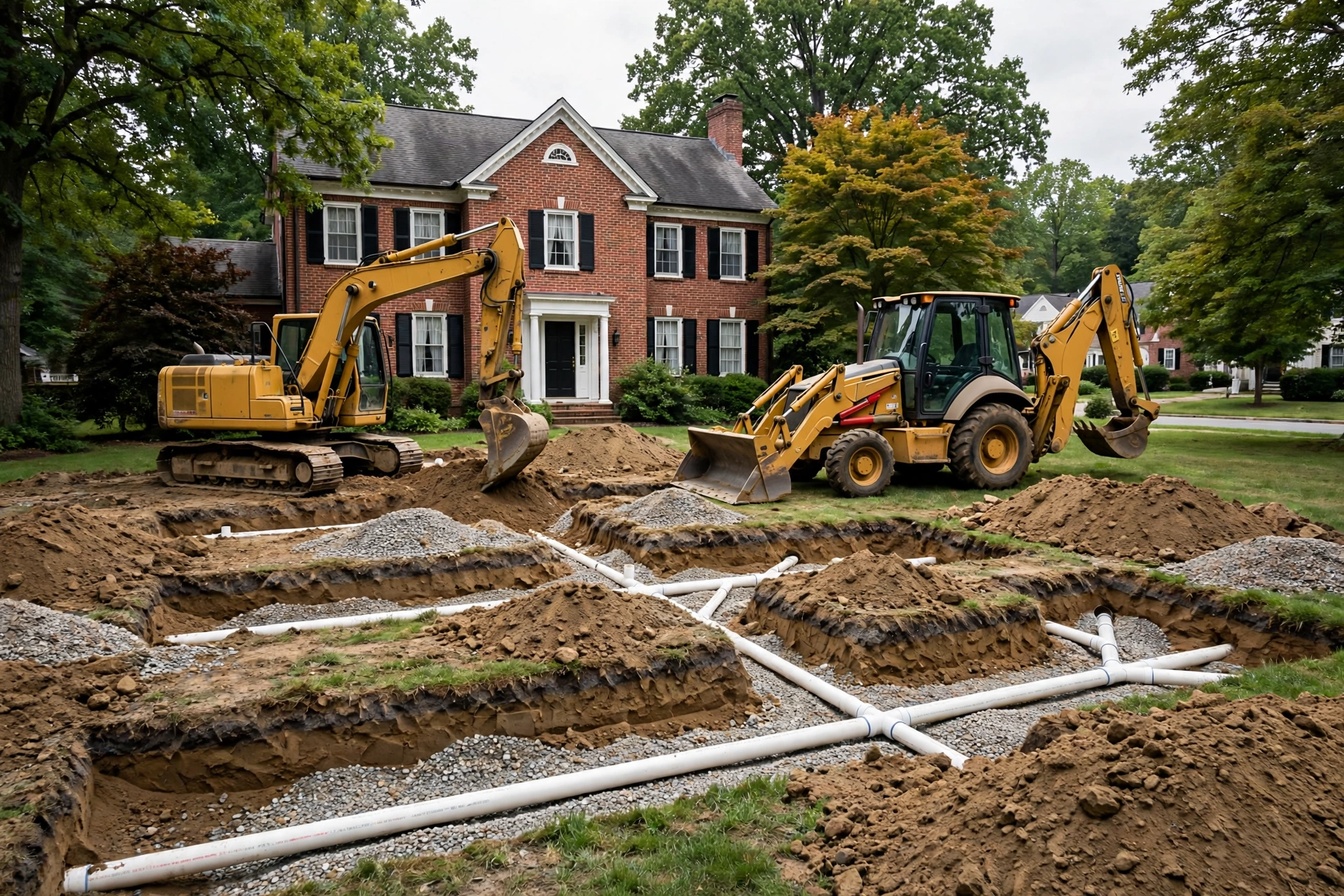
Replacing a field is expensive because it is a small construction project, not a repair visit. A crew has to bring in an excavator and a dump truck, dig up the old field, haul away failed soil and old pipe, and then build a new field to current code. That usually means new trenches, new gravel or chamber units, new distribution piping, and often a new distribution box. The yard then has to be graded and reseeded. A typical job takes three to five days of on site work, and the permitting and soil testing beforehand can add two to six weeks. Labor, equipment, materials, testing, permits, and restoration all stack up, which is why the bill lands in the thousands rather than the hundreds.
Age is the most common reason a field fails. A well built and well maintained drain field can last twenty to thirty years, and some last longer. But soil slowly clogs over time as a layer of biological material, called biomat, builds up where the effluent meets the soil. Eventually the soil cannot absorb water fast enough, and the field is done. Heavy water use, a tank that has not been pumped on schedule, driving vehicles over the field, and tree roots can all shorten that life considerably. Once the soil itself is clogged, there is no cleaning product or quick fix that restores it. That is the moment replacement becomes the honest answer.
Cost Breakdown: Where the Money Goes
A drain field replacement quote is not one line item. It is a bundle of smaller costs, and knowing what they are helps you spot a quote that is missing something important or padding something unnecessary. The largest share is almost always excavation and installation labor, which covers the crew, the excavator, the dump truck, and the days of digging and building. Materials come next, including perforated pipe, gravel or chamber units, the distribution box, and filter fabric. Then there are the costs people forget to budget for: soil testing, the permit, the engineering design if an alternative system is needed, and putting the yard back together afterward.
For a conventional replacement on a typical Virginia property, the rough split looks something like this. Excavation and installation labor usually runs 3,000 to 7,000 dollars. Materials run 1,500 to 4,500 dollars. Soil testing and the permit usually add 250 to 1,200 dollars. If your county requires an engineered design for an alternative system, engineering fees commonly add another 1,000 to 2,500 dollars. Yard restoration, meaning topsoil, grading, and grass seed or sod, can add a few hundred to a couple of thousand dollars depending on how much of the yard was disturbed. None of these numbers are exact, but together they explain why a full replacement lands where it does.
Conventional Systems vs Alternative Systems
The single biggest factor in your price is whether your property can use a conventional gravity drain field or needs an alternative design. A conventional system is the simple one most people picture. Effluent flows by gravity from the tank through a distribution box and into shallow trenches filled with gravel and perforated pipe. It is the least expensive option, and when the soil is good, it is also reliable and long lasting. Most Virginia homes on favorable soil with a conventional replacement should expect something in the 8,000 to 17,000 dollar range for the complete system work, with the field itself typically accounting for 3,000 to 15,000 dollars of that depending on size and site conditions.
An alternative system becomes necessary when the soil does not drain well enough, the water table is too high, the bedrock is too close to the surface, or the lot is too small for a standard field. These are common conditions across Virginia, which is why alternative systems are so frequently discussed here. A mound system raises the drain field above the natural ground level in a built up mound of sand and gravel. A low pressure pipe system uses a pump to dose effluent evenly through a network of smaller pipes. An aerobic treatment unit adds oxygen and mechanical treatment before the effluent reaches the soil. A drip system distributes treated effluent slowly through shallow tubing. Each design solves a different soil problem, and each one costs more than a conventional field because it adds equipment, engineering, and ongoing maintenance.
For planning purposes, a mound system typically runs 10,000 to 20,000 dollars for the field portion, and a full alternative installation can reach 18,000 to 40,000 dollars once the tank, pump, controls, and engineering are included. Aerobic systems generally fall in a similar band, roughly 15,000 to 25,000 dollars for a complete installation, and they add an ongoing cost that conventional systems do not have: electricity to run the aerator and pump, plus regular service visits and a maintenance contract that many Virginia localities require. That ongoing cost matters when you compare options. A cheaper installation that costs you several hundred dollars a year to maintain may not be cheaper over twenty years.
Your county health department, not your contractor, makes the final call on which type of system your property can use. The decision is based on a soil evaluation, often called a perc test, and a site evaluation done by a licensed soil evaluator. If your soil fails the test for a conventional field, no amount of shopping around will change that result. What you can shop for is the price of building the system your site requires, and the quality of the installer who builds it. If one contractor tells you a conventional field will work and another says you need a mound, ask both to explain their reasoning in writing, and check with your local health department before you decide. That one phone call can save you from paying for a system that fails inspection or fails early.
How Your Part of Virginia Changes the Price
Virginia is not one market for septic work. Labor rates, soil, and local rules vary enough that the same job can cost noticeably different amounts in different parts of the state. Northern Virginia is the most expensive region in most cases, driven by higher labor costs and smaller lots that make equipment access harder. A conventional replacement in Fairfax, Loudoun, or Prince William County will often land at the upper end of the statewide range, and alternative systems there can push past 40,000 dollars. The tradeoff is that Northern Virginia also has the deepest bench of licensed installers, so getting three competitive quotes is usually straightforward.
Tidewater and Hampton Roads bring a different challenge: a high water table. In Virginia Beach, Norfolk, Chesapeake, and the Eastern Shore, groundwater can sit close to the surface, which limits how deep a drain field can go and often requires a raised or alternative design. Flooding and heavy rain also hit this region harder, and a field that stays saturated cannot do its job. If you live in Tidewater, it is worth reading about what happens to a septic system in wet weather, because the same conditions that stress your current field will shape the design of its replacement. You can learn more in our guide to septic problems after heavy rain, which covers the warning signs and the steps that protect a field during wet seasons.
Signs Your Drain Field Needs Replacing
Most drain fields do not fail overnight. They give warnings for months, sometimes years, before they stop working completely. The most common sign is standing water or soggy ground over the field, especially when it has not rained recently. If one patch of your yard stays wet while the rest dries out, or if you notice a strip of grass that is suddenly much greener and faster growing than the rest of the lawn, that is effluent reaching the surface instead of filtering down through the soil. Both are signs worth taking seriously right away. Our guide to standing water over a septic drain field walks through the causes and what to check first.

Slow drains and gurgling toilets throughout the house are another warning, especially when they affect several fixtures at once. A single slow sink is usually a local clog. Every toilet and shower draining slowly at the same time points to the system as a whole, and often to the field. Sewage odors in the yard, or a strong smell near the tank and field area, are a further sign that effluent is not being treated and absorbed the way it should be. And if sewage backs up into the home, even once, treat it as urgent. That is not a nuisance. It is a health hazard, and it usually means the field has little or no capacity left.
It is important to separate a failing field from a full tank, because the two problems look similar and have very different price tags. A tank that simply needs pumping can cause slow drains and odors, and pumping costs a few hundred dollars. A field that has failed needs a replacement costing thousands. Before you agree to a replacement, have the tank pumped and inspected. A reputable installer will do this as part of the diagnosis, and if the problem clears up after pumping, you may have just saved yourself a large bill. Regular pumping is also the single best way to protect a field in the first place. When a tank goes too long between pumpings, solids can wash out into the field and clog the soil permanently. That is why skipping pumping is such an expensive habit, as explained in our article on what happens if you never pump your septic tank.
Repair vs Replacement: When You Can Avoid the Full Cost
Not every failing field needs a complete replacement, and it is worth knowing the difference before you commit to the biggest bill. A partial repair is possible when the problem is limited to one part of the system. A crushed or root invaded lateral line, a tilted or clogged distribution box, or a broken pipe between the tank and the field can often be fixed for 1,000 to 8,000 dollars, depending on how much digging is involved. A single lateral replacement typically runs 1,500 to 5,000 dollars. If the rest of the field is still absorbing well, fixing the damaged section can buy you years of additional life.
Replacement becomes necessary when the soil itself has failed. That is what happens with advanced biomat clogging, where the soil pores are sealed and effluent has nowhere to go. No repair fixes that, because the problem is not a pipe. It is the ground. The same is true when a field is simply at the end of its life after thirty or more years of service, or when solids from a neglected tank have washed into the field and clogged it throughout. In those cases, patching one line is throwing money at a field that will keep failing. A good installer will tell you this plainly rather than selling you a repair that will not hold.
Permits, Inspections, and Virginia Rules
Replacing a drain field in Virginia is a regulated job, and understanding the process helps you avoid delays and surprises. The Virginia Department of Health sets the statewide rules for onsite sewage systems, and your local health department applies them. Before any digging starts, a licensed professional evaluates your soil and site, prepares a design, and submits it for a permit. The health department reviews the design, issues a construction permit, and then inspects the work at key stages, usually before the trenches are backfilled. Only after the final inspection passes is the system approved for use.
One Virginia rule worth knowing about took effect in July 2025. Under House Bill 2671, when a buyer, lender, or real estate agent asks for a septic inspection as part of a sale, refinance, or transfer, that inspection must follow statewide minimum standards. It has to be done by a licensed onsite sewage system operator, installer, or soil evaluator, with a written contract signed before the work starts and a written report delivered within ten business days. The law does not require an inspection for every sale, but buyers and lenders ask for one in most transactions, so a failing drain field is now much more likely to come to light during a sale, at the worst possible time for a seller. If you are planning to sell in the next few years and your field is showing signs of trouble, dealing with it now is usually cheaper and less stressful than negotiating it under the pressure of a pending sale. A replacement done on your own schedule is almost always less costly than one done on a closing deadline.
Your installer should handle the permit application and coordinate the inspections as part of the job. That is normal, and it should be reflected in the quote. What you should do is confirm that the permit is in hand before work begins, and ask for copies of the approved design and the final inspection report when the job is done. Keep those documents with your house records. The next owner will want them, your county will have them on file, and they are your proof that the system was built to code. If you ever need to find the records for an older system, your county health department can tell you where they are kept.
What the Replacement Process Looks Like
Knowing what happens during a replacement takes much of the stress out of it. The job usually begins with the site evaluation and the permit, which can take two to six weeks depending on your county and the time of year. Your installer or soil evaluator tests the soil, designs the new field, and submits the paperwork. Once the permit is approved, the crew schedules the work, and the physical job itself usually takes three to five days for a conventional field. Alternative systems can take longer, especially if a pump, controls, or a mound has to be built.

Once the new field is installed and inspected, the crew backfills the trenches, grades the area, and restores the surface with topsoil and seed or sod. The tank is pumped and checked, the system is tested with water to confirm that effluent flows evenly to all parts of the field, and the final inspection is completed. You will be able to use your plumbing normally throughout most of the job, though the crew may ask you to limit water use on the day the tank is disconnected and reconnected. Ask your installer in advance which days will affect your water use so you can plan around them.
How to Get a Fair Quote and Avoid Overpaying
The most important thing you can do is get at least three written quotes from licensed Virginia installers, and compare them line by line rather than looking only at the bottom number. A quote that is much lower than the others is not necessarily a bargain. It may leave out the permit, the soil test, the disposal of the old field, or the yard restoration, and those costs will appear later as extras. A quote that is much higher may include work you do not need, such as replacing a tank that is still sound. Ask each installer to break the price into labor, materials, testing, permits, and restoration, so you can see where the differences actually are.
Before you invite anyone to quote, check that they are licensed to install onsite sewage systems in Virginia and that they carry liability insurance. Your local health department can usually confirm a license, and a reputable company will provide proof of insurance without hesitation. Ask how many drain field replacements they have done in your county in the past year. Local experience matters, because the installer who knows your county inspector and your local soil is less likely to run into surprises.
Ask each installer the same questions so the answers are comparable. How many days will the job take, and what happens if the weather delays it. What exactly is included in the price, and what would cost extra. What warranty do they offer on the workmanship, and for how long. Will they handle the permit and the inspections, and are those fees included. What will the yard look like when they finish, and is a follow up visit to top up settled soil included. A contractor who answers these questions clearly and in writing is usually a contractor who will do the job properly.
How to Make Your New Drain Field Last
A new drain field is a fresh start, and a few habits will help it last its full life. The most important is regular tank pumping, usually every three to five years for a typical household, and more often if you have a large family or a garbage disposal. Pumping keeps solids out of the field, and solids in the field are what clog soil permanently. The second habit is spreading out water use. Doing all the laundry in one day can flood a field faster than it can absorb, so spread loads through the week and fix leaking toilets and faucets promptly. A running toilet can send hundreds of gallons a day into a system that was never designed for it.
Protect the field area itself. Never drive or park vehicles on it, and never build a shed, patio, or driveway over it. The weight compacts the soil and can crush the pipes, and the damage is often not obvious until the field starts failing. Our guide on whether you can drive over a septic drain field explains the risks in detail. Keep trees and large shrubs away from the field, since roots seek out the moisture in the pipes and can invade them. And divert roof runoff and surface water away from the field area, because a saturated field cannot absorb effluent. A field that stays dry between uses lasts far longer than one that is constantly wet.
Be careful about what goes down your drains. The only things that should be flushed are human waste and toilet paper. Wipes, even those labeled flushable, do not break down the way toilet paper does and can clog the system. Grease, paint, solvents, and harsh chemicals should never go down the drain, because they can kill the helpful bacteria in the tank and damage the soil biology in the field. The EPA septic system guidance is a reliable place to check the basics of care and maintenance if you want a second source for what helps and what harms a system.
Frequently Asked Questions
How much does septic drain field replacement cost in Virginia?
For a conventional gravity system on favorable soil, most Virginia homeowners pay roughly 8,000 to 17,000 dollars for the complete replacement, with the field itself typically costing 3,000 to 15,000 dollars depending on size and site conditions. When clay soil, a high water table, or shallow bedrock requires an alternative system such as a mound or aerobic unit, the total usually runs 18,000 to 40,000 dollars or more. Always get written quotes from licensed installers in your county, since soil and labor rates vary widely across the state.
Can I replace just part of a drain field?
Sometimes, yes. If only one lateral line is crushed or root damaged and the rest of the field is still absorbing well, a partial replacement costing roughly 1,500 to 5,000 dollars may be enough. But if the soil itself is clogged throughout the field, a partial fix will not last, and a full replacement is the honest answer. A proper diagnosis, including test pits or a load test, is what tells you which situation you are in.
The Bottom Line
Septic drain field replacement cost in Virginia is not a small number, but it is a manageable one when you understand what you are paying for. A conventional replacement for a typical home usually lands between 8,000 and 17,000 dollars, while an alternative system on difficult soil runs 18,000 to 40,000 dollars or more. The difference is almost always the soil, not the size of the house. Get the soil tested, get the permit, get three written quotes, and ask each installer to explain the diagnosis in plain language. A contractor who does that is one you can trust with a job this size. And once the new field is in the ground, protect it. Pump the tank on schedule, spread out your water use, and keep vehicles and trees off the field. The money you spend on a replacement is an investment in the next twenty or thirty years of your home, and a little care now is what makes that investment last.
Greetings Glows Team is dedicated to creating meaningful, helpful, and thoughtfully curated content for everyday inspiration and special moments.
What We Focus On:
Well-researched and reader-friendly articles.
Meaningful greetings, blessings, prayers, and inspirational messages.
Carefully curated ideas for everyday life and special occasions.
Clear, helpful, and engaging information.
Consistent quality and attention to detail in every publication.
Our goal is simple: to make every visit worthwhile with content that inspires, informs, and brings a little more positivity to your day.