If you have just moved into a home with a septic system, one of the first questions that comes up is a simple one: how deep is my septic tank buried? It sounds like a trivia question, but the answer matters in practical ways. When the pumper truck arrives, the technician needs to find and expose the access lid. If you are planning landscaping, a fence, or a shed, you need to know where not to dig. And if you are just getting familiar with the system, knowing what sits under your yard helps everything else make sense. This guide gives you the direct answer, explains the engineering reasons behind the depth, and shows you exactly how to find your own tank’s depth.
The direct answer
There is no single standard burial depth for septic tanks. That is the first thing to know, because a lot of homeowners expect one number and feel uneasy when they cannot find it.
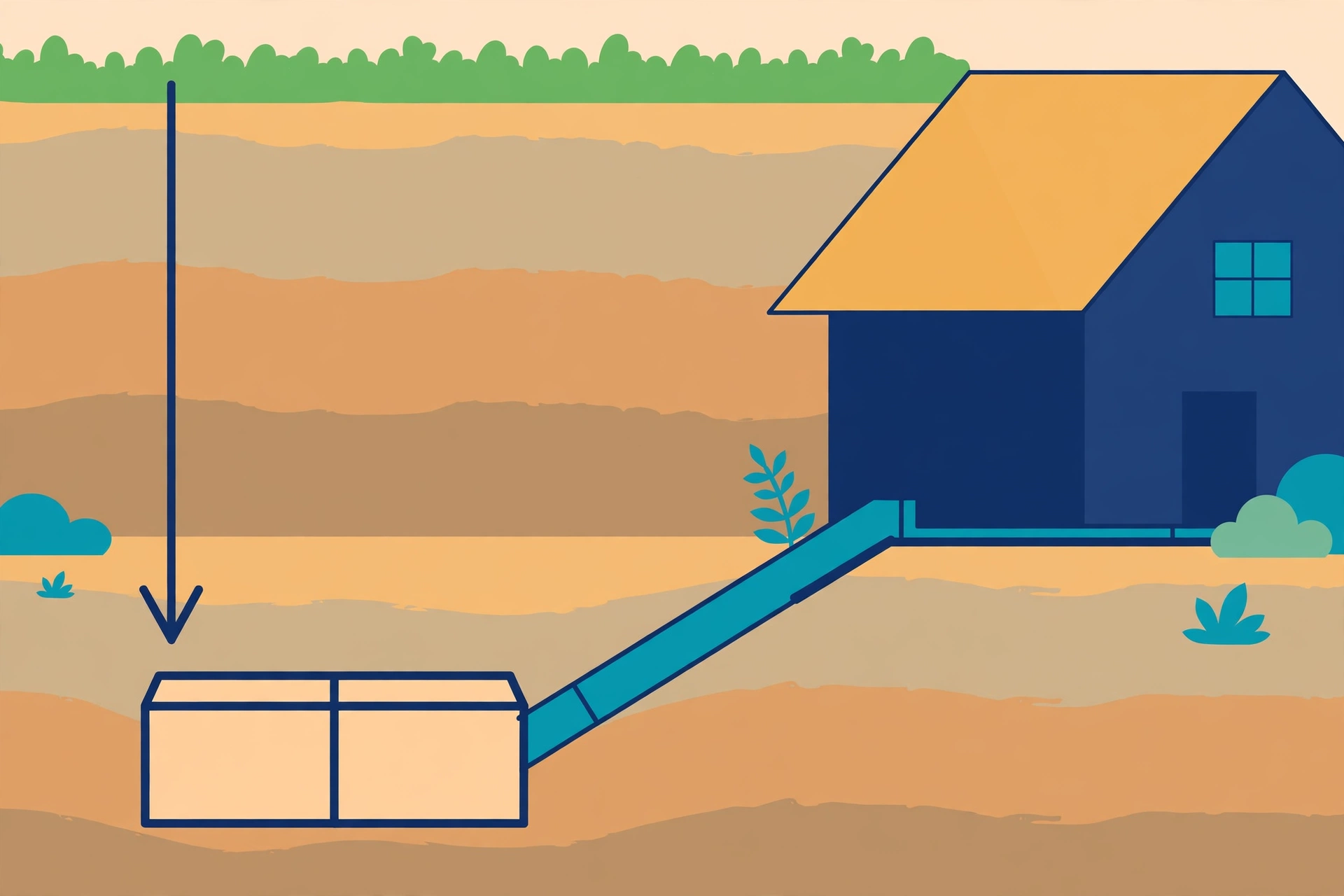
That said, the range is narrower than you might think. The top of most residential septic tanks sits somewhere between 4 inches and 4 feet below the surface of the ground. The vast majority fall toward the shallow end of that range. The access lid, which is the part you actually care about when it is time for pumping or inspection, is often only 6 to 12 inches below the grass on many systems.
Part of the confusion comes from mixing up three different measurements. Depth to the top of the tank is the total cover of soil above the concrete or fiberglass shell. Depth to the lid is how far you have to dig to uncover the opening a pumper uses. Depth of the inlet pipe is where the sewer line from your house enters the tank, which usually sits a bit below the top. When someone asks how deep a septic tank is buried, they usually mean how deep they would have to dig to reach the lid, and that is typically the shallowest of the three.
| What you are measuring | Typical depth below the surface |
|---|---|
| Access lid | 6 to 12 inches, or at the surface with a riser |
| Inlet pipe from the house | 1 to 3 feet at the tank |
| Top of the tank shell | 4 inches to 4 feet |
Older tanks sometimes sit deeper, especially if the lot was regraded after installation or if a particularly deep sewer line dictated the placement. Newer installations tend to be on the shallow side, partly because modern installers know a shallow tank is easier to service, and partly because of the structural and freezing considerations explained below.
What determines how deep a septic tank is buried
A septic tank ends up where it is for a handful of very practical reasons. None of them are mysterious once you see the logic, and together they explain why your tank sits at its particular depth.
The sewer line has to slope downhill
Everything starts at your house. Wastewater leaves your home through a sewer pipe that relies on gravity alone, so that pipe has to slope steadily downward from the foundation to the tank. Installers aim for a gentle fall, roughly a quarter inch of drop per foot of run, enough to keep solids moving without letting water race ahead and leave them behind.
Your house sewer line usually exits the foundation only a foot or two below grade. Follow that gentle slope out ten to twenty-five feet, and the pipe arrives at the tank inlet not far below the surface. The tank simply has to sit low enough to receive that pipe. This gravity-flow requirement is the single biggest reason tanks are not buried very deep.
The frost line in your climate
In cold climates, the tank has to sit below the local frost line, the depth to which the ground freezes in winter. If a tank or its inlet pipe sits above that line, the contents can freeze solid and the system stops working until it thaws. In northern states the frost line can run several feet deep, which pushes tanks noticeably deeper than they would be in Georgia or Florida, where freezing is barely a factor. This is why septic tank depth varies so much from one region to another.
Local codes and the original permit
Every installation is governed by a permit issued by the county or state health department, and those permits set minimum soil cover over the tank. The installer had to meet that minimum, and the as-built drawing filed with the permit shows exactly where the tank went and how deep it was set. Local rules rarely dictate an exact depth, but they do set the floor, and they are the reason professional installation always involves a permit rather than a guess.
Bedrock, soil, and the shape of the land
The ground itself has a vote. Where bedrock sits close to the surface, the tank goes in shallow because excavating rock is expensive and sometimes impossible. Where the land slopes, the installer works with the grade so the system keeps its downhill flow from house to tank to drain field. Deep, well-drained soil gives more options; thin or rocky soil forces the tank upward.
Tanks have structural limits
Here is one most homeowners never hear about: a septic tank cannot be buried too deeply. Every tank is engineered to carry a certain weight of soil above it, and exceeding the manufacturer’s maximum burial depth risks cracking a concrete tank or deforming a fiberglass or polyethylene one. Heavy vehicle traffic over a buried tank is a similar threat, which is why installers keep tanks in lawn areas rather than under driveways. Shallow burial is not just cheaper and easier to service, it is also safer for the tank itself.
Why septic tanks are usually shallower than people expect
Most homeowners picture their tank sitting far underground, like a basement for wastewater. In reality, it is more like a shallow box under the lawn. Several of the factors above push in the same direction. The house sewer line exits shallow, so the tank must sit shallow to receive it by gravity. Shallow tanks are cheaper to dig, easier to inspect, and simpler to pump. Deep burial risks structural damage and, in many soils, risks groundwater infiltration into the tank. And a tank does not need to be deep to do its job. It separates solids, grease, and clear liquid by settling, and that process works the same whether the lid is six inches down or three feet down.
The main exception is cold country, where frost protection wins over convenience. Even there, the solution is usually a few extra inches of soil cover plus insulation over the tank, not burying it dramatically deeper.
How to find out your tank’s depth
You have a few reliable ways to pin down the actual depth of your own tank, ranging from a phone call to careful work in the yard. Start with the easiest and work downward.

Check the permit records at your county health department
This is the best first step and the one most homeowners skip. When your system was installed, the installer filed a permit with an as-built drawing showing the tank location and the depth it was set. Call your county health or environmental health department, give them your address, and ask for the septic permit records. Many counties now have these available online or by email. The drawing will show you where to look and how deep the installer buried the lid, which takes the guesswork out of everything else. If you are new to the whole system, the first time homeowner septic system guide walks through what else those records can tell you.
Follow the sewer line out from the house
Find where your main sewer line exits the house. There is often a cleanout pipe with a cap near the foundation wall, and the tank lies in a fairly straight line beyond it, usually somewhere between 10 and 25 feet from the house. Basement laundry or bathroom locations can hint at the exit point, since the line takes the most direct path it can. Once you know the direction and rough distance, you know where to probe.
Probe carefully with a soil probe
A soil probe is a long, thin metal rod, about four to five feet long, that you push into the ground by hand. Working in a grid pattern in the area where you expect the tank, push the probe down steadily and feel for the solid, flat surface of the tank top or lid. A hollow thud or a sudden stop at a consistent shallow depth usually means you have found it. Push, never jab, and stop if you meet heavy resistance. Go easy near the spot where the sewer line enters, because you do not want to damage the pipe. If probing sounds intimidating, it is honestly a short learning curve, and most homeowners find the tank within an hour of careful poking.
Read the clues in your yard
Your lawn sometimes tells you where the tank is. Grass over a tank and drain field often grows a little greener or faster because of the warmth and moisture below, though this is a hint, not proof. Look for a slight rectangular settling or depression in the lawn, an area where the ground feels different underfoot, or a spot where snow melts faster in winter. None of these alone is conclusive, but stacked together they narrow the search considerably.
Use a metal detector or call a locator
If your tank is steel, a basic metal detector will find it quickly. For concrete or fiberglass tanks, the metal handles on the lids sometimes give enough of a signal. If you would rather not probe around yourself, a septic professional can locate the tank electronically or with a camera pushed through the sewer line, and many pumping companies include locating as part of a service visit. This is also the right move if your property has buried utilities you are unsure about.
Risers: the permanent end to digging
A riser is a watertight extension, usually plastic or concrete, that connects the tank lid up to the surface of the lawn. With a riser installed, the lid sits flush with the grass, visible and reachable without a shovel. Once you have a riser, the question of how deep your lid is buried stops mattering, because you never dig for it again.
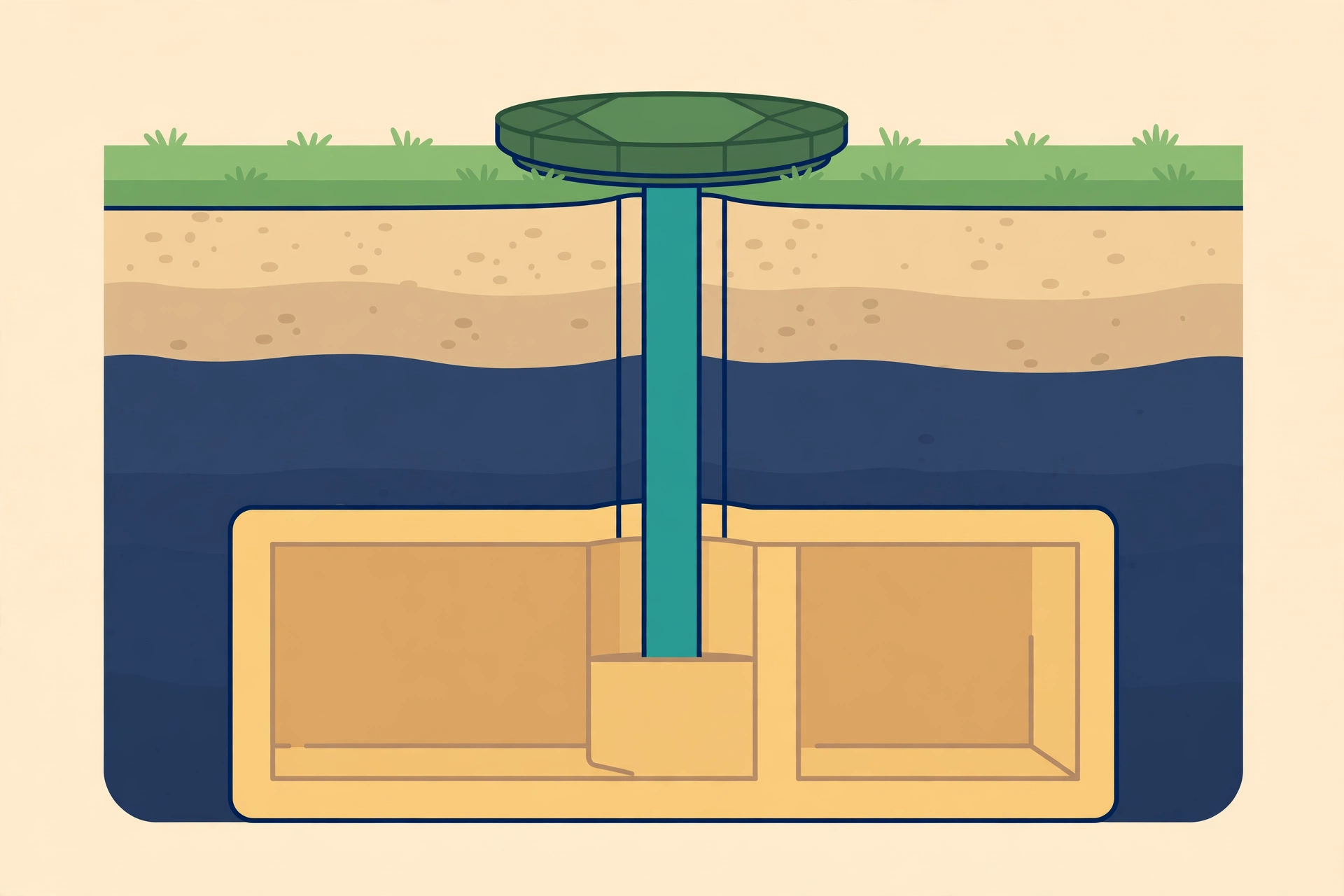
Risers make every future service visit faster and cheaper. The pumper opens the lid in seconds instead of spending time locating and excavating it, and you can check the tank yourself between visits if you ever need to. Most installers can add a riser during a scheduled pumping visit, since the lid is already exposed. If you know your tank’s lid sits a foot or more down, or if you have ever paid extra for the time it took to dig it up, a riser is one of the smartest small upgrades a septic owner can make.
A safety note that matters
One thing should never be casual: a septic tank is a genuinely dangerous place. The inside of a tank holds toxic gases like hydrogen sulfide and methane, and the atmosphere can be oxygen-poor enough to cause collapse within seconds of leaning in. Tanks are also a drowning risk. Never enter a septic tank, never let children play on or around the lids, and keep lids secured at all times.
Careful surface probing and reading your yard are fine for a homeowner. Anything beyond that, lifting heavy lids, entering the tank, or doing your own repairs, belongs to a licensed professional. If you are curious about what homeowners are and are not allowed to do with their systems, the guide to whether you can pump your own septic tank legally lays out the line clearly.
Common questions about septic tank depth
Can the depth change over time?
Yes, and it happens more often than people realize. If a previous owner added fill dirt, regraded the yard, or built up a garden bed over the tank area, the cover above your tank is deeper than what the original permit shows. Erosion and settling can go the other way, leaving less cover than intended. This is worth keeping in mind before any landscaping project near the tank, and it is another reason the permit drawing is a starting point rather than the final word.
Does a bigger tank sit deeper?
Not as a rule. A larger tank is usually wider or longer, not deeper, because the slope of the sewer line and the frost line set the depth, not the tank’s capacity. A 1,500-gallon tank and a 1,000-gallon tank on the same property would typically be buried at about the same depth. What changes with size is the footprint in your yard.
The bottom line is simple. Your septic tank is probably much shallower than you imagined, most likely with its lid somewhere between 6 and 12 inches below the grass. A quick call to your county health department can confirm it, a soil probe can prove it, and a riser can make the whole question irrelevant. Knowing what is under your yard is one of those small pieces of homeowner knowledge that pays off every time a service visit comes around. For a refresher on how often that service visit should happen, the pumping frequency chart by household size is a good next read, and the EPA’s septic system guidance for homeowners is the authoritative reference worth bookmarking.
Greetings Glows Team is dedicated to creating meaningful, helpful, and thoughtfully curated content for everyday inspiration and special moments.
What We Focus On:
Well-researched and reader-friendly articles.
Meaningful greetings, blessings, prayers, and inspirational messages.
Carefully curated ideas for everyday life and special occasions.
Clear, helpful, and engaging information.
Consistent quality and attention to detail in every publication.
Our goal is simple: to make every visit worthwhile with content that inspires, informs, and brings a little more positivity to your day.