Every three years is one of the most common answers you will hear when you ask how often a septic tank should be pumped. It sounds simple, it is easy to remember, and it lines up nicely with the inspection schedule many professionals recommend. But is it actually enough for your home? The honest answer is that it depends, and the difference between a schedule that works and one that quietly puts your system at risk comes down to what is happening inside your tank.
For some households, pumping every three years is plenty. The tank stays well within its safe operating range, the drainfield gets only clean liquid, and the system hums along for decades. For other households, three years is too long. Solids build up faster than the schedule allows, and by the time the third year rolls around, the tank is already sending material downstream that it was never meant to send. The trouble is that both situations look exactly the same from the surface, right up until the day something goes wrong.
This guide walks through where the three year idea comes from, what your tank is actually doing between pump outs, and how to tell whether three years is right for your household. You will also find a simple way to work out your own interval and the warning signs that mean you should not wait.
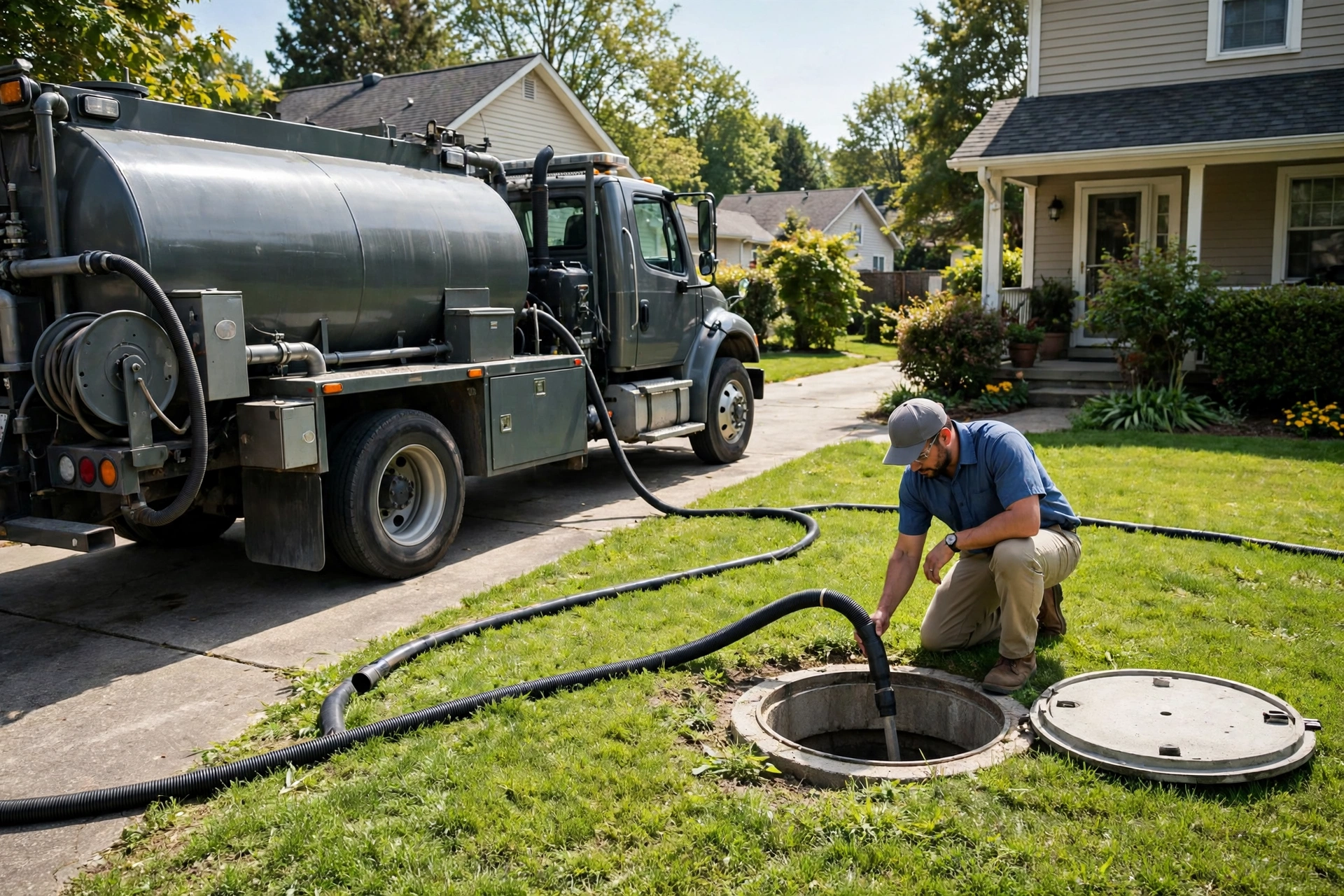
The Short Answer: Is Pumping Every 3 Years Enough?
For many households, yes. Pumping every three years is enough when your tank is a reasonable size for the number of people living in your home, your water use is fairly average, and you do not have a garbage disposal sending extra food waste into the system. A couple living in a home with a 1,500 gallon tank, for example, will usually be well within safe limits at three years. A family of four in a 1,000 gallon tank is closer to the edge, but three years is still often workable if nothing else is pushing the system hard.
The key point is that three years is a starting point, not a guarantee. The real schedule is set by how fast solids accumulate in your tank, and that rate is different in every home. The rest of this article shows you how to figure out your own rate and how to check it before it becomes a problem.
Where the 3 Year Rule of Thumb Comes From
The three year figure did not come out of nowhere. It comes from the most widely quoted guidance in the septic world, published by the United States Environmental Protection Agency. The EPA recommends that a typical household septic tank be pumped every three to five years, and that conventional systems be inspected at least every three years. You can read the EPA guidance for homeowners on the EPA septic systems page, which covers basic care, inspection, and pumping in plain language.
Over time, the three to five year range got shortened in everyday conversation to just three years. Contractors like it because it is safe and simple to recommend, and homeowners like it because it is easy to remember. But treating the low end of a range as a universal rule hides the fact that the range was always meant to flex with your household. Some homes can safely stretch toward five years, while others need service sooner than three. Local rules add another layer, since some counties and townships set their own pumping schedules. If your local health department has a rule, that rule comes first.
How a Septic Tank Actually Fills Up
To understand why three years works for one home and not another, it helps to picture what is happening underground. A septic tank is not a storage container that simply fills with waste until it is full. It is a settling chamber, and its job is to separate what comes in from your home into three layers. The lightest material floats to the top and forms a scum layer of oils, grease, and floating solids. The heaviest material sinks to the bottom and forms a sludge layer of solid waste that bacteria break down only very slowly. Between the two sits a layer of relatively clear liquid, and that liquid is the only thing that is supposed to leave the tank and flow out to the drainfield.
Two simple devices, the inlet and outlet baffles, keep those layers where they belong. As long as the sludge and scum layers stay thin, the system works quietly and well. But both layers grow a little every day, and they never stop growing on their own. Bacteria in the tank break down some of the waste, but a portion of it cannot be broken down at all. That remainder settles as sludge and stays there until someone pumps it out.
As the layers thicken, the clear middle layer gets thinner, and the space the tank has to do its job shrinks from both sides at once. Eventually the sludge rises high enough, or the scum drops low enough, that solid material starts slipping past the outlet baffle and into the drainfield. That is the moment a routine maintenance question turns into a system problem, because the drainfield is a network of pipes and soil that cannot be pumped clean the way a tank can. Once solids clog the soil, the damage is often slow to show and expensive to fix.
When Pumping Every 3 Years Is Enough
Three years is a genuinely good interval for a large share of homes. If most of the points below describe your household, you can feel reasonably comfortable with a three year cycle, as long as you also get the system inspected on that same visit and you keep an eye out for warning signs between services.
A small household in a right sized tank
The single biggest factor is how many people share the tank. One or two people produce far less waste than a full house, and a tank that would fill in three years under a family of five might take seven or eight years to reach the same level with a couple.
No garbage disposal, or one that is rarely used
A garbage disposal is one of the fastest ways to shorten a pumping interval. Ground food waste adds a large amount of solid material to the tank, and much of it does not break down quickly. Homes that send every meal down the disposal can see their sludge accumulate far faster than homes that scrape plates into the trash. If you do not have a disposal, or you use yours only occasionally, your tank fills at the slower rate that the standard guidance assumes, and three years fits well.
Average water use and sensible habits
Water use matters because every gallon that enters the tank pushes a gallon out toward the drainfield, and heavy water use gives solids less time to settle. Homes with average habits, meaning normal showers, sensible laundry loads spread through the week, and no running toilets or dripping fixtures, keep the tank working the way it was designed to work.
When Every 3 Years Is Not Enough
Now the other side. If several of the situations below apply to your home, three years is probably too long, and you should be thinking in terms of two years or even less. None of these factors alone is a disaster, but they add up quickly, and that is exactly how tanks get into trouble without anyone noticing.
A large household or a small tank
This is the most common reason a three year schedule fails. A family of five or six sharing a 1,000 gallon tank fills it far faster than the guidance assumes. The same is true of a modest tank serving a home that has grown since it was built, perhaps with an extra bedroom or a finished basement that added people without adding tank capacity.
A garbage disposal in daily use
As noted above, a disposal adds a heavy load of food solids. Guidance from the EPA and university extension services generally suggests that a disposal can increase the solids entering a tank by a large amount, and many professionals advise cutting the pumping interval substantially for homes that use one heavily.
Heavy water use
Big households are not the only source of heavy water use. Frequent laundry, long showers, a large soaking tub, and a home with several bathrooms in regular use can all push a lot of water through the tank. High water use carries more solids into the tank and reduces the quiet settling time the tank needs to separate them.
Guests, rentals, and part time residents
Households change through the year. Summer guests, college kids home for months at a time, a short term rental, or an adult child moving back can all raise the number of people using the system without anyone updating the pumping schedule. A tank that was fine on a three year cycle for two people can be pushed hard by a summer of six, so base your schedule on the busy periods, not the quiet ones. Older systems deserve the same caution, since baffles wear and a drainfield that has been in service for decades may already be partially loaded.
Pumping Frequency by Household Size and Tank Size
The table below gives you a practical starting point. It is based on the widely used pumping interval guidance published with EPA homeowner materials and Penn State Extension research, and it assumes average water use and no garbage disposal. Treat the figures as typical guidance, not exact rules. Your own water use, your disposal, and the condition of your system will shift the numbers, but the pattern is what matters most. A bigger tank buys time, and more people spend it.
| Tank size | 1 to 2 people | 3 to 4 people | 5 to 6 people |
|---|---|---|---|
| 1,000 gallons | About every 5 to 6 years | About every 2.5 to 3 years | About every 1.5 to 2 years |
| 1,250 gallons | About every 7 to 8 years | About every 3.5 to 4 years | About every 2 to 2.5 years |
| 1,500 gallons | About every 9 years | About every 4 years | About every 2.5 to 3 years |
| 2,000 gallons | About every 12 years | About every 6 years | About every 3.5 to 4 years |
Read the table with a careful eye. A family of four in a 1,000 gallon tank sits right on the three year line, which is why three years feels right for so many homes. That is the most common residential tank size for a three bedroom house, and four people is a common household size, so the rule of thumb and the table agree. But move one step in either direction and the picture changes fast. The same family in a 1,500 gallon tank can comfortably go about four years, while a family of six in a 1,000 gallon tank needs service about every year and a half to two years. For a deeper look at how household size changes the schedule, our guide to the septic tank pumping frequency chart by household size walks through the same numbers in more detail.
Now add a garbage disposal. As a rough guide, heavy disposal use can shorten these intervals by roughly a third to a half, depending on how much food goes down the drain. A family of four in a 1,000 gallon tank that uses a disposal daily should be thinking about every two years rather than three.
How Sludge and Scum Levels Decide the Real Schedule
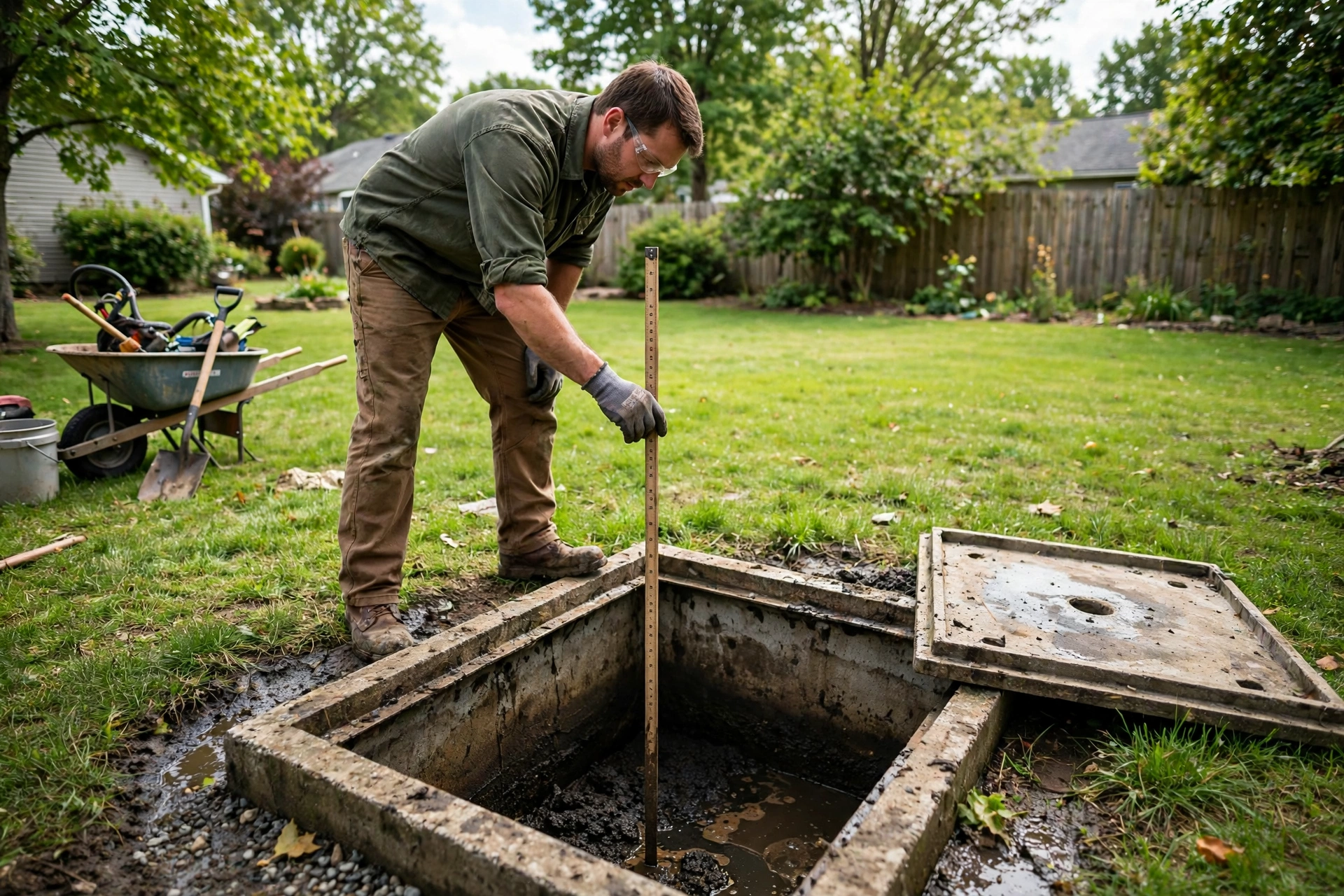
The calendar is a guess. The sludge and scum levels are the measurement. Every pumping decision should ultimately come back to those two layers, because they are what actually determines whether your tank is still doing its job or has started sending solids downstream. The EPA homeowner guidance sets the trigger plainly. Pump when the bottom of the scum layer is within six inches of the bottom of the outlet, when the top of the sludge layer is within twelve inches of the bottom of the outlet, or when sludge and scum together make up more than a quarter of the liquid depth.
Measuring those levels is straightforward for a professional. A technician lowers a measuring stick, often called a sludge judge, through the access opening and reads the depth of each layer. The tool is simple, the reading takes minutes, and it gives you a real number instead of a guess. It is worth asking for the measurement specifically if the pumper does not offer it, because the numbers let you compare one visit with the next and work out roughly how long you have before the tank reaches its limit.
There is also a useful habit to build around this. Keep a simple record of each visit, noting the date, the tank size, the sludge and scum measurements, and anything the technician mentions about the baffles, the filter, or the general condition. After two visits you will have a trend. If the levels were low at three years, you have room to stretch the interval. If they were already near the limit at two years, you know three years was too long. Remember too that a tank can be overdue without looking full, since the liquid level stays roughly constant during normal use. The problem is happening in the layers, not in the waterline, which is why measurement beats guesswork every time.
Signs Your Tank Needs Pumping Sooner Than 3 Years
Your system will usually give you hints before it fails outright, but the hints are easy to miss or explain away. Slow drains are the most common early sign, and they are also the most commonly ignored. When several fixtures drain slowly at the same time, especially the lowest ones in the house, the tank is a likely suspect. A single slow sink is usually a local clog. The whole house slowing down together is a system signal. Odors point the same way. A sewage smell inside the house or a persistent smell in the yard over the tank or drainfield deserves attention rather than air freshener, especially when it shows up together with slow drains.
Outside, watch the ground over the drainfield. Grass that is unusually green or lush in one patch, ground that stays soggy after dry weather, or standing water near the tank or drainfield are all signs that liquid is not being absorbed the way it should be. None of these signs means you should panic, but all of them mean you should not wait for the calendar. Call a licensed pumper, describe what you are seeing, and let them measure the tank.
There is one more sign that is not a symptom at all, and it is the most reliable one. You do not know when the tank was last pumped. If you bought the house and the previous owner left no records, or the last pump out was so long ago that nobody remembers it, assume the tank is due. A first pump out soon after moving in gives you a clean starting point and a measurement to build your schedule on.
What Happens If You Wait Too Long
Skipping a pump out rarely causes an immediate disaster, and that is exactly why it is so tempting. A tank that is a year overdue usually keeps working, at least on the surface. The damage builds slowly and stays hidden, which makes it easy to put off one more year. The problem is that the cost of that delay is not spread evenly. It concentrates in the drainfield, and drainfield trouble is where a routine maintenance bill turns into a major repair. Inside the home, the first real failure is usually a sewage backup through the lowest drains, which is a health hazard as well as a costly cleanup.
When solids escape the tank, they travel to the drainfield and settle into the soil. The soil under a drainfield can only absorb so much, and a heavy solids load clogs it faster than it can recover. Over time the soil clogs, liquid stops draining away, and the field begins to fail. Pumping the tank at that point removes the solids from the tank, but it does not unclog the soil. The damage to the field can persist long after the tank itself is clean.
The financial side is straightforward, even without putting exact numbers on it. A routine pump out is a modest, predictable maintenance cost that happens every few years. A drainfield repair or replacement is a major project that can cost many times more, and it often comes with yard disruption, permits, and days without a working system. The gap between those two costs is so large that pumping a little too often is almost always cheaper than pumping a little too late. You can read more about the full chain of consequences in our article on what happens if you never pump your septic tank.
How to Check Your Levels or Ask Your Pumper
You do not need to measure the tank yourself to stay on top of this, and in most cases you should not try. Opening a septic tank is a job for a professional. The gases inside a tank can be dangerous, the lids are heavy, and a misstep can cause serious injury. What you can do is ask the right questions and keep good records, and that is usually enough.
At your next pump out, ask the technician to measure the sludge and scum levels before pumping and to tell you the numbers. Ask how close those levels were to the safe limits, and whether the baffles and the effluent filter, if your system has one, looked sound. Ask how long they think you can go before the next service, based on what they saw rather than a generic schedule. If you want a sense of how long the appointment itself runs, our guide to how long it takes to pump a septic tank covers the usual timing and what makes it vary.
A Simple Decision Framework for Homeowners
Here is a practical way to settle the question for your own home. Work through the steps in order, and let the answers point you to a schedule instead of letting a round number decide for you.
Start with the basics. Find out your tank size and count the people who use the system regularly, including anyone who stays for months at a time. Look at the table earlier in this article and find the interval that matches your combination. That number is your starting point, not your final answer.
Next, adjust for the factors that speed things up. If you use a garbage disposal daily, shorten the interval noticeably, often by about a third to a half. If your water use is heavy, shorten it further. If your household swells in summer or over the holidays, base the schedule on the busy season. Then adjust for the factors that slow things down. A small household in a large tank, no disposal, and modest water use can safely stretch toward the longer end of the range, but stretch in small steps, and only with measurements to back the decision.
Finally, confirm with a measurement. Book the next service at the interval you worked out, ask for the sludge and scum readings, and write them down. If the levels were comfortably low, you can hold the interval or stretch it slightly next time. If they were near the limit, shorten the interval and check again. After two or three cycles you will have a schedule built on your own system, and you will never need to guess again. When you are torn between two intervals, choose the shorter one. The cost of pumping a year early is small, while the cost of pumping a year late can be very large.
Keeping Track So You Never Have to Guess Again
Most septic trouble starts with a missing record. Nobody remembers the last pump out, the paperwork is lost, and the schedule drifts until a warning sign forces the issue. A simple habit fixes this, and it takes only a few minutes a year.
Write down the date of every pump out and inspection, along with the tank size, the sludge and scum measurements, and anything the technician noted about the system. Keep it in one place, whether that is a folder, a note on your phone, or a page in a household binder. Put a reminder in your calendar for the next service as soon as the current one is done, so the date does not slip.
A monthly maintenance routine helps too. Spreading small checks through the year, like watching water use, checking for leaks, and noting any slow drains or odors, means problems get caught while they are still small. Our septic system maintenance schedule by month lays out a simple year round routine you can follow without much effort.

Frequently Asked Questions
Is pumping every 3 years enough for a family of four?
Often yes, if the tank is 1,000 gallons or larger and the household does not use a garbage disposal heavily. A family of four in a 1,000 gallon tank sits close to the three year line, so it is worth having the sludge and scum measured at each visit to confirm the interval is holding. The same family in a 1,500 gallon tank will usually have more room to spare. With a disposal in daily use, plan on closer to two years.
Can I go 5 years between pump outs?
Some households can. A couple in a home with a large tank, no disposal, and average water use may safely reach five years or more. The key is evidence. Only stretch the interval if a measurement shows the layers are still well below the safe limits. Stretching on a guess, without ever opening the tank, is how systems get into trouble quietly.
What if I just bought a house and have no pumping records?
Book a pump out and inspection soon after moving in. It gives you a clean starting point, a measurement of the tank, and a chance to find out the tank size and condition. From there you can set a schedule based on real information instead of guessing. If the tank turns out to be in good shape and the levels are low, you have lost nothing but a routine service fee. If it turns out to be overdue, you have caught it before it became a backup.
The Bottom Line
Pumping your septic tank every three years is enough for many homes, and it is a good default if you have no other information. It sits at the careful end of the EPA three to five year guidance, and it matches the inspection schedule most professionals recommend. For a small household, a right sized tank, and average habits, three years leaves a comfortable margin.
But it is not enough for every home. Large households, small tanks, heavy disposal use, high water use, and older systems can all push a tank past its safe limit before year three arrives. The table in this article will point you in the right direction, and a simple sludge and scum measurement will confirm it. The smartest schedule is not the one printed in a guide. It is the one built from your tank size, your household, and your own measurements over time.
So keep the three year habit if it fits your home, and adjust it without hesitation if the evidence says otherwise. Write down every service, ask for the numbers at each visit, and watch for the warning signs between services. Three years is a fine place to start. Your tank will tell you whether it is the right place to stay.
Greetings Glows Team is dedicated to creating meaningful, helpful, and thoughtfully curated content for everyday inspiration and special moments.
What We Focus On:
Well-researched and reader-friendly articles.
Meaningful greetings, blessings, prayers, and inspirational messages.
Carefully curated ideas for everyday life and special occasions.
Clear, helpful, and engaging information.
Consistent quality and attention to detail in every publication.
Our goal is simple: to make every visit worthwhile with content that inspires, informs, and brings a little more positivity to your day.